In Exercises 39–40, graph f and g in the same rectangular coordinate system. Use transformations of the graph of f to obtain the graph of g. Graph and give equations of all asymptotes. Use the graphs to determine each function's domain and range. f(x) = log x and g(x) = - log (x+3)
Table of contents
- 0. Review of Algebra4h 18m
- 1. Equations & Inequalities3h 18m
- 2. Graphs of Equations1h 43m
- 3. Functions2h 17m
- 4. Polynomial Functions1h 44m
- 5. Rational Functions1h 23m
- 6. Exponential & Logarithmic Functions2h 28m
- 7. Systems of Equations & Matrices4h 5m
- 8. Conic Sections2h 23m
- 9. Sequences, Series, & Induction1h 22m
- 10. Combinatorics & Probability1h 45m
6. Exponential & Logarithmic Functions
Introduction to Logarithms
Problem 41
Textbook Question
Solve each equation. 3x - 15 = logx 1 (x>0, x≠1)
Verified step by step guidance1
Identify the equation given: \$3x - 15 = \log_{x} 1\( with the conditions \)x > 0\( and \)x \neq 1$.
Recall the logarithm property that \(\log_{a} 1 = 0\) for any base \(a > 0\) and \(a \neq 1\). Therefore, replace \(\log_{x} 1\) with 0 in the equation.
Rewrite the equation as \$3x - 15 = 0$ after substituting the logarithm value.
Solve the linear equation \$3x - 15 = 0\( by isolating \)x\(: add 15 to both sides to get \)3x = 15\(, then divide both sides by 3 to find \)x$.
Check the solution against the domain restrictions \(x > 0\) and \(x \neq 1\) to ensure it is valid.
Verified video answer for a similar problem:This video solution was recommended by our tutors as helpful for the problem above
Video duration:
2mPlay a video:
Was this helpful?
Key Concepts
Here are the essential concepts you must grasp in order to answer the question correctly.
Properties of Logarithms
Logarithms are the inverse operations of exponentiation. Understanding their properties, such as the domain restrictions (x > 0 and base ≠ 1) and how to manipulate logarithmic expressions, is essential for solving equations involving logs.
Recommended video:
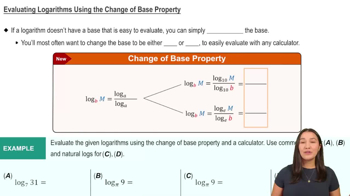
Change of Base Property
Solving Linear Equations
Linear equations involve variables raised to the first power and can be solved using basic algebraic operations like addition, subtraction, multiplication, and division. Recognizing and isolating the variable is key to finding solutions.
Recommended video:
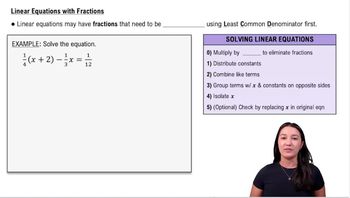
Solving Linear Equations with Fractions
Domain Restrictions in Logarithmic Equations
Logarithmic functions have domain restrictions: the argument must be positive, and the base cannot be 1. These restrictions limit the possible solutions and must be considered to ensure valid answers.
Recommended video:
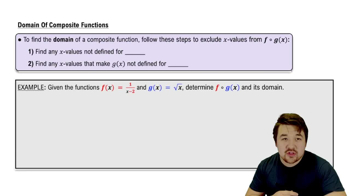
Domain Restrictions of Composed Functions
Watch next
Master Logarithms Introduction with a bite sized video explanation from Patrick
Start learningRelated Videos
Related Practice
Textbook Question
899
views