Ch. 1 - Equations and Inequalities
Blitzer - College Algebra 8th Edition
Blitzer8th EditionCollege AlgebraISBN: 9780136970514Not the one you use?Change textbook
Chapter 2, Problem 47

Exercises 41–60 contain rational equations with variables in denominators. For each equation, a. write the value or values of the variable that make a denominator zero. These are the restrictions on the variable. b. Keeping the restrictions in mind, solve the equation. (x - 2)/2x + 1 = (x + 1)/x

Verified step by step guidance
1
Identify the denominators in the equation \(\frac{(x - 2)}{2x} + 1 = \frac{(x + 1)}{x}\). The denominators are \$2x\( and \)x$.
Find the values of \(x\) that make the denominators zero by setting each denominator equal to zero: \$2x = 0\( and \)x = 0\(. Solve these to find the restrictions on \)x$.
Rewrite the equation to have a common denominator or clear the denominators by multiplying every term by the least common denominator (LCD), which is \$2x$.
After clearing denominators, simplify the resulting equation and collect like terms to form a linear equation in \(x\).
Solve the simplified linear equation for \(x\), then check your solution(s) against the restrictions found in step 2 to ensure no denominator is zero.

Verified video answer for a similar problem:

This video solution was recommended by our tutors as helpful for the problem above.
Video duration:
3m
Was this helpful?

Key Concepts

Here are the essential concepts you must grasp in order to answer the question correctly.

Rational Equations and Denominators

Rational equations involve expressions with variables in the denominator. Understanding how to handle these is crucial because denominators cannot be zero, as division by zero is undefined. Identifying denominators and their restrictions helps avoid invalid solutions.
Recommended video:
Guided course
02:58
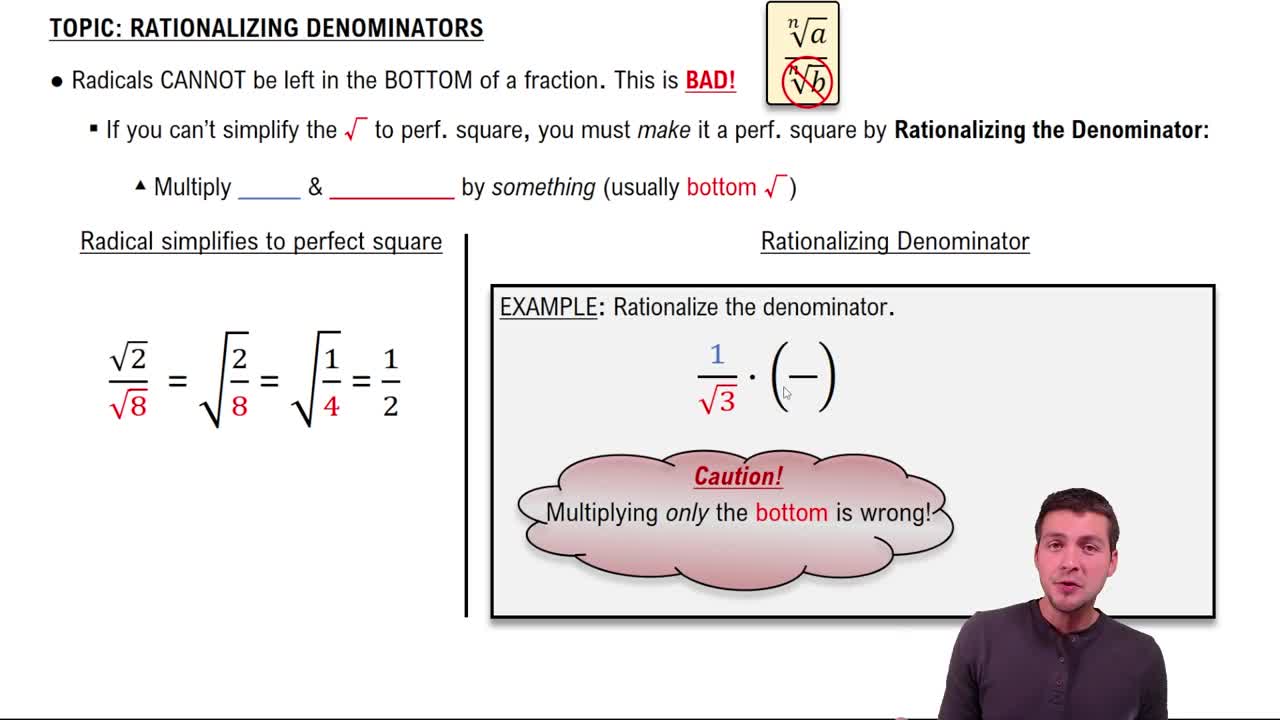
Rationalizing Denominators

Domain Restrictions

Domain restrictions are values of the variable that make any denominator zero, which must be excluded from the solution set. Finding these restrictions involves setting each denominator equal to zero and solving for the variable to ensure solutions are valid.
Recommended video:
3:51
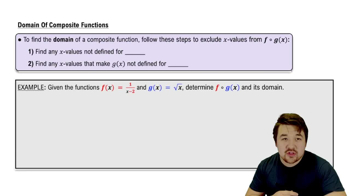
Domain Restrictions of Composed Functions

Solving Rational Equations

To solve rational equations, first identify restrictions, then multiply both sides by the least common denominator (LCD) to eliminate fractions. After clearing denominators, solve the resulting equation and check solutions against restrictions to discard any extraneous roots.
Recommended video:
05:56
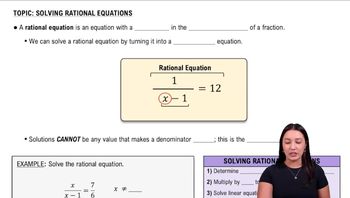
Introduction to Rational Equations