Let ƒ(x)=2x-3 and g(x)=-x+3. Find each function value. (g∘ƒ)(0)
Verified step by step guidance
1
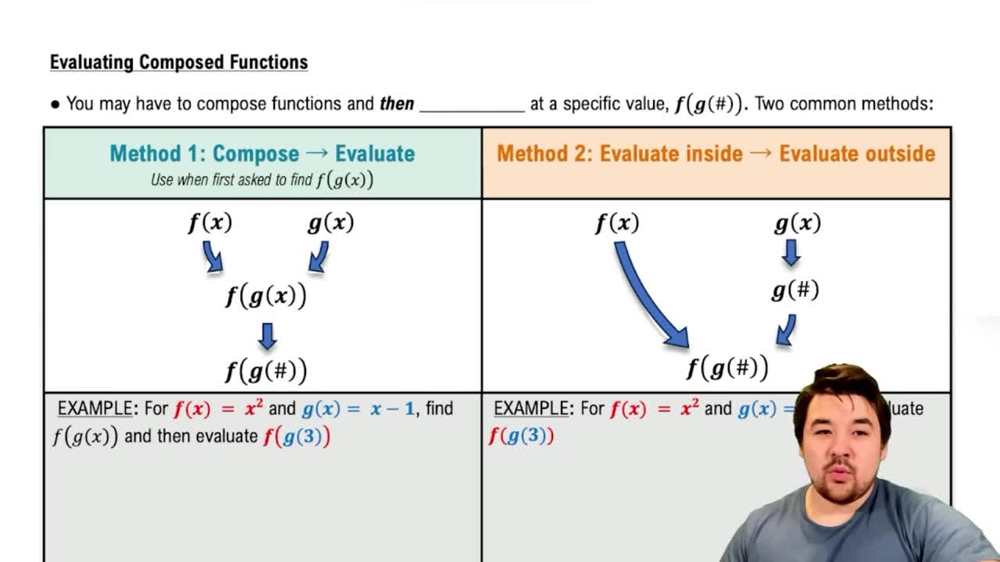
Understand that the notation \((g \circ f)(0)\) means the composition of the functions \(g\) and \(f\) evaluated at \(x=0\). This is written as \(g(f(0))\), which means you first find \(f(0)\) and then plug that result into \(g\).
Calculate \(f(0)\) by substituting \(x=0\) into the function \(f(x) = 2x - 3\). So, \(f(0) = 2(0) - 3\).
Simplify the expression for \(f(0)\) to find its value.
Take the result from \(f(0)\) and substitute it into the function \(g(x) = -x + 3\). This means you replace \(x\) in \(g(x)\) with the value you found for \(f(0)\), so you compute \(g(f(0)) = -[f(0)] + 3\).
Simplify the expression for \(g(f(0))\) to find the final value of the composition \((g \circ f)(0)\).
Verified video answer for a similar problem:
This video solution was recommended by our tutors as helpful for the problem above
Video duration:
1m
Play a video:
0 Comments
Key Concepts
Here are the essential concepts you must grasp in order to answer the question correctly.
Function Composition
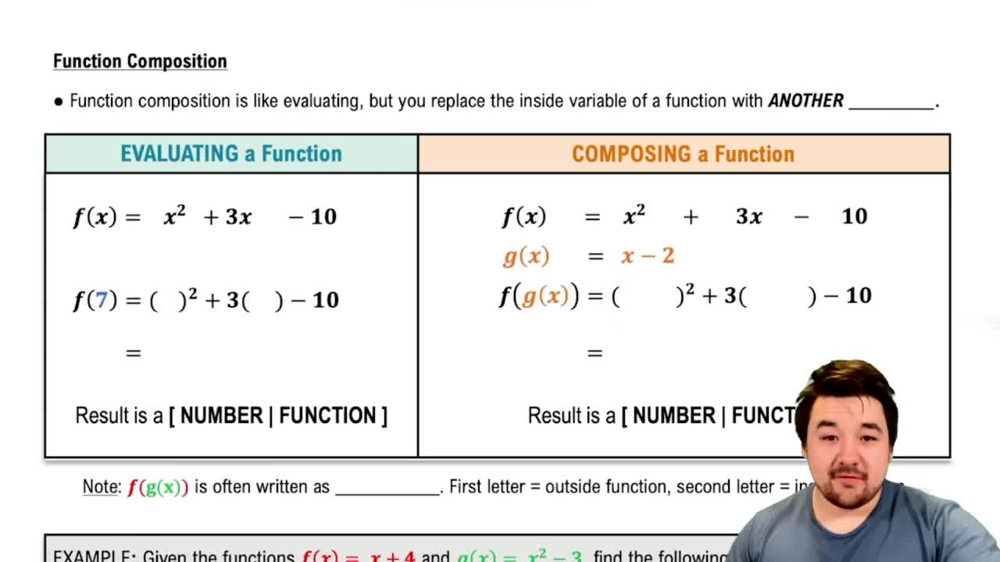
Function composition involves applying one function to the result of another, denoted as (g∘ƒ)(x) = g(ƒ(x)). It means you first evaluate ƒ at x, then use that output as the input for g. This process combines two functions into a single operation.
Evaluating a function at a specific input means substituting the input value into the function's formula and simplifying to find the output. For example, ƒ(0) means replacing x with 0 in ƒ(x) and calculating the result.
Linear functions have the form f(x) = mx + b, where m and b are constants. They produce straight-line graphs and are easy to evaluate and compose because their outputs change at a constant rate with respect to x.

 1:36 minutes
 Verified step by step guidance
 4:56
4:56