Ch. 4 - Exponential and Logarithmic Functions
Blitzer - College Algebra 8th Edition
Blitzer8th EditionCollege AlgebraISBN: 9780136970514Not the one you use?Change textbook
Chapter 5, Problem 43

Graph f(x) = 4x and g(x) = log4 x in the same rectangular coordinate system.

Verified step by step guidance
1
Recognize that the functions given are inverses of each other: \(f(x) = 4^x\) is an exponential function, and \(g(x) = \log_4 x\) is its inverse logarithmic function.
Create a table of values for \(f(x) = 4^x\) by choosing several values of \(x\) (such as \(-2\), \(-1\), \(0\), \(1\), \(2\)) and calculating the corresponding \(f(x)\) values.
Create a table of values for \(g(x) = \log_4 x\) by choosing several positive values of \(x\) (such as \(\frac{1}{16}\), \(\frac{1}{4}\), \(1\), \(4\), \(16\)) and calculating the corresponding \(g(x)\) values.
Plot the points from both tables on the same rectangular coordinate system, noting that \(f(x)\) will be increasing and \(g(x)\) will be increasing but only defined for \(x > 0\).
Draw the graphs smoothly through the plotted points, remembering that the graph of \(g(x)\) is the reflection of the graph of \(f(x)\) across the line \(y = x\).

Verified video answer for a similar problem:

This video solution was recommended by our tutors as helpful for the problem above.
Video duration:
5m
Was this helpful?

Key Concepts

Here are the essential concepts you must grasp in order to answer the question correctly.

Exponential Functions

An exponential function has the form f(x) = a^x, where the base a is a positive constant not equal to 1. It models rapid growth or decay and has a domain of all real numbers and a range of positive real numbers. For f(x) = 4^x, the graph passes through (0,1) and increases rapidly as x increases.
Recommended video:
6:13
Exponential Functions

Logarithmic Functions

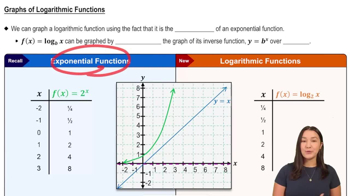
A logarithmic function is the inverse of an exponential function and is written as g(x) = log_a(x), where a is the base. It is defined only for positive x-values and has a range of all real numbers. For g(x) = log_4(x), the graph passes through (1,0) and increases slowly, reflecting the inverse relationship to 4^x.
Recommended video:
5:26
Graphs of Logarithmic Functions

Inverse Functions and Their Graphs

Inverse functions reverse the effect of each other, so their graphs are symmetric about the line y = x. Since g(x) = log_4(x) is the inverse of f(x) = 4^x, plotting both on the same coordinate system shows this symmetry, helping to understand their relationship visually.
Recommended video:
5:26
Graphs of Logarithmic Functions
Related Practice
Textbook Question

Solve each exponential equation in Exercises 23–48. Express the solution set in terms of natural logarithms or common logarithms. Then use a calculator to obtain a decimal approximation, correct to two decimal places, for the solution. e4x+5e2x−24=0

631
views
Textbook Question

Evaluate each expression without using a calculator. 8log8198^{\(\log\)_8 19}

728
views
Textbook Question

Solve each exponential equation in Exercises 23–48. Express the solution set in terms of natural logarithms or common logarithms. Then use a calculator to obtain a decimal approximation, correct to two decimal places, for the solution. e2x−3ex+2=0

933
views
Textbook Question

Use properties of logarithms to condense each logarithmic expression. Write the expression as a single logarithm whose coefficient is 1. Where possible, evaluate logarithmic expressions without using a calculator. ln x + ln 7

758
views
Textbook Question

The figure shows the graph of f(x) = ex. In Exercises 35-46, use transformations of this graph to graph each function. Be sure to give equations of the asymptotes. Use the graphs to determine graphs. each function's domain and range. If applicable, use a graphing utility to confirm your hand-drawn h(x) = e2x + 1

793
views
Textbook Question

The figure shows the graph of f(x) = ex. In Exercises 35-46, use transformations of this graph to graph each function. Be sure to give equations of the asymptotes. Use the graphs to determine graphs. each function's domain and range. If applicable, use a graphing utility to confirm your hand-drawn g(x) = 2ex

810
views