Graph f(x) = 4x and g(x) = log4 x in the same rectangular coordinate system.
Verified step by step guidance
1
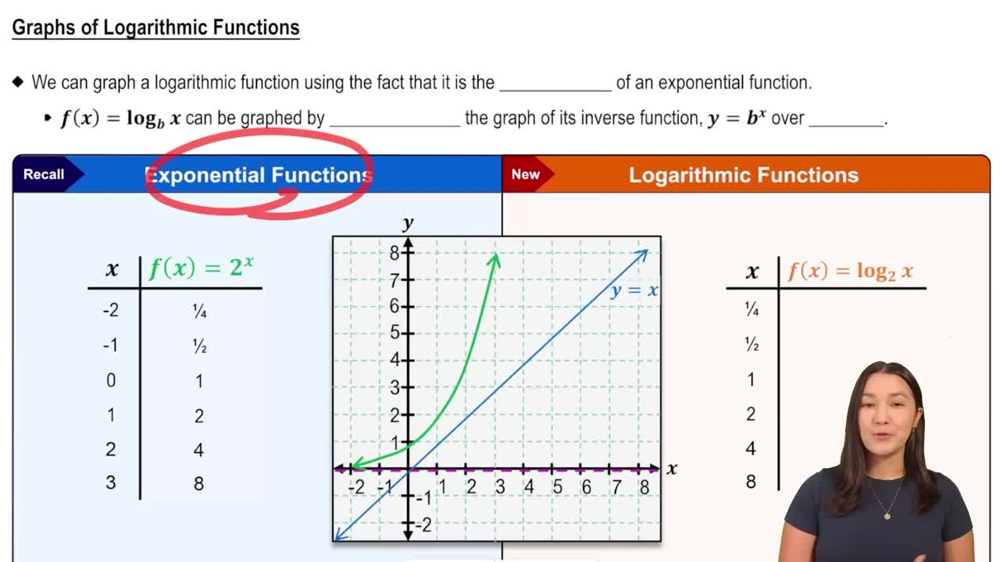
Recognize that the functions given are inverses of each other: \(f(x) = 4^x\) is an exponential function, and \(g(x) = \log_4 x\) is its inverse logarithmic function.
Create a table of values for \(f(x) = 4^x\) by choosing several values of \(x\) (such as \(-2\), \(-1\), \(0\), \(1\), \(2\)) and calculating the corresponding \(f(x)\) values.
Create a table of values for \(g(x) = \log_4 x\) by choosing several positive values of \(x\) (such as \(\frac{1}{16}\), \(\frac{1}{4}\), \(1\), \(4\), \(16\)) and calculating the corresponding \(g(x)\) values.
Plot the points from both tables on the same rectangular coordinate system, noting that \(f(x)\) will be increasing and \(g(x)\) will be increasing but only defined for \(x > 0\).
Draw the graphs smoothly through the plotted points, remembering that the graph of \(g(x)\) is the reflection of the graph of \(f(x)\) across the line \(y = x\).
Verified video answer for a similar problem:
This video solution was recommended by our tutors as helpful for the problem above
Video duration:
5m
Play a video:
0 Comments
Key Concepts
Here are the essential concepts you must grasp in order to answer the question correctly.
Exponential Functions
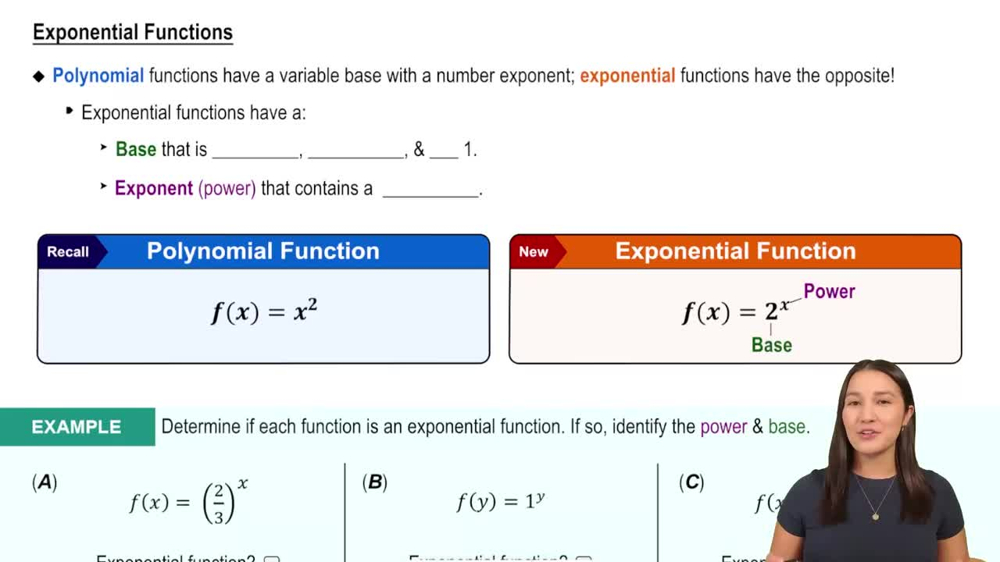
An exponential function has the form f(x) = a^x, where the base a is a positive constant not equal to 1. It models rapid growth or decay and has a domain of all real numbers and a range of positive real numbers. For f(x) = 4^x, the graph passes through (0,1) and increases rapidly as x increases.
A logarithmic function is the inverse of an exponential function and is written as g(x) = log_a(x), where a is the base. It is defined only for positive x-values and has a range of all real numbers. For g(x) = log_4(x), the graph passes through (1,0) and increases slowly, reflecting the inverse relationship to 4^x.
Inverse functions reverse the effect of each other, so their graphs are symmetric about the line y = x. Since g(x) = log_4(x) is the inverse of f(x) = 4^x, plotting both on the same coordinate system shows this symmetry, helping to understand their relationship visually.

 5:07 minutes
 Verified step by step guidance
 6:13
6:13