Solve each polynomial inequality in Exercises 1–42 and graph the solution set on a real number line. Express each solution set in interval notation. (x+1)(x+2)(x+3)≥0
Ch. 3 - Polynomial and Rational Functions

Chapter 4, Problem 29
Find an nth-degree polynomial function with real coefficients satisfying the given conditions. If you are using a graphing utility, use it to graph the function and verify the real zeros and the given function value. n=4; i and 3i are zeros; f(-1) = 20
Verified step by step guidance1
Identify the given zeros of the polynomial. Since the polynomial has real coefficients and the zeros include complex numbers \(i\) and \$3i\(, their conjugates \)-i\( and \)-3i\( must also be zeros. So the zeros are \)i\(, \)-i\(, \)3i\(, and \)-3i$.
Write the factors corresponding to each zero. For zeros \(i\) and \(-i\), the factor is \((x - i)(x + i) = x^{2} + 1\). For zeros \$3i\( and \)-3i\(, the factor is \)(x - 3i)(x + 3i) = x^{2} + 9$.
Form the polynomial as the product of these quadratic factors multiplied by a constant \(a\): \(f(x) = a(x^{2} + 1)(x^{2} + 9)\).
Use the given function value \(f(-1) = 20\) to find the constant \(a\). Substitute \(x = -1\) into the polynomial: \(f(-1) = a((-1)^{2} + 1)((-1)^{2} + 9) = a(1 + 1)(1 + 9) = a(2)(10) = 20\).
Solve for \(a\) from the equation \$20 = 20a\( to find the value of \)a\(. Then write the final polynomial function \)f(x)\( with this value of \)a$.

Verified video answer for a similar problem:
This video solution was recommended by our tutors as helpful for the problem above.
Video duration:
5mWas this helpful?
Key Concepts
Here are the essential concepts you must grasp in order to answer the question correctly.
Complex Conjugate Root Theorem
For polynomials with real coefficients, non-real complex roots always come in conjugate pairs. If i is a root, then -i must also be a root. This ensures the polynomial remains with real coefficients when expanded.
Recommended video:
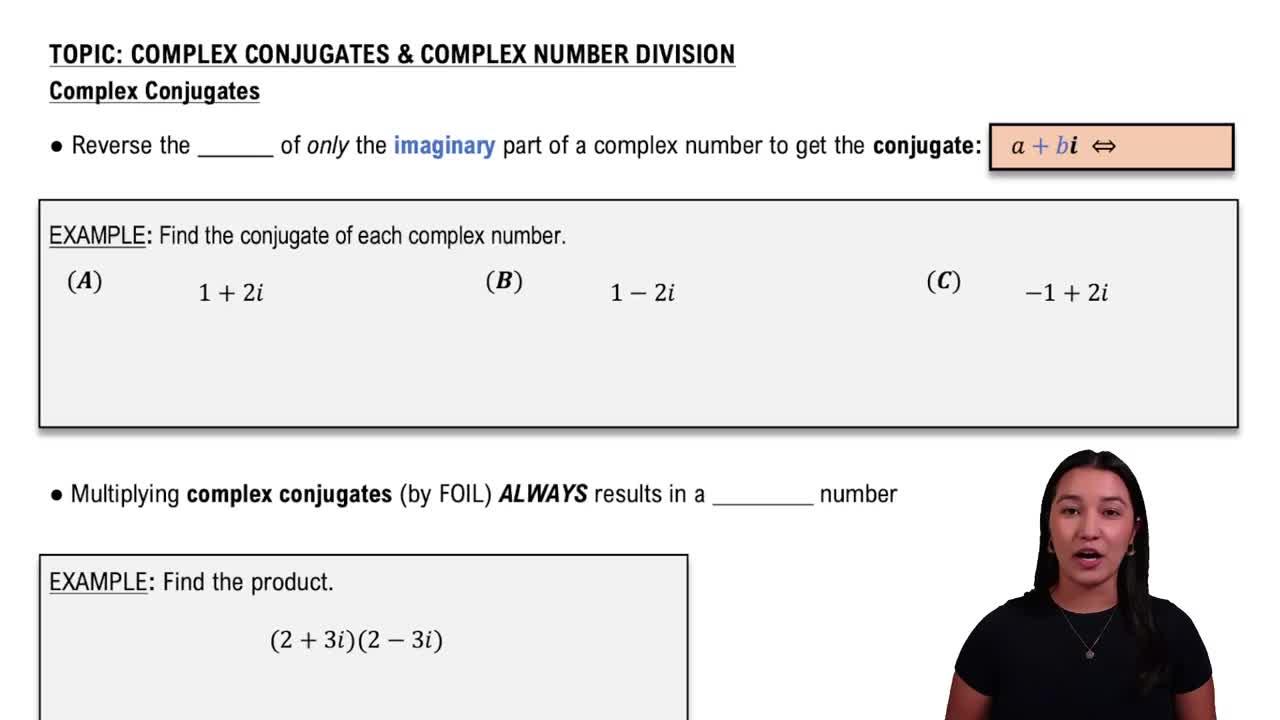
Complex Conjugates
Constructing Polynomials from Roots
A polynomial can be formed by multiplying factors corresponding to its roots. For roots r, the factor is (x - r). Given roots i, -i, 3i, and -3i, the polynomial is the product of (x - i)(x + i)(x - 3i)(x + 3i), which simplifies to a polynomial with real coefficients.
Recommended video:
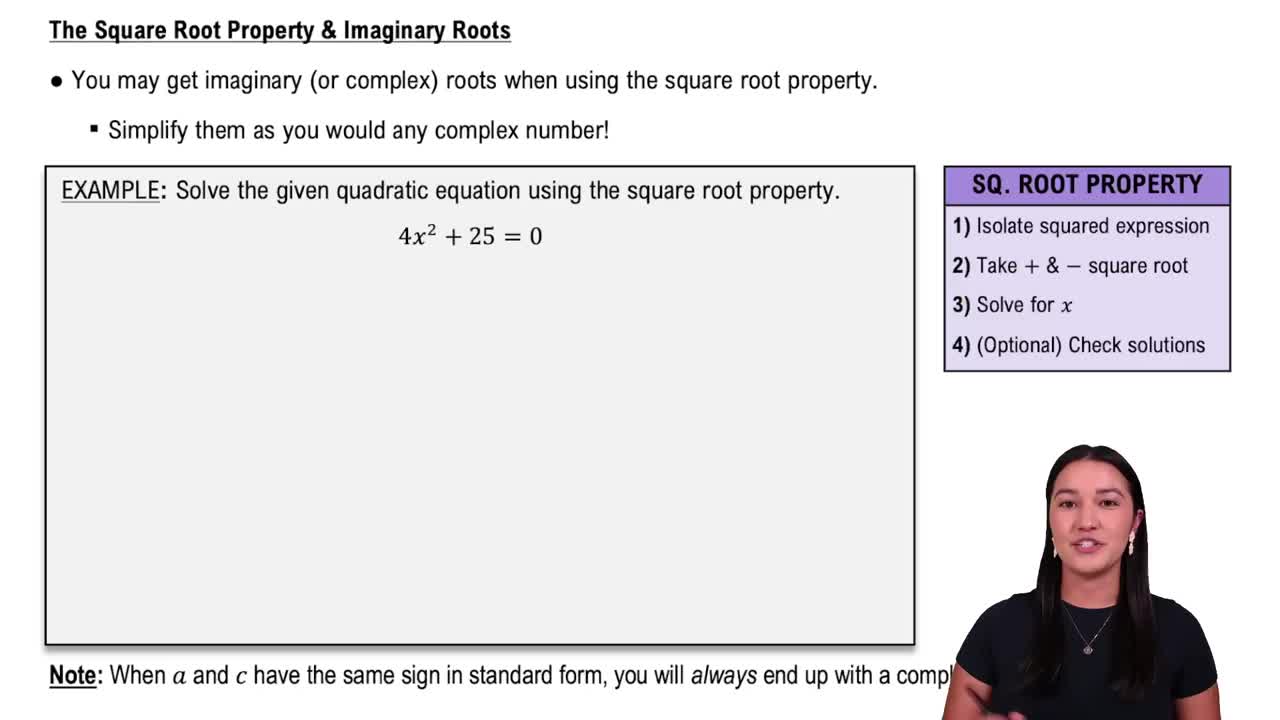
Imaginary Roots with the Square Root Property
Using a Given Function Value to Find Leading Coefficient
After forming the polynomial with unknown leading coefficient a, substitute the given x-value (here, x = -1) and set the polynomial equal to the given function value (f(-1) = 20). Solving for a determines the exact polynomial.
Recommended video:
Guided course
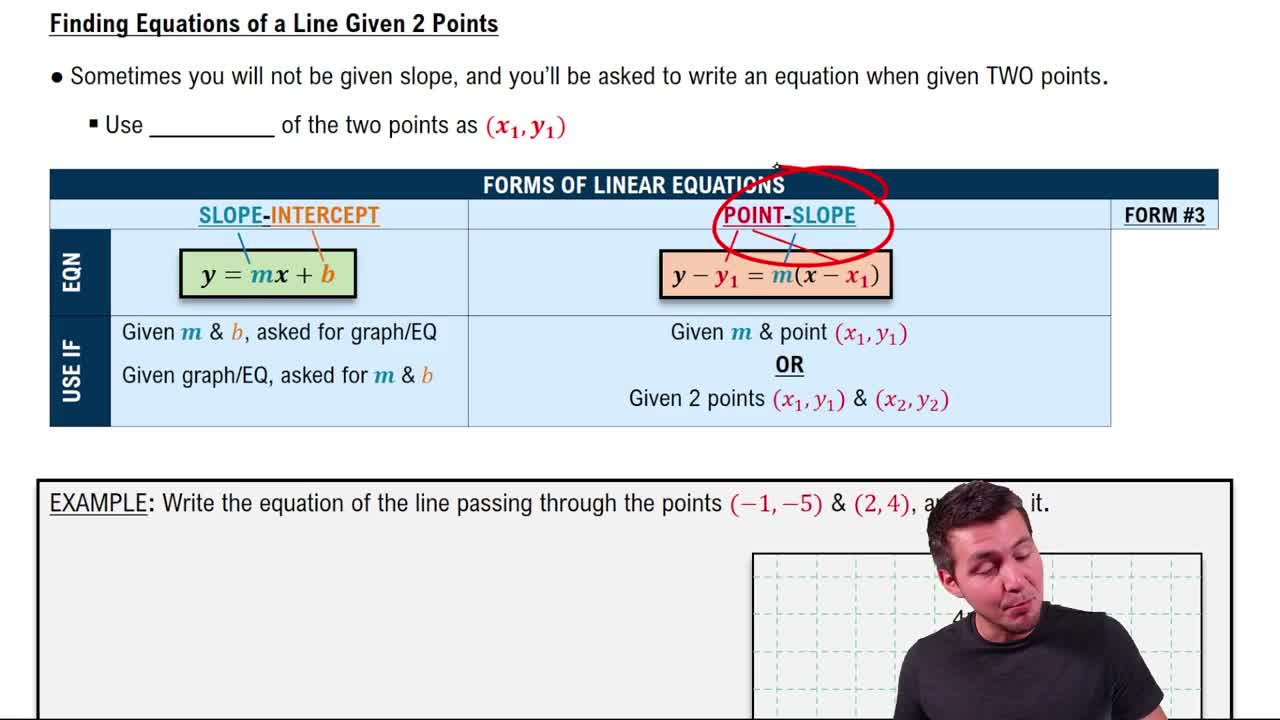
Finding Equations of Lines Given Two Points
Related Practice
Textbook Question
526
views
Textbook Question
Find an nth-degree polynomial function with real coefficients satisfying the given conditions. If you are using a graphing utility, use it to graph the function and verify the real zeros and the given function value. n=4; -2, 5, and 3+2i are zeros; f(1) = -96
602
views
Textbook Question
In Exercises 27–29, divide using long division.
595
views
Textbook Question
Find the vertical asymptotes, if any, and the values of x corresponding to holes, if any, of the graph of each rational function. f(x)=(x2−9)/(x−3)
1960
views
Textbook Question
Divide using synthetic division. (x4−256)/(x−4)
373
views
Textbook Question
Use the vertex and intercepts to sketch the graph of each quadratic function. Give the equation of the parabola's axis of symmetry. Use the graph to determine the function's domain and range. f(x)=x2+3x−10
2043
views