Factor each polynomial. See Examples 5 and 6. 27-r3
Verified step by step guidance
1
Recognize that the expression \$27 - r^3\( is a difference of cubes because \)27\( can be written as \)3^3\( and \)r^3$ is already a cube.
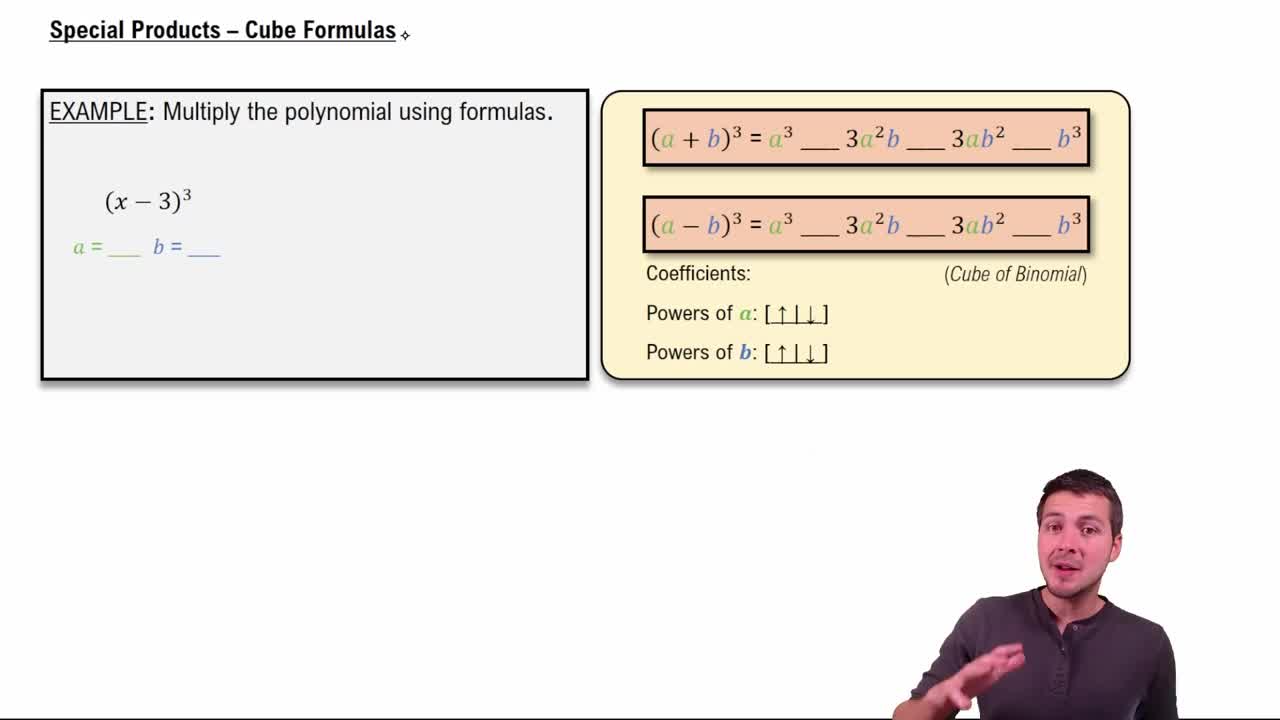
Recall the formula for factoring a difference of cubes: \(a^3 - b^3 = (a - b)(a^2 + ab + b^2)\).
Identify \(a\) and \(b\) in the expression: here, \(a = 3\) and \(b = r\).
Apply the difference of cubes formula by substituting \(a\) and \(b\): write the factorization as \((3 - r)(3^2 + 3 imes r + r^2)\).
Simplify the terms inside the second parenthesis: \$3^2 = 9\(, so the factorization becomes \)(3 - r)(9 + 3r + r^2)$.
Verified video answer for a similar problem:
This video solution was recommended by our tutors as helpful for the problem above
Video duration:
2m
Play a video:
0 Comments
Key Concepts
Here are the essential concepts you must grasp in order to answer the question correctly.
Difference of Cubes
The difference of cubes formula is used to factor expressions of the form a³ - b³. It factors into (a - b)(a² + ab + b²). Recognizing this pattern allows you to break down cubic expressions into simpler polynomial factors.
To apply the difference of cubes formula, you must identify terms that are perfect cubes. For example, 27 is 3³ and r³ is the cube of r. Recognizing these helps in rewriting the expression in the form a³ - b³.
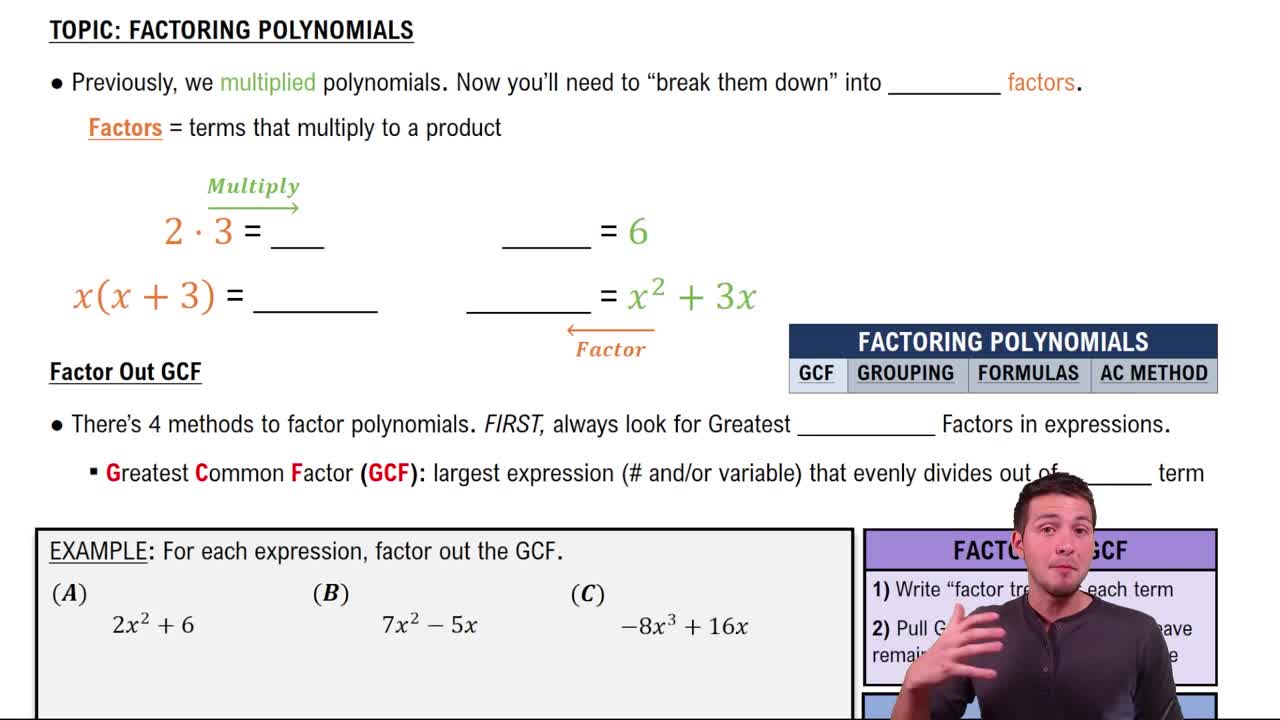
Factoring polynomials involves rewriting them as products of simpler polynomials. Understanding various factoring methods, such as factoring out the greatest common factor or special products like difference of squares and cubes, is essential for simplifying expressions.

 2:06 minutes
 Verified step by step guidance
 03:41
03:41