Ch. P - Fundamental Concepts of Algebra
Blitzer - College Algebra 8th Edition
Blitzer8th EditionCollege AlgebraISBN: 9780136970514Not the one you use?Change textbook
Chapter 1, Problem 26

Evaluate each exponential expression: 5-3• 5

Verified step by step guidance
1
Recall the property of exponents that states when multiplying powers with the same base, you add the exponents: \(a^m \cdot a^n = a^{m+n}\).
Identify the base and exponents in the expression \(5^{-3} \cdot 5^1\) (since \(5\) can be written as \$5^1$).
Apply the exponent addition rule: \(5^{-3} \cdot 5^1 = 5^{-3 + 1}\).
Simplify the exponent by performing the addition: \(-3 + 1 = -2\), so the expression becomes \$5^{-2}$.
Rewrite the expression with a negative exponent as a fraction: \(5^{-2} = \frac{1}{5^2}\).

Verified video answer for a similar problem:

This video solution was recommended by our tutors as helpful for the problem above.
Video duration:
2m
Was this helpful?

Key Concepts

Here are the essential concepts you must grasp in order to answer the question correctly.

Exponents and Powers

Exponents indicate how many times a base number is multiplied by itself. For example, 5^3 means 5 multiplied by itself three times (5 × 5 × 5). Understanding this helps in evaluating expressions involving powers.
Recommended video:
04:10
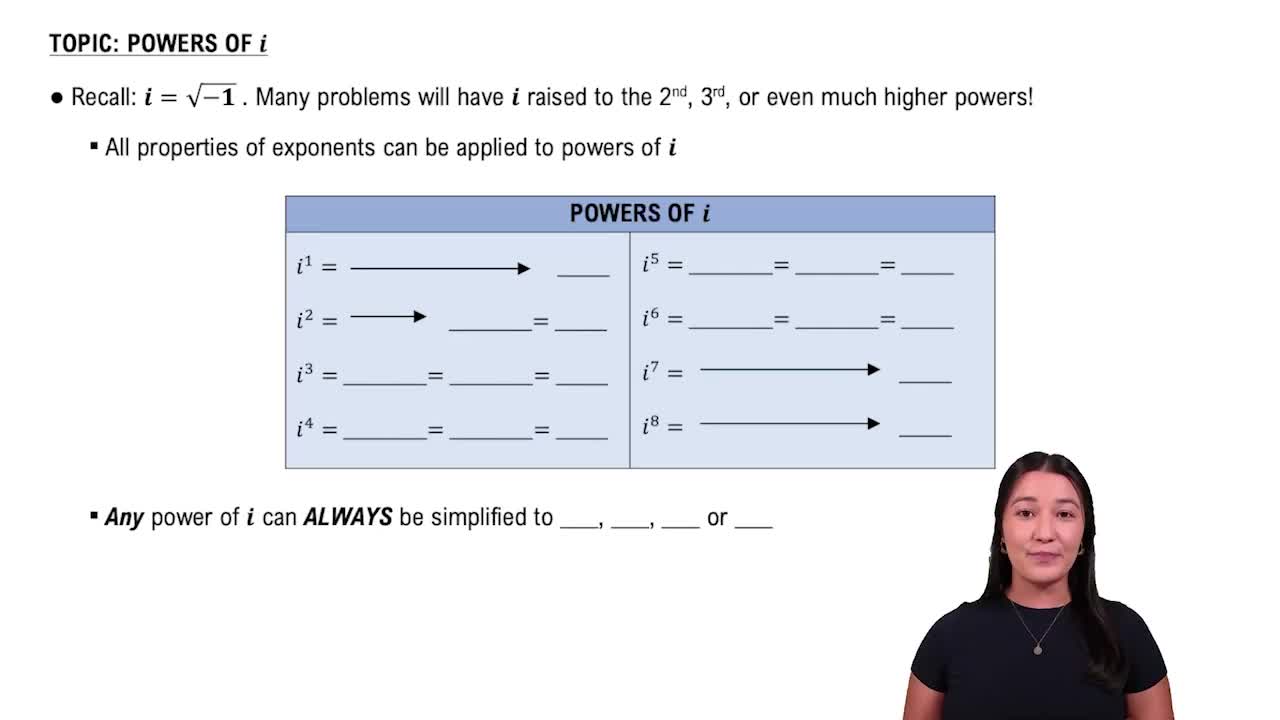
Powers of i

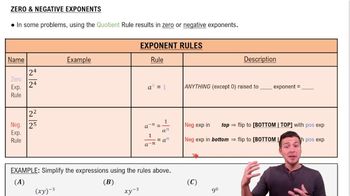
Negative Exponents

A negative exponent means taking the reciprocal of the base raised to the positive exponent. For instance, 5^(-3) equals 1 divided by 5^3, or 1/(5 × 5 × 5). This concept is essential for simplifying expressions with negative powers.
Recommended video:
Guided course
6:37
Zero and Negative Rules

Multiplication of Exponential Expressions with the Same Base

When multiplying exponential expressions with the same base, add their exponents. For example, 5^a × 5^b = 5^(a+b). This rule simplifies the evaluation of expressions like 5^(-3) × 5.
Recommended video:
4:46
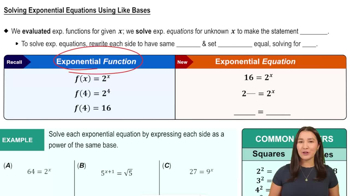
Solving Exponential Equations Using Like Bases