Ch. 3 - Polynomial and Rational Functions
Blitzer - College Algebra 8th Edition
Blitzer8th EditionCollege AlgebraISBN: 9780136970514Not the one you use?Change textbook
Chapter 4, Problem 26

In Exercises 25–26, graph each polynomial function. f(x)=x3(x+4)2(x1)f(x) = -x^3(x + 4)^2(x-1)

Verified step by step guidance
1
Identify the degree and leading term of the polynomial function \(f(x) = -x^3 (x + 4)^2 (x - 1)\). To do this, expand the powers and multiply the highest degree terms: the degree is the sum of the exponents, and the leading coefficient comes from multiplying the leading coefficients of each factor.
Determine the zeros (roots) of the function by setting each factor equal to zero: solve \(x^3 = 0\), \((x + 4)^2 = 0\), and \((x - 1) = 0\). These zeros are the x-values where the graph will cross or touch the x-axis.
Analyze the multiplicity of each zero: a zero with an odd multiplicity (like 3 or 1) means the graph crosses the x-axis at that zero, while a zero with an even multiplicity (like 2) means the graph touches the x-axis and turns around at that zero.
Determine the end behavior of the polynomial by looking at the leading term's degree and sign. Since the degree is odd and the leading coefficient is negative, the graph will fall to the right and rise to the left (or vice versa, depending on the sign).
Plot the zeros on the x-axis, use the multiplicity to sketch the behavior at each zero, and use the end behavior to guide the shape of the graph as \(x\) approaches positive and negative infinity. Connect these points smoothly to complete the graph.

Verified video answer for a similar problem:

This video solution was recommended by our tutors as helpful for the problem above.
Video duration:
5m
Was this helpful?

Key Concepts

Here are the essential concepts you must grasp in order to answer the question correctly.

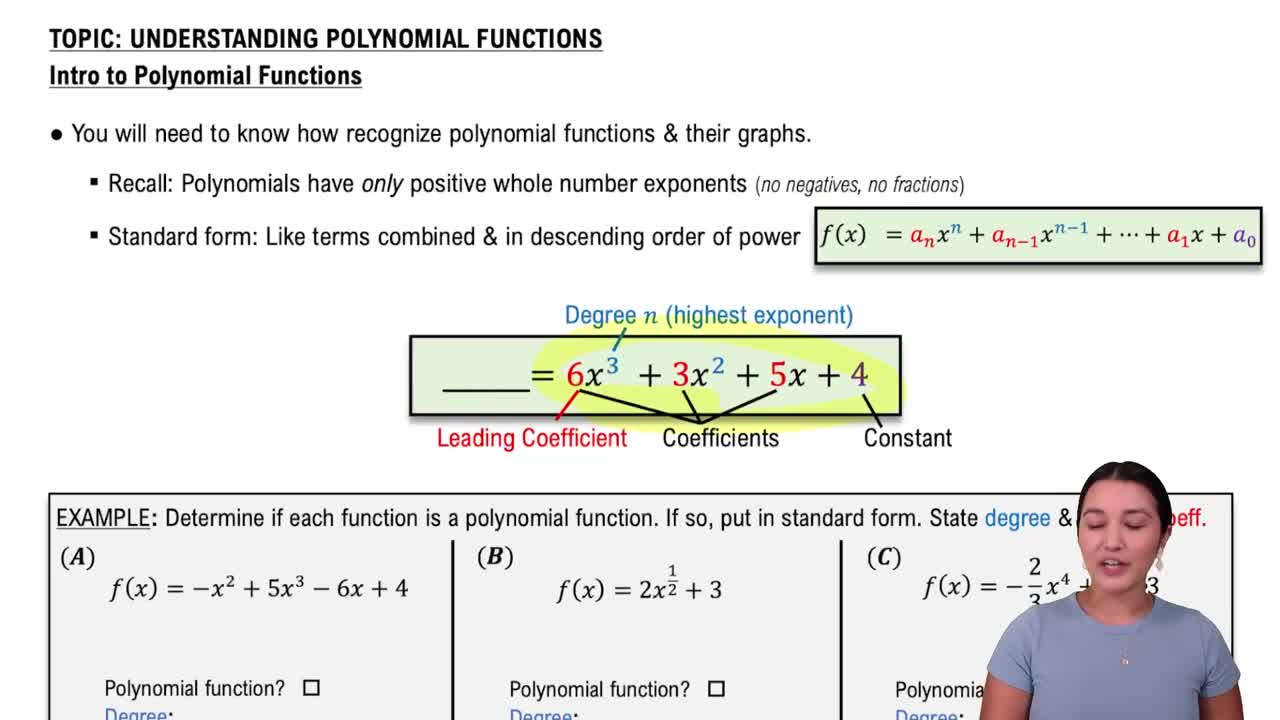
Polynomial Function and Degree

A polynomial function is an expression consisting of variables raised to whole-number exponents and their coefficients. The degree of the polynomial is the highest exponent sum in any term, which determines the general shape and end behavior of the graph.
Recommended video:
06:04
Introduction to Polynomial Functions

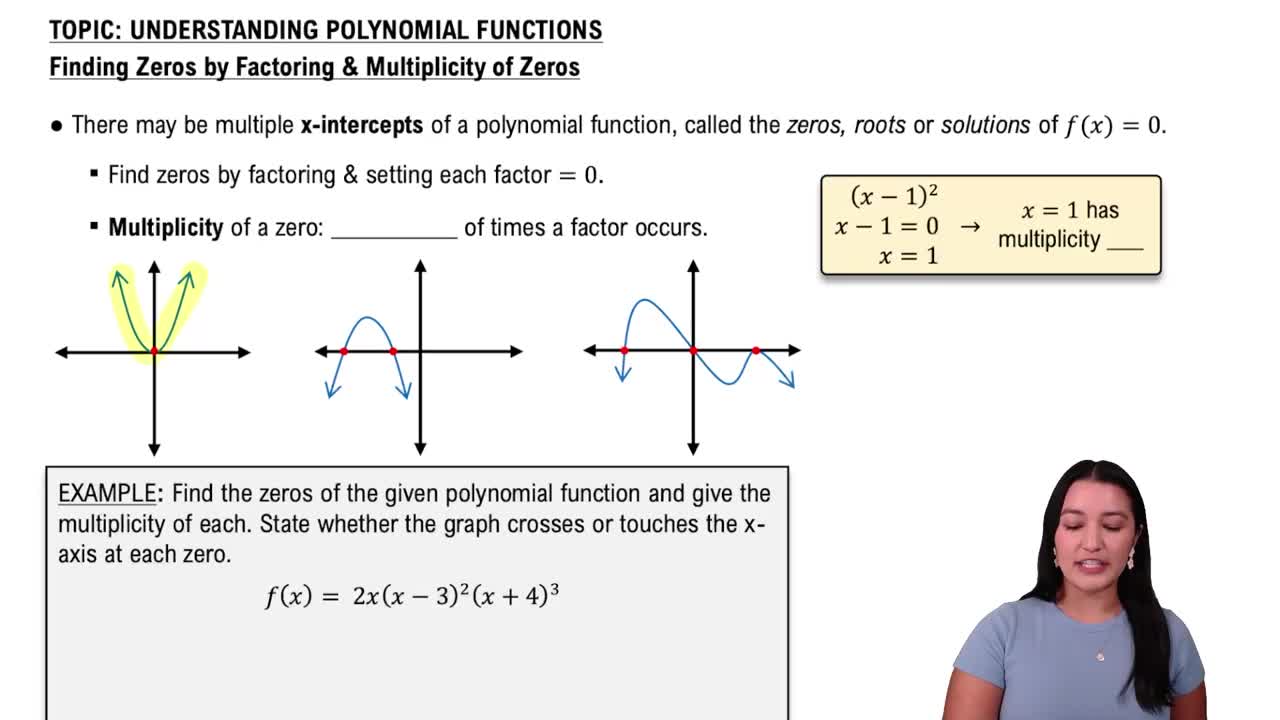
Zeros and Their Multiplicities

Zeros of a polynomial are the values of x that make the function equal to zero. The multiplicity of a zero indicates how many times that root is repeated, affecting whether the graph crosses or touches the x-axis at that point.
Recommended video:
03:42
Finding Zeros & Their Multiplicity

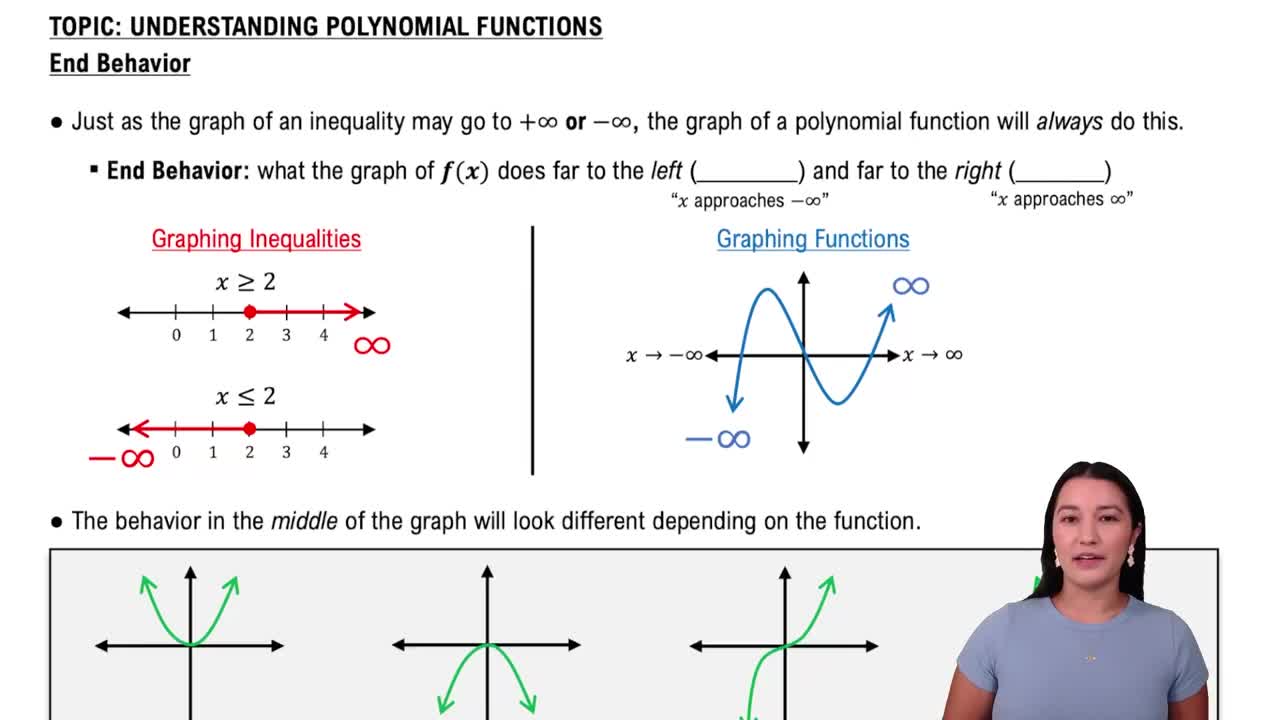
End Behavior of Polynomial Functions

End behavior describes how the graph behaves as x approaches positive or negative infinity. It depends on the leading term's degree and coefficient, indicating whether the graph rises or falls on each end.
Recommended video:
06:08
End Behavior of Polynomial Functions