Use the table to evaluate each expression, if possible.
Verified step by step guidance
1
Identify the functions \( f(x) \) and \( g(x) \) from the given table. You need to find the values of \( f(0) \) and \( g(0) \) by looking up the corresponding outputs when \( x = 0 \).
Recall that the expression \( (f/g)(0) \) means \( \frac{f(0)}{g(0)} \). This is the value of the function \( f(x) \) divided by the value of the function \( g(x) \) at \( x = 0 \).
Check if \( g(0) \) is not zero because division by zero is undefined. If \( g(0) = 0 \), then \( (f/g)(0) \) is undefined and cannot be evaluated.
If \( g(0) \neq 0 \), substitute the values of \( f(0) \) and \( g(0) \) into the fraction \( \frac{f(0)}{g(0)} \).
Simplify the fraction if possible to express the final value of \( (f/g)(0) \).
Verified video answer for a similar problem:
This video solution was recommended by our tutors as helpful for the problem above
Video duration:
57s
Play a video:
0 Comments
Key Concepts
Here are the essential concepts you must grasp in order to answer the question correctly.
Function Notation and Evaluation
Function notation, such as f(x) or g(x), represents the output of a function for a given input x. Evaluating a function at a specific value means substituting that value into the function's formula or table to find the corresponding output.
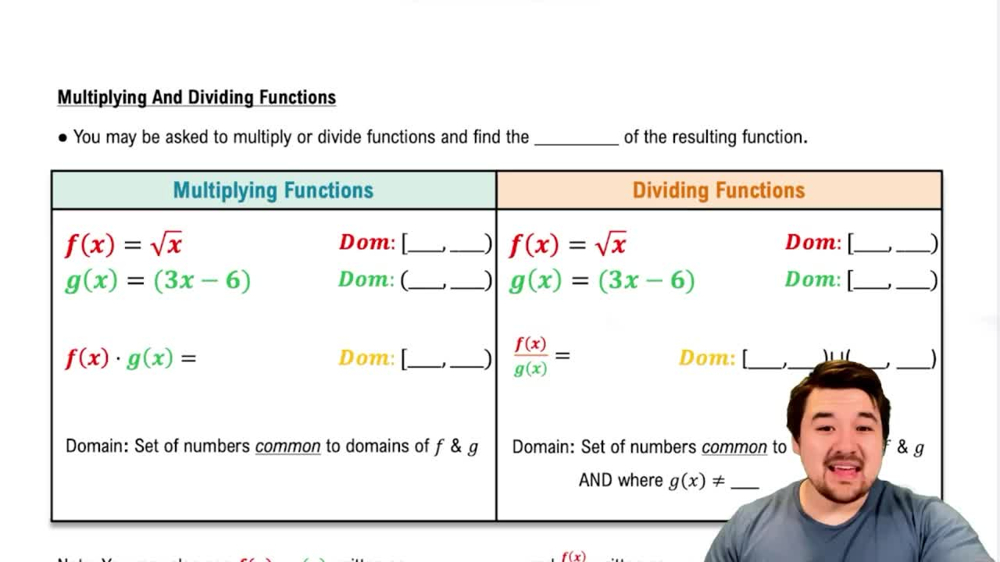
The quotient of two functions (f/g)(x) is defined as f(x) divided by g(x), provided g(x) ≠ 0. This operation combines two functions by dividing their outputs for the same input, and it is important to check the denominator to avoid division by zero.
When functions are given in table form, values of f(x) and g(x) at specific inputs are listed. To evaluate expressions like (f/g)(0), locate the values of f(0) and g(0) in the table and perform the required operation, ensuring the denominator is not zero.

 0:57 minutes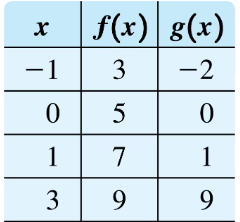
 Verified step by step guidance
 4:26
4:26