State the name of the property illustrated. 1/(x+3) (x+3)=1, x≠−3
Table of contents
- 0. Review of Algebra4h 18m
- 1. Equations & Inequalities3h 18m
- 2. Graphs of Equations1h 43m
- 3. Functions2h 17m
- 4. Polynomial Functions1h 44m
- 5. Rational Functions1h 23m
- 6. Exponential & Logarithmic Functions2h 28m
- 7. Systems of Equations & Matrices4h 5m
- 8. Conic Sections2h 23m
- 9. Sequences, Series, & Induction1h 22m
- 10. Combinatorics & Probability1h 45m
0. Review of Algebra
Exponents
Problem 84
Textbook Question
Evaluate each expression. (-2)6
Verified step by step guidance1
Identify the base and the exponent in the expression \((-2)^6\). Here, the base is \(-2\) and the exponent is \$6$.
Recall that an exponent indicates how many times the base is multiplied by itself. So, \((-2)^6\) means \((-2) \times (-2) \times (-2) \times (-2) \times (-2) \times (-2)\).
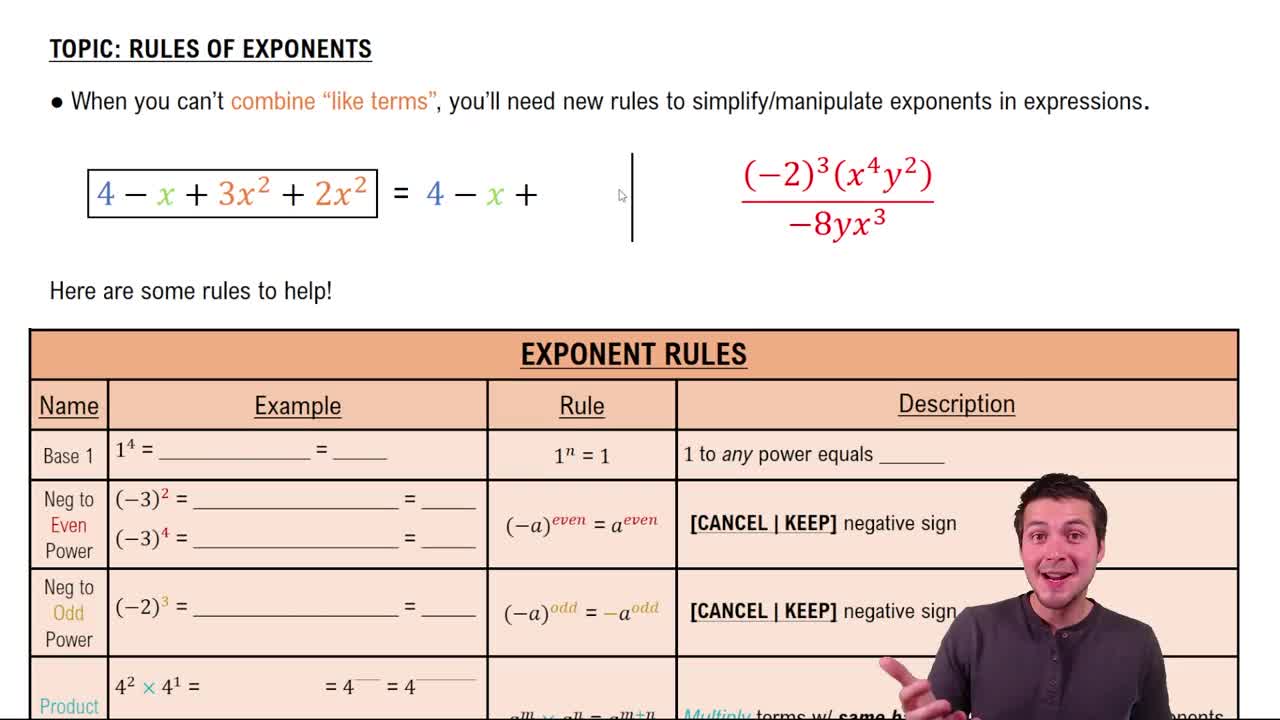
Since the exponent is even, multiplying a negative number an even number of times results in a positive number. This is because each pair of negative factors multiplies to a positive.
Calculate the value of \$2^6\( by multiplying \)2\( by itself six times: \)2 \times 2 \times 2 \times 2 \times 2 \times 2$.
Combine the sign consideration from step 3 with the magnitude from step 4 to determine the final value of \((-2)^6\).
Verified video answer for a similar problem:This video solution was recommended by our tutors as helpful for the problem above
Video duration:
1mPlay a video:
Was this helpful?
Key Concepts
Here are the essential concepts you must grasp in order to answer the question correctly.
Exponents and Powers
An exponent indicates how many times a base number is multiplied by itself. For example, in (-2)^6, the base is -2 and the exponent 6 means multiplying -2 by itself six times.
Recommended video:
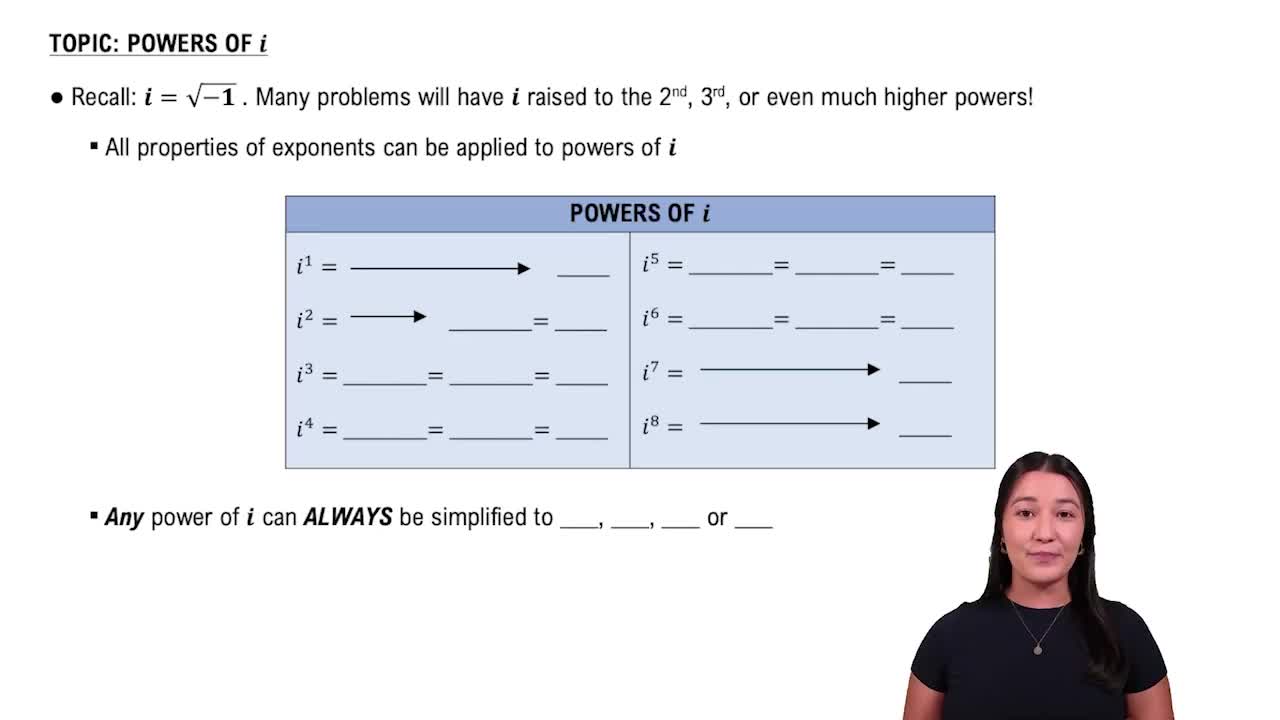
Powers of i
Negative Base with Even Exponent
When a negative number is raised to an even exponent, the result is positive because multiplying an even number of negative factors results in a positive product.
Recommended video:
Guided course
Introduction to Exponent Rules
Order of Operations and Parentheses
Parentheses indicate that the negative sign is part of the base. Thus, (-2)^6 means the entire -2 is raised to the 6th power, unlike -2^6, which would mean the negative of 2 raised to the 6th power.
Recommended video:
Guided course
Performing Row Operations on Matrices
Watch next
Master Introduction to Exponent Rules with a bite sized video explanation from Patrick
Start learningRelated Videos
Related Practice
Textbook Question
869
views