Decide whether each statement is true or false. The equation 5x=4x is an example of a contradiction.
Verified step by step guidance
1
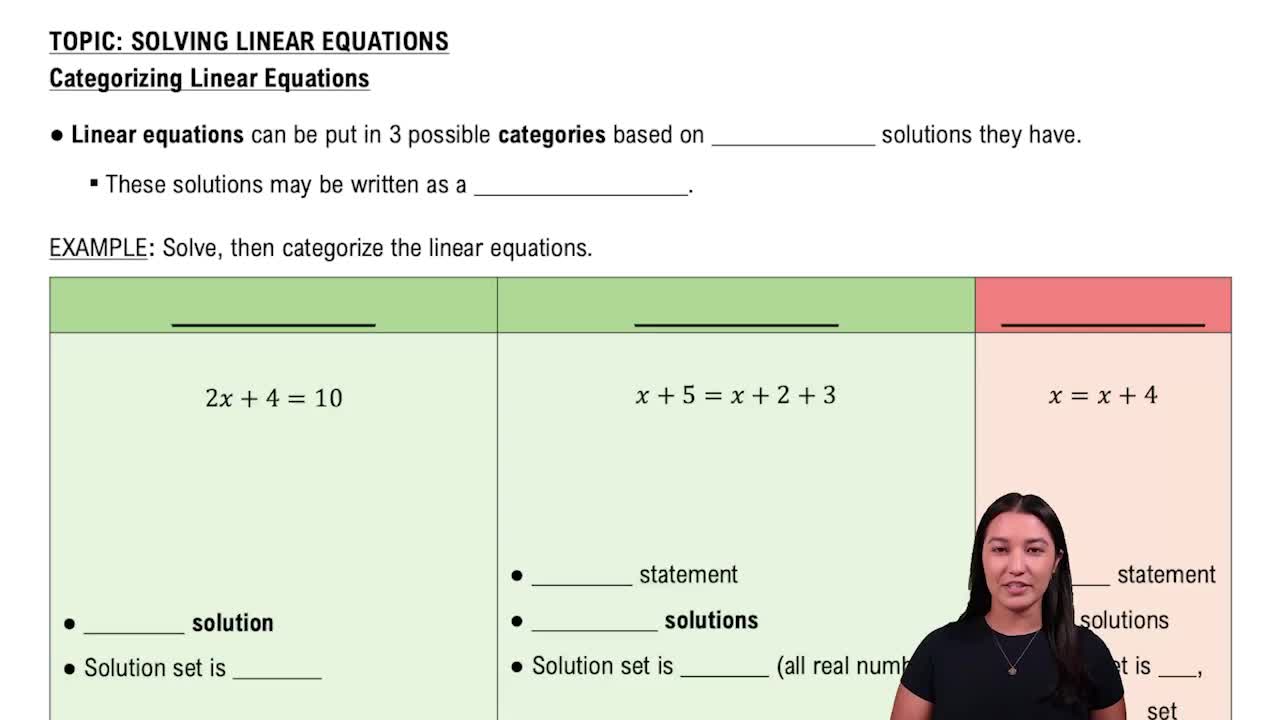
Recall that a contradiction is an equation that has no solution, meaning it is never true for any value of the variable.
Start with the given equation: \$5x = 4x$.
Subtract \$4x\( from both sides to isolate the variable terms on one side: \)5x - 4x = 4x - 4x$.
Simplify both sides: \(x = 0\).
Since the equation simplifies to \(x = 0\), which is a specific solution, the equation is not a contradiction because it has at least one solution.
Verified video answer for a similar problem:
This video solution was recommended by our tutors as helpful for the problem above
Video duration:
1m
Play a video:
0 Comments
Key Concepts
Here are the essential concepts you must grasp in order to answer the question correctly.
Equation and Solution
An equation is a mathematical statement asserting the equality of two expressions. Solving an equation involves finding all values of the variable that make the equation true. Understanding what it means for an equation to have solutions is fundamental to analyzing its nature.
A contradiction is an equation that has no solution because it leads to a false statement, such as 0 = 5. Recognizing contradictions helps determine when an equation cannot be satisfied by any value of the variable.
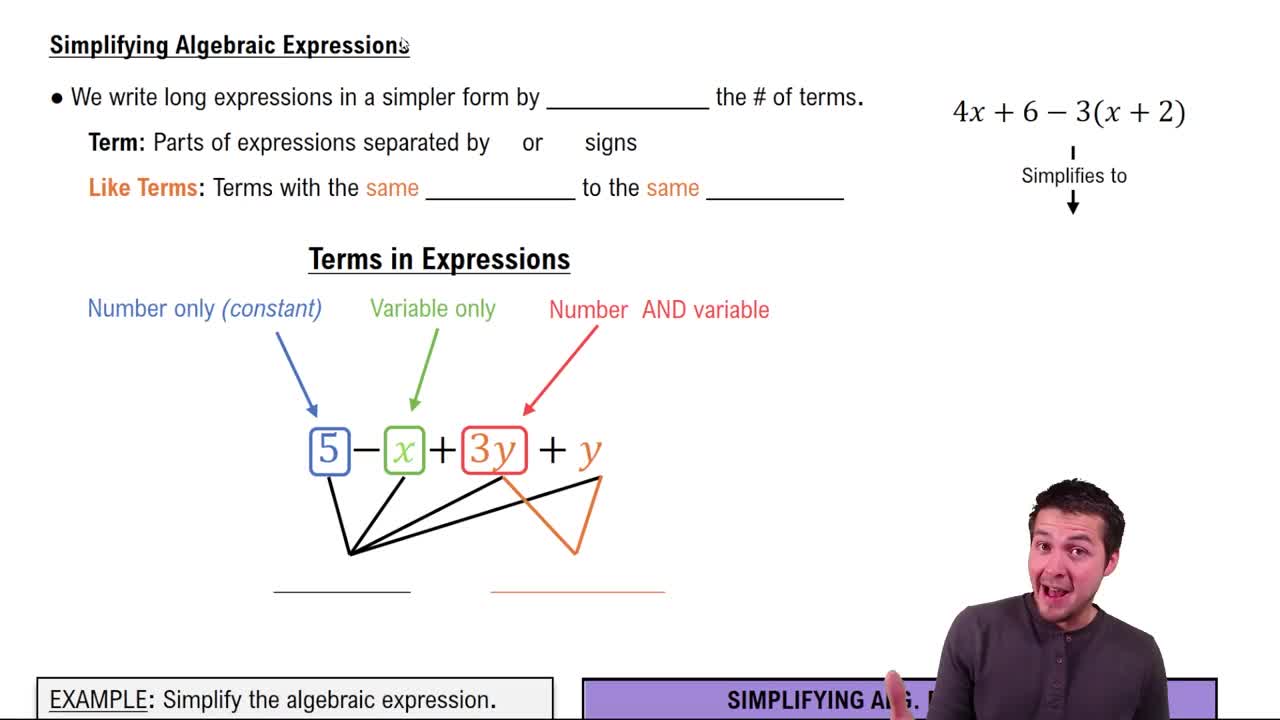
Simplifying both sides of an equation by combining like terms or performing operations helps reveal the true nature of the equation. For example, simplifying 5x = 4x leads to x = 0, showing whether the equation is always true, false, or conditional.

 1:28 minutes
 Verified step by step guidance
 06:00
06:00