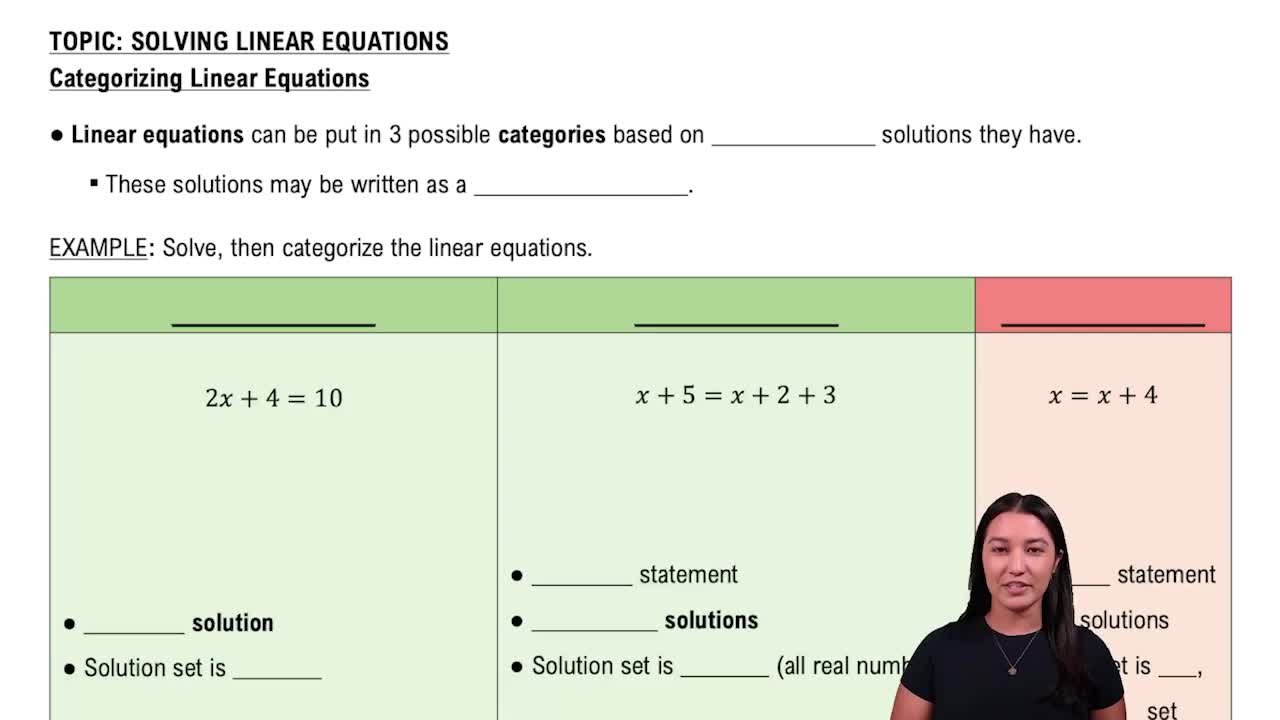
A conditional equation is an equation that is true only for certain values of the variable(s) involved. It is not universally true for all values of the variable(s).
To understand this concept, consider the equation \( x + 3 = 7 \). This equation is true only when \( x = 4 \). If \( x \) takes any other value, the equation will not hold.
Conditional equations are solved by isolating the variable to determine the specific value(s) that satisfy the equation.
For example, solving \( x + 3 = 7 \) involves subtracting 3 from both sides: \( x = 7 - 3 \). This gives \( x = 4 \), which is the condition under which the equation is true.
In summary, a conditional equation depends on specific values of the variable(s) to be true, unlike identities, which are true for all values of the variable(s).
Verified video answer for a similar problem:
This video solution was recommended by our tutors as helpful for the problem above
Video duration:
3m
Play a video:
0 Comments
Key Concepts
Here are the essential concepts you must grasp in order to answer the question correctly.
Conditional Equation
A conditional equation is an equation that holds true for specific values of the variable(s) involved. Unlike an identity, which is true for all values, a conditional equation may only be valid under certain conditions. For example, the equation 2x + 3 = 7 is conditional because it is only true when x = 2.
The solution of an equation is the value or set of values that satisfy the equation, making it true. In the case of a conditional equation, finding the solution involves isolating the variable to determine the specific values that fulfill the equation's conditions. For instance, solving 2x + 3 = 7 leads to x = 2, which is the solution.
An example of a conditional equation is x^2 - 4 = 0. This equation is conditional because it is true only for specific values of x, namely x = 2 and x = -2. These values satisfy the equation, demonstrating that conditional equations can have multiple solutions depending on the variable's constraints.