Solve each polynomial inequality in Exercises 1–42 and graph the solution set on a real number line. Express each solution set in interval notation.
Ch. 3 - Polynomial and Rational Functions

Chapter 4, Problem 16
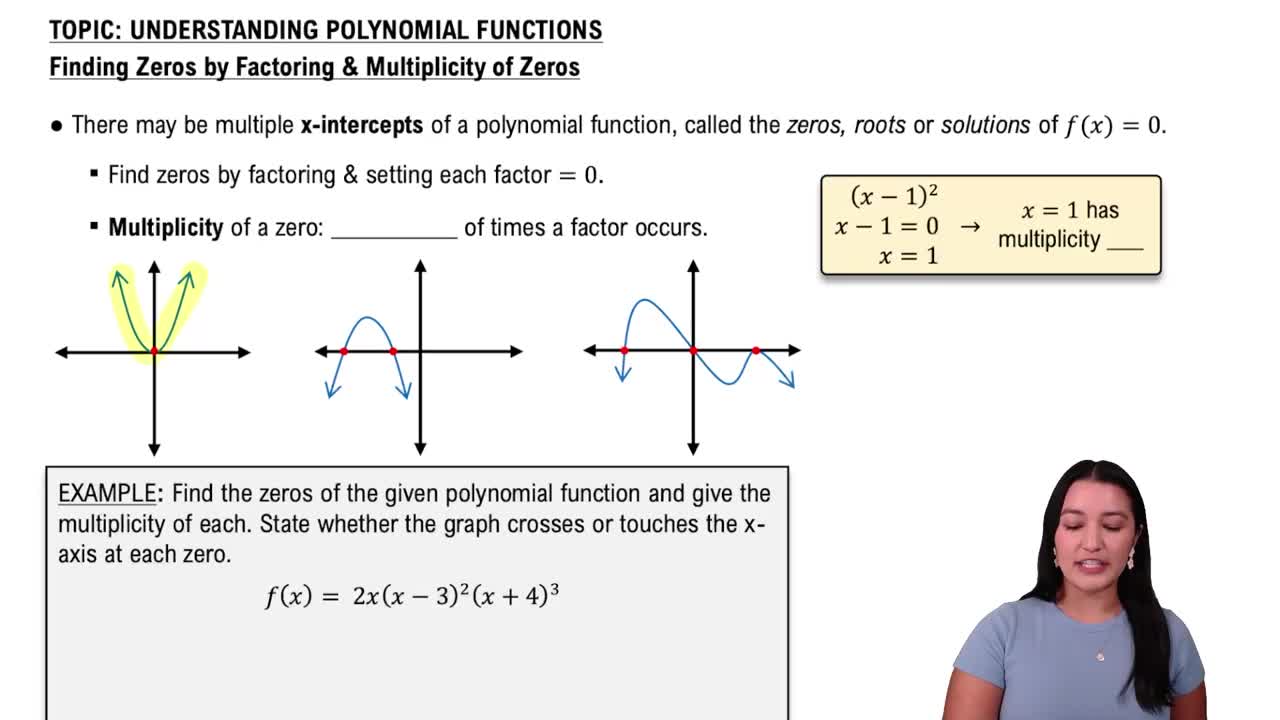
Find the zeros for each polynomial function and give the multiplicity of each zero. State whether the graph crosses the x-axis, or touches the x-axis and turns around, at each zero.
Verified step by step guidance1
Identify the zeros of the polynomial by setting each factor equal to zero: solve \(x - 1 = 0\), \(x + 2 = 0\), and \(x + 5 = 0\) to find the zeros.
Determine the multiplicity of each zero by looking at the exponent on each factor: the factor \((x - 1)\) has multiplicity 1, \((x + 2)^2\) has multiplicity 2, and \((x + 5)^2\) has multiplicity 2.
Recall that if a zero has an odd multiplicity, the graph crosses the x-axis at that zero; if the multiplicity is even, the graph touches the x-axis and turns around at that zero.
Summarize the behavior at each zero: for \(x = 1\) (multiplicity 1), the graph crosses the x-axis; for \(x = -2\) and \(x = -5\) (both multiplicity 2), the graph touches and turns around at the x-axis.
Combine all this information to describe the zeros, their multiplicities, and the behavior of the graph at each zero.

Verified video answer for a similar problem:
This video solution was recommended by our tutors as helpful for the problem above.
Video duration:
3mWas this helpful?
Key Concepts
Here are the essential concepts you must grasp in order to answer the question correctly.
Zeros of a Polynomial Function
Zeros of a polynomial are the values of x that make the function equal to zero. They correspond to the x-intercepts of the graph. To find zeros, set the polynomial equal to zero and solve for x, often by factoring or using given factored form.
Recommended video:
Finding Zeros & Their Multiplicity
Multiplicity of Zeros
Multiplicity refers to how many times a particular zero appears as a factor in the polynomial. If a zero has even multiplicity, the graph touches the x-axis and turns around at that zero. If the multiplicity is odd, the graph crosses the x-axis at that zero.
Recommended video:
Finding Zeros & Their Multiplicity
Behavior of Graph at Zeros
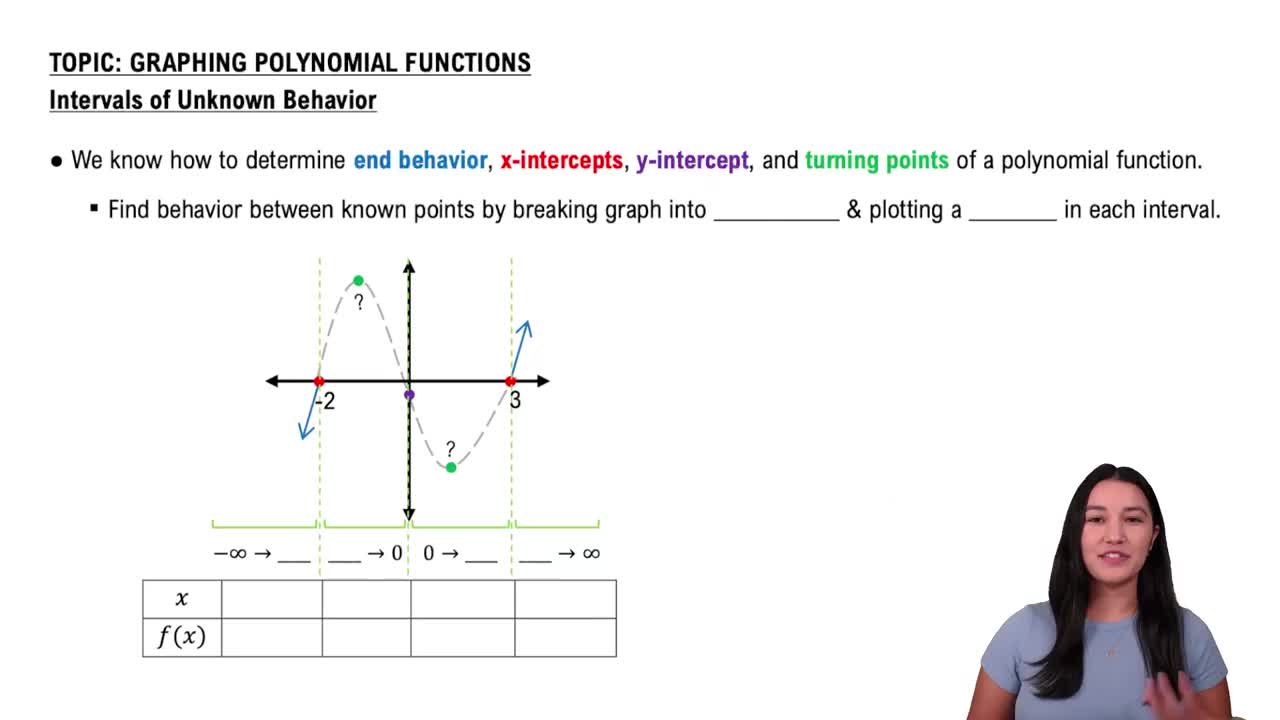
The graph's behavior at each zero depends on the zero's multiplicity. For odd multiplicity, the graph crosses the x-axis, indicating a sign change. For even multiplicity, the graph only touches the axis and reverses direction, showing no sign change.
Recommended video:
Identifying Intervals of Unknown Behavior
Related Practice
Textbook Question
526
views
Textbook Question
Use the vertex and intercepts to sketch the graph of each quadratic function. Give the equation of the parabola's axis of symmetry. Use the graph to determine the function's domain and range. f(x)=(x−4)2−1
1309
views
Textbook Question
Write an equation that expresses each relationship. Then solve the equation for y. x varies jointly as y and z and inversely as the square of w.
549
views
Textbook Question
Write an equation that expresses each relationship. Then solve the equation for y. x varies jointly as z and the sum of y and w.
532
views
Textbook Question
Divide using long division. State the quotient, and the remainder, r(x).
530
views
Textbook Question
Use the graph of the rational function in the figure shown to complete each statement in Exercises 15–20.
As __
1413
views