Write each number in standard form a+bi. -6-√-24 / 2
Verified step by step guidance
1
Recognize that the expression involves a complex number because of the square root of a negative number: \(\sqrt{-24}\).
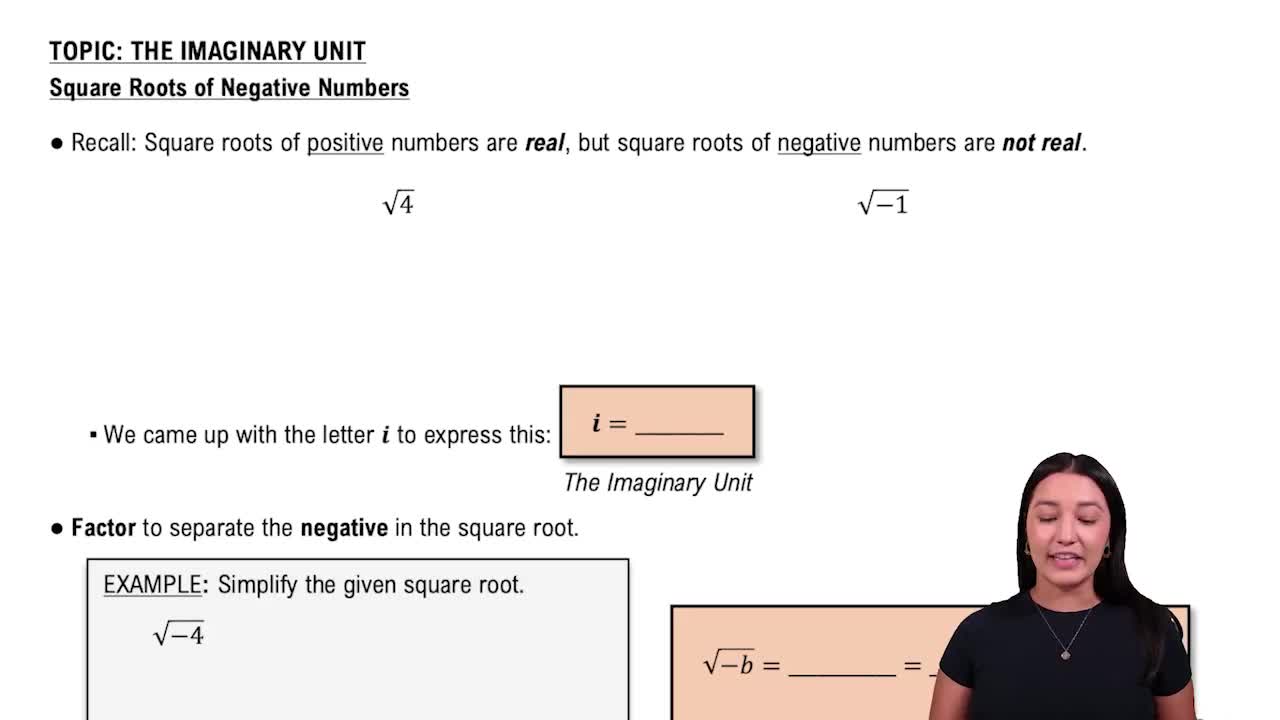
Rewrite the square root of the negative number using imaginary unit \(i\), where \(i = \sqrt{-1}\). So, \(\sqrt{-24} = \sqrt{24} \cdot i\).
Simplify \(\sqrt{24}\) by factoring it into \(\sqrt{4 \times 6} = \sqrt{4} \times \sqrt{6} = 2\sqrt{6}\), so \(\sqrt{-24} = 2\sqrt{6}i\).
Substitute back into the original expression: \(\frac{-6 - 2\sqrt{6}i}{2}\).
Separate the fraction into real and imaginary parts: \(\frac{-6}{2} - \frac{2\sqrt{6}i}{2}\), then simplify each part to write the expression in standard form \(a + bi\).
Verified video answer for a similar problem:
This video solution was recommended by our tutors as helpful for the problem above
Video duration:
3m
Play a video:
0 Comments
Key Concepts
Here are the essential concepts you must grasp in order to answer the question correctly.
Complex Numbers and Imaginary Unit
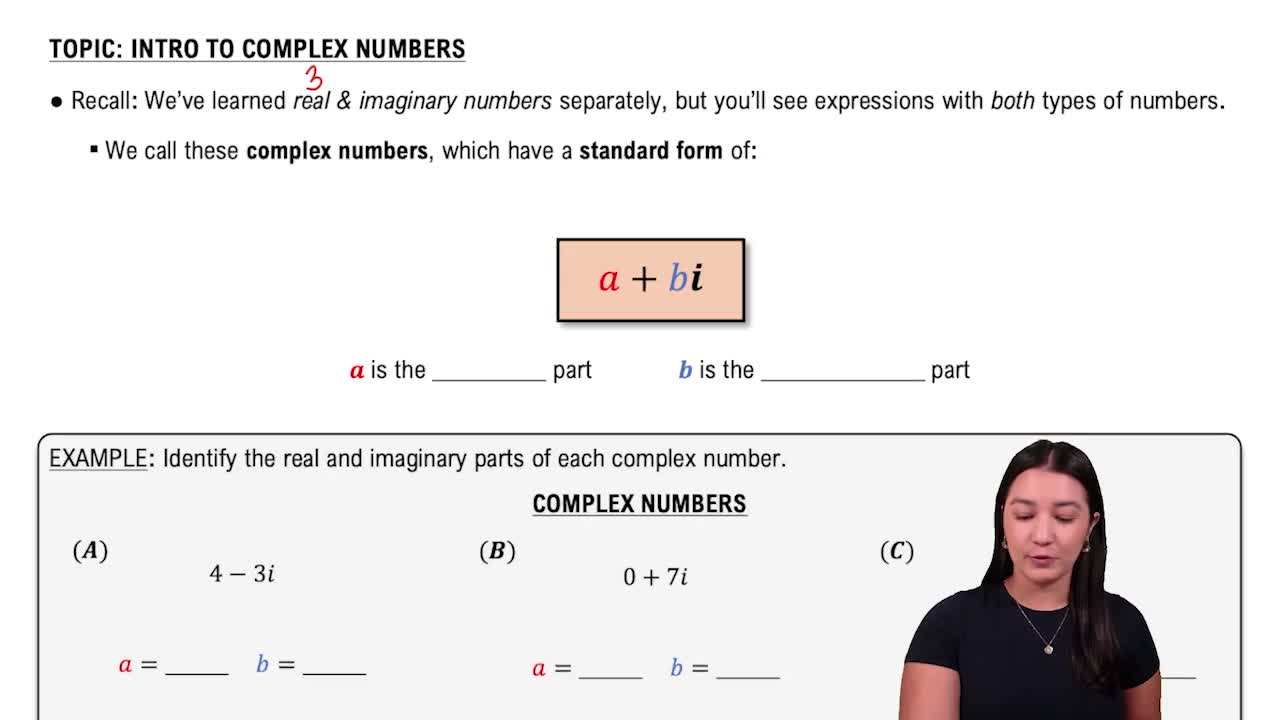
Complex numbers are expressed in the form a + bi, where a and b are real numbers and i is the imaginary unit with the property i² = -1. Understanding how to represent square roots of negative numbers using i is essential for rewriting expressions involving √-24.
To simplify the square root of a negative number, separate it into the square root of the positive part and the imaginary unit i. For example, √-24 can be written as √24 * i, and then further simplified by factoring 24 into perfect squares.
Algebraic Simplification and Division of Complex Expressions
When dividing expressions involving complex numbers, apply algebraic rules carefully, including distributing division over addition or subtraction and simplifying numerator and denominator separately. This helps in rewriting the expression in the standard form a + bi.

 3:07 minutes
 Verified step by step guidance
 03:31
03:31