Find the domain of each rational function. f(x)=5x/(x−4)
Table of contents
- 0. Review of Algebra4h 18m
- 1. Equations & Inequalities3h 18m
- 2. Graphs of Equations1h 43m
- 3. Functions2h 17m
- 4. Polynomial Functions1h 44m
- 5. Rational Functions1h 23m
- 6. Exponential & Logarithmic Functions2h 28m
- 7. Systems of Equations & Matrices4h 5m
- 8. Conic Sections2h 23m
- 9. Sequences, Series, & Induction1h 22m
- 10. Combinatorics & Probability1h 45m
5. Rational Functions
Asymptotes
Multiple Choice
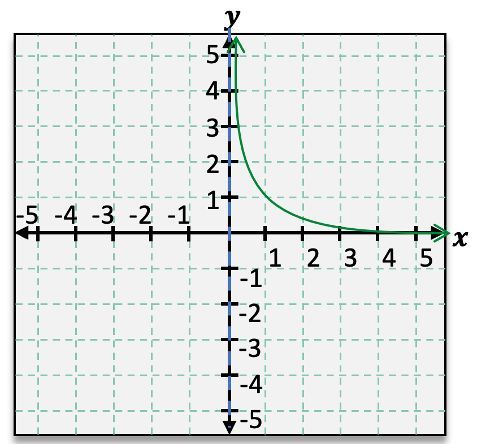
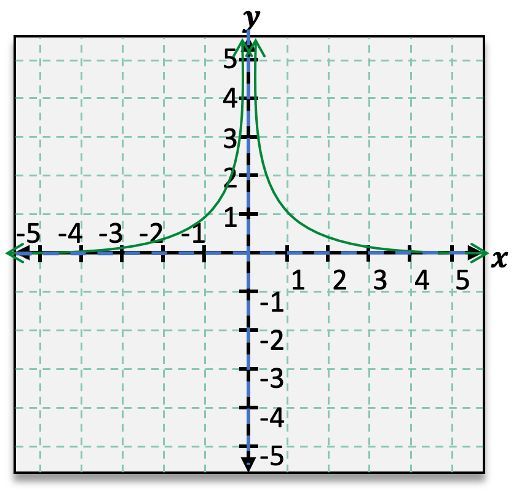
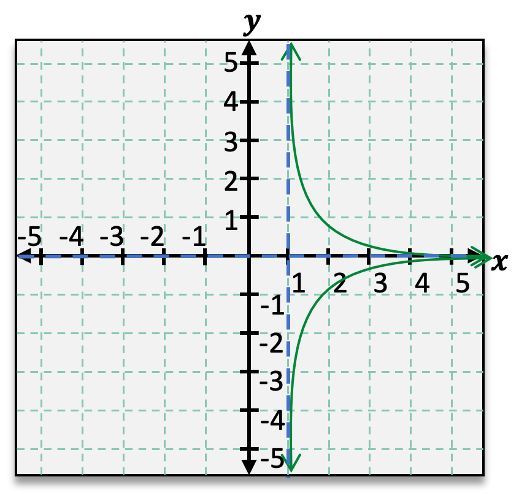
Sketch the graph of the function f(x)=x21. Identify the asymptotes on the graph.
A
Vertical Asymptote: x=0, Horizontal Asymptote: None
B
Vertical Asymptote: x=0, Horizontal Asymptote: y=0
C
Vertical Asymptote: x=0, Horizontal Asymptote: y=0
D
Vertical Asymptote: x=1 , Horizontal Asymptote: y=0
0 Comments
Verified step by step guidance1
The function given is \( f(x) = \frac{1}{x^2} \). This is a rational function where the numerator is a constant and the denominator is a quadratic expression.
Identify the vertical asymptote by setting the denominator equal to zero. Since the denominator is \( x^2 \), set \( x^2 = 0 \). Solving this gives \( x = 0 \). Therefore, there is a vertical asymptote at \( x = 0 \).
To find the horizontal asymptote, consider the behavior of \( f(x) \) as \( x \) approaches infinity. As \( x \to \infty \) or \( x \to -\infty \), \( \frac{1}{x^2} \to 0 \). Thus, the horizontal asymptote is \( y = 0 \).
The graph of \( f(x) = \frac{1}{x^2} \) is symmetric about the y-axis because it is an even function. This means the graph will look the same on both sides of the y-axis.
In the graph, as \( x \) approaches 0 from the positive or negative side, \( f(x) \) approaches infinity, confirming the vertical asymptote at \( x = 0 \). As \( x \) moves away from zero in either direction, \( f(x) \) approaches zero, confirming the horizontal asymptote at \( y = 0 \).
Related Videos
Related Practice
Textbook Question
761
views

