Solve each polynomial inequality in Exercises 1–42 and graph the solution set on a real number line. Express each solution set in interval notation. x2+5x+4>0
Ch. 3 - Polynomial and Rational Functions

Chapter 4, Problem 5
Determine which functions are polynomial functions. For those that are, identify the degree.
Verified step by step guidance1
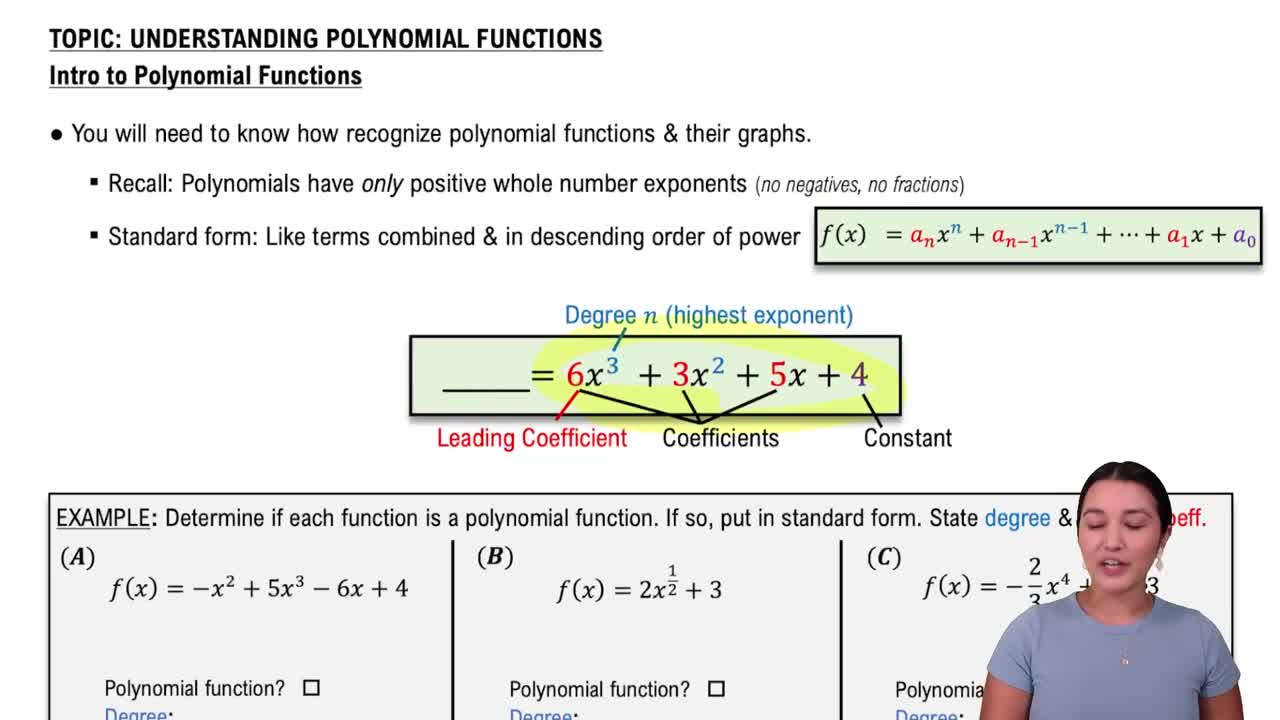
Recall that a polynomial function is a function of the form \(h(x) = a_n x^n + a_{n-1} x^{n-1} + \cdots + a_1 x + a_0\), where each exponent \(n, n-1, \ldots, 1, 0\) is a whole number (non-negative integer), and the coefficients \(a_i\) are real numbers.
Examine the given function: \(h(x) = 7x^3 + 2x^2 + \frac{1}{x}\). Notice that the first two terms, \$7x^3\( and \)2x^2$, have exponents 3 and 2, which are whole numbers.
Look closely at the term \(\frac{1}{x}\). This can be rewritten as \(x^{-1}\), which has an exponent of \(-1\), a negative integer.
Since polynomial functions cannot have negative exponents, the presence of \(x^{-1}\) means \(h(x)\) is not a polynomial function.
Therefore, \(h(x)\) is not a polynomial function, and identifying the degree does not apply in this case.

Verified video answer for a similar problem:
This video solution was recommended by our tutors as helpful for the problem above.
Video duration:
1mWas this helpful?
Key Concepts
Here are the essential concepts you must grasp in order to answer the question correctly.
Polynomial Functions
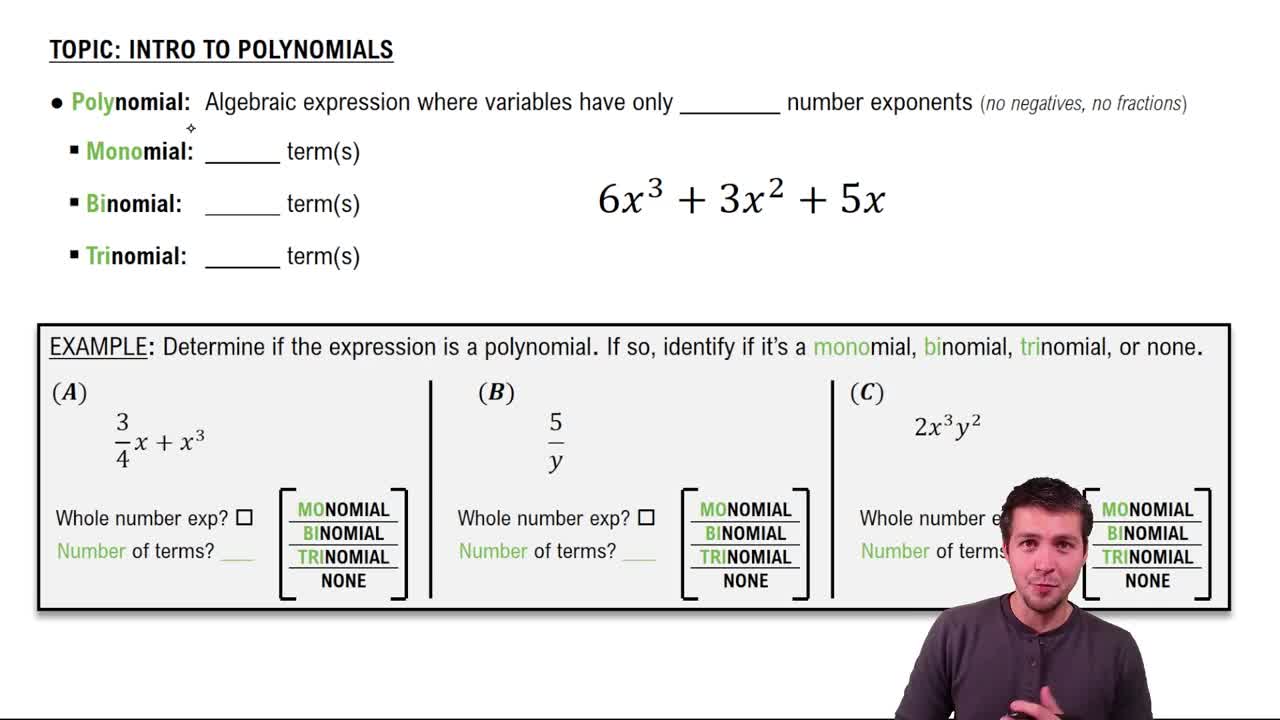
A polynomial function is a function that can be expressed as a sum of terms consisting of variables raised to non-negative integer powers multiplied by coefficients. It has the general form f(x) = a_n x^n + a_{n-1} x^{n-1} + ... + a_1 x + a_0, where n is a whole number and coefficients are real numbers.
Recommended video:
Introduction to Polynomial Functions
Degree of a Polynomial
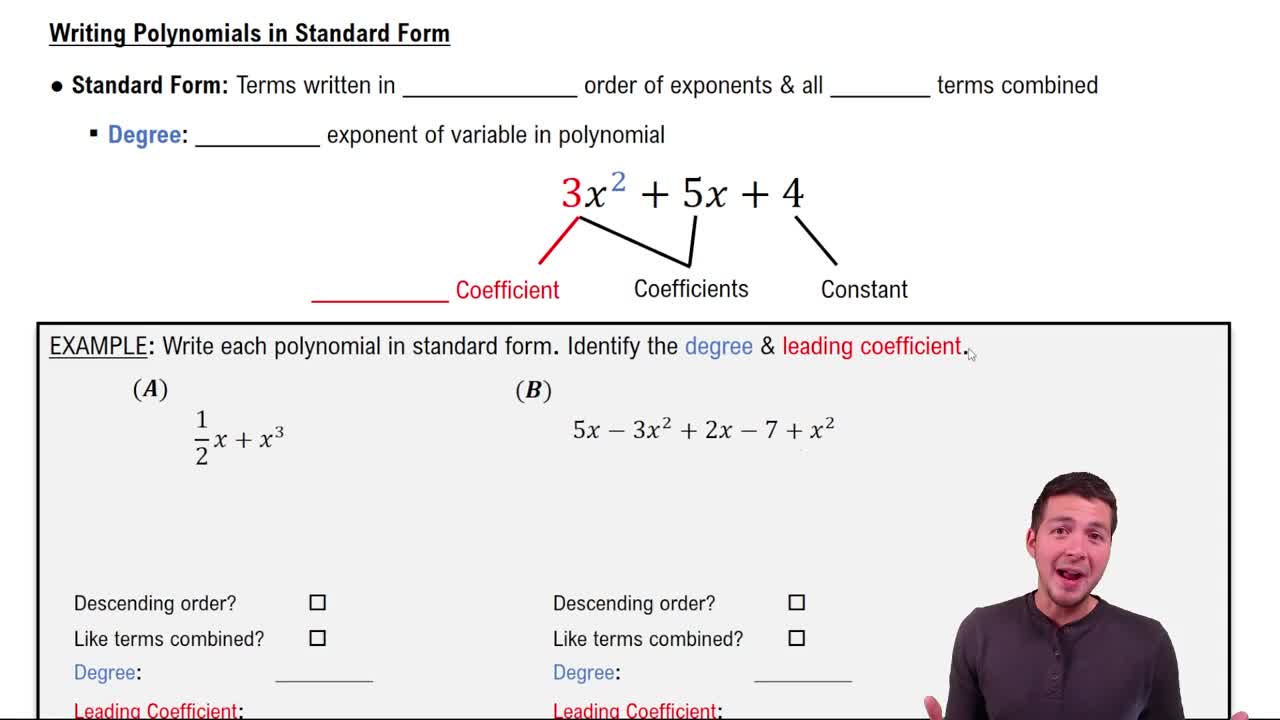
The degree of a polynomial is the highest power of the variable in the polynomial with a non-zero coefficient. It indicates the polynomial's order and affects the shape and behavior of its graph. For example, in 7x^3 + 2x^2 + 1, the degree is 3.
Recommended video:
Guided course
Standard Form of Polynomials
Non-Polynomial Terms
Terms with variables in the denominator or with negative or fractional exponents are not part of polynomial functions. For instance, the term 1/x can be rewritten as x^(-1), which disqualifies the function from being a polynomial because polynomials require non-negative integer exponents.
Recommended video:
Guided course
Introduction to Polynomials
Related Practice
Textbook Question
609
views
Textbook Question
Use the four-step procedure for solving variation problems given on page 447 to solve Exercises 1–10. y varies directly as x and inversely as the square of z. y = 20 when x = 50 and z = 5. Find y when x = 3 and z = 6.
738
views
Textbook Question
Divide using long division. State the quotient, and the remainder, .
817
views
1
rank
Textbook Question
Use the Rational Zero Theorem to list all possible rational zeros for each given function. f(x)=4x4−x3+5x2−2x−6
524
views
Textbook Question
In Exercises 5–6, use the function's equation, and not its graph, to find (a) the minimum or maximum value and where it occurs. (b) the function's domain and its range.
904
views
Textbook Question
In Exercises 1–8, use the Rational Zero Theorem to list all possible rational zeros for each given function. f(x)=3x4−11x3−3x2−6x+8
482
views