Graph each function. See Examples 1 and 2. ƒ(x)=3|x|
Verified step by step guidance
1
Understand the function given: \(f(x) = 3|x|\). This means the output is three times the absolute value of \(x\).
Recall the shape of the basic absolute value function \(|x|\), which forms a 'V' shape with its vertex at the origin (0,0).
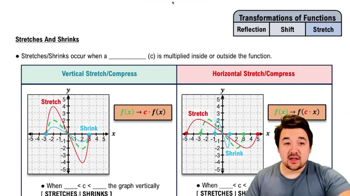
To graph \(f(x) = 3|x|\), multiply the output of \(|x|\) by 3, which vertically stretches the graph by a factor of 3. This makes the 'V' shape steeper.
Plot key points to guide your graph: for example, when \(x=0\), \(f(0) = 3|0| = 0\); when \(x=1\), \(f(1) = 3|1| = 3\); and when \(x=-1\), \(f(-1) = 3| -1| = 3\).
Draw the graph by connecting these points with straight lines forming a 'V' shape, ensuring the vertex is at the origin and the arms rise steeply due to the factor of 3.
Verified video answer for a similar problem:
This video solution was recommended by our tutors as helpful for the problem above
Video duration:
6m
Play a video:
0 Comments
Key Concepts
Here are the essential concepts you must grasp in order to answer the question correctly.
Absolute Value Function
The absolute value function, denoted |x|, outputs the non-negative value of x regardless of its sign. It creates a V-shaped graph symmetric about the y-axis, reflecting all negative inputs as positive outputs.
Multiplying a function by a constant greater than 1, like 3 in 3|x|, stretches the graph vertically. This means all output values are scaled by that factor, making the graph steeper compared to the parent function.
Absolute value functions can be viewed as piecewise functions with different expressions for x ≥ 0 and x < 0. Understanding this helps in plotting points accurately and visualizing the graph's shape.

 6:28 minutes
 Verified step by step guidance
 4:56
4:56