Use the Leading Coefficient Test to determine the end behavior of the graph of the polynomial function.
Ch. 3 - Polynomial and Rational Functions

Chapter 4, Problem 20
In Exercises 19–24, (a) Use the Leading Coefficient Test to determine the graph's end behavior. (b) Determine whether the graph has y-axis symmetry, origin symmetry, or neither. (c) Graph the function.
Verified step by step guidance1
Identify the degree and leading coefficient of the polynomial function \(f(x) = 4x - x^3\). The highest power of \(x\) is 3, so the degree is 3, and the leading coefficient is the coefficient of \(x^3\), which is \(-1\).
Apply the Leading Coefficient Test to determine the end behavior: Since the degree is odd (3) and the leading coefficient is negative (\(-1\)), as \(x \to \infty\), \(f(x) \to -\infty\), and as \(x \to -\infty\), \(f(x) \to \infty\).
Check for symmetry by testing \(f(-x)\) and comparing it to \(f(x)\) and \(-f(x)\). Calculate \(f(-x) = 4(-x) - (-x)^3 = -4x + x^3\). Since \(f(-x) \neq f(x)\) and \(f(-x) \neq -f(x)\), the function has neither y-axis symmetry nor origin symmetry.
To graph the function, start by plotting key points such as the y-intercept at \(x=0\), where \(f(0) = 0\), and other points by substituting values of \(x\) (e.g., \(x=1, -1, 2, -2\)) to understand the shape of the curve.
Use the end behavior from step 2 and the points from step 4 to sketch the graph, showing that the graph falls to the right and rises to the left, consistent with the Leading Coefficient Test for an odd degree polynomial with a negative leading coefficient.

Verified video answer for a similar problem:
This video solution was recommended by our tutors as helpful for the problem above.
Video duration:
5mWas this helpful?
Key Concepts
Here are the essential concepts you must grasp in order to answer the question correctly.
Leading Coefficient Test
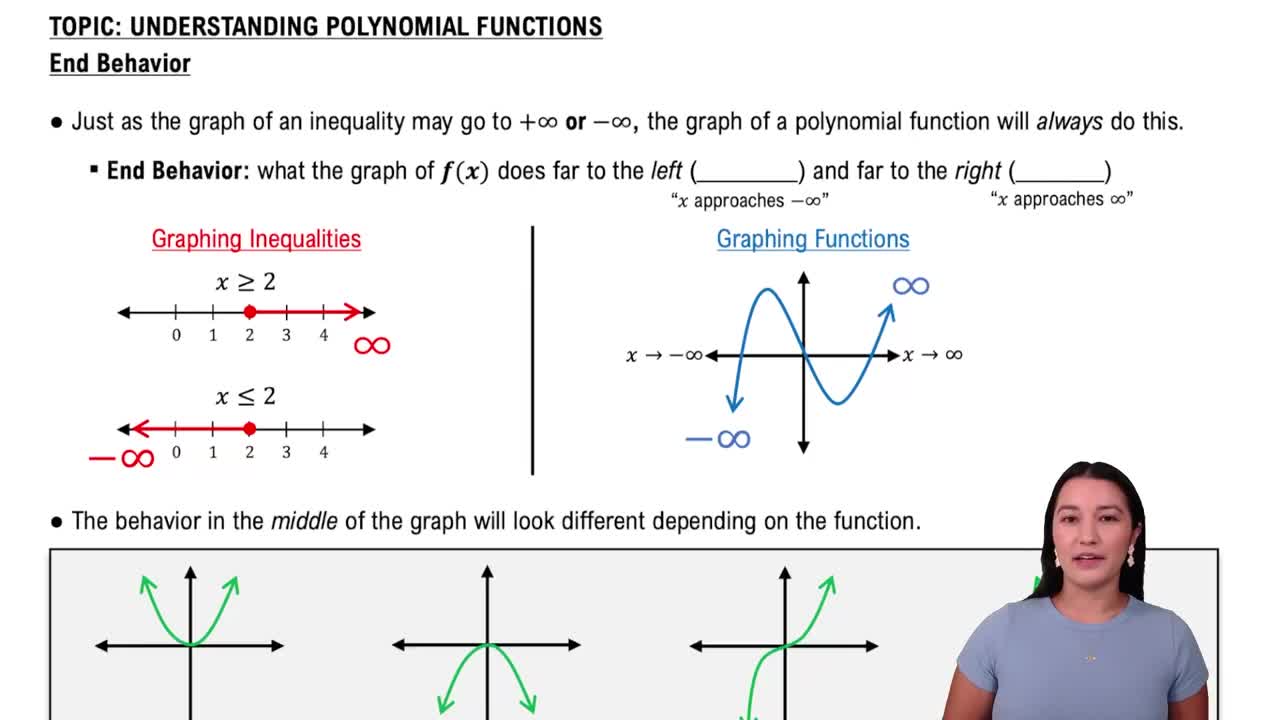
The Leading Coefficient Test helps determine the end behavior of a polynomial function by examining the degree and leading coefficient. For odd-degree polynomials, the ends of the graph go in opposite directions, while for even-degree polynomials, both ends go the same way. The sign of the leading coefficient indicates whether the graph rises or falls on the right end.
Recommended video:
End Behavior of Polynomial Functions
Symmetry of Functions
Symmetry in graphs refers to whether a function is even, odd, or neither. Even functions have y-axis symmetry, meaning f(x) = f(-x). Odd functions have origin symmetry, meaning f(-x) = -f(x). Checking these properties helps understand the shape and behavior of the graph.
Recommended video:
Function Composition
Graphing Polynomial Functions
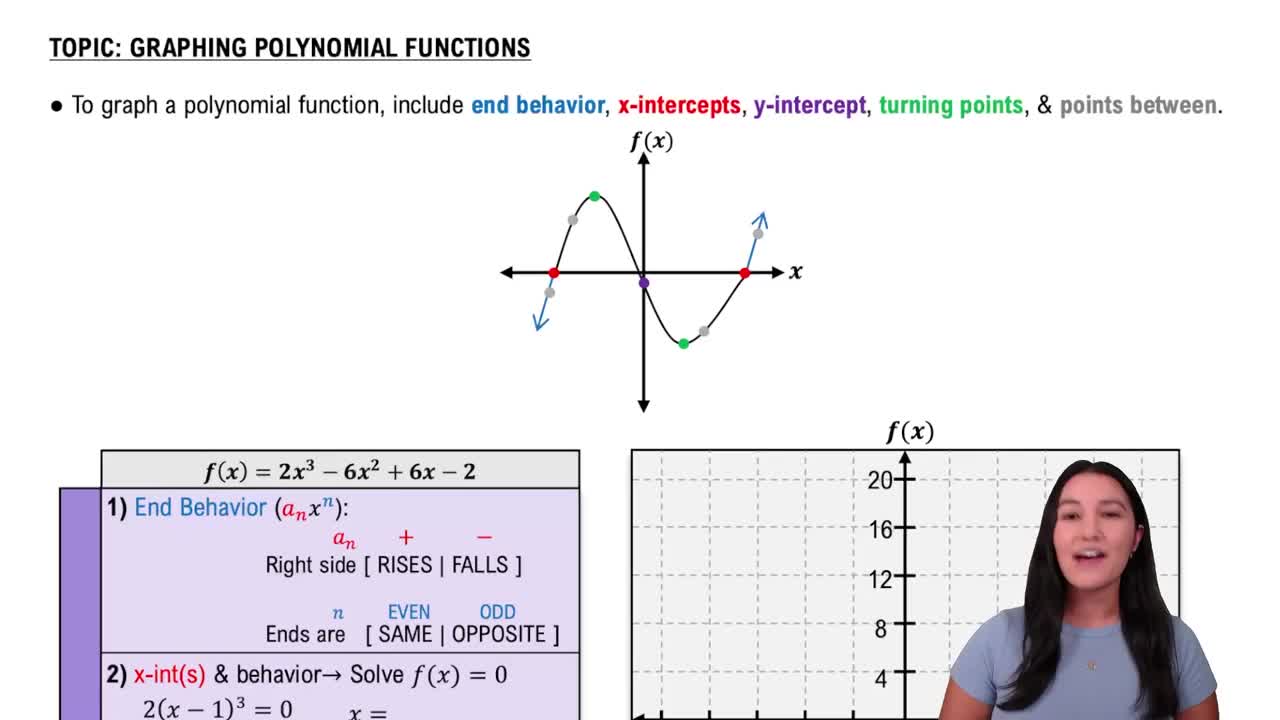
Graphing polynomials involves plotting key points, analyzing end behavior, and identifying intercepts and symmetry. Understanding the degree and coefficients guides the shape, while evaluating the function at specific x-values helps plot accurate points for a complete graph.
Recommended video:
Graphing Polynomial Functions
Related Practice
Textbook Question
660
views
Textbook Question
Solve each polynomial inequality in Exercises 1–42 and graph the solution set on a real number line. Express each solution set in interval notation.
639
views
Textbook Question
In Exercises 17–24, a) List all possible rational roots. b) List all possible rational roots. c) Use the quotient from part (b) to find the remaining roots and solve the equation. 6x3+25x2−24x+5=0
111
views
Textbook Question
Solve each polynomial inequality in Exercises 1–42 and graph the solution set on a real number line. Express each solution set in interval notation.
515
views
Textbook Question
Use the Leading Coefficient Test to determine the end behavior of the graph of the polynomial function.
549
views
Textbook Question
Write an equation that expresses each relationship. Then solve the equation for y. x varies directly as z and inversely as the sum of y and w.
571
views