Ch. 2 - Functions and Graphs
Blitzer - College Algebra 8th Edition
Blitzer8th EditionCollege AlgebraISBN: 9780136970514Not the one you use?Change textbook
Chapter 3, Problem 117

Begin by graphing the cube root function, f(x) = ∛x. Then use transformations of this graph to graph the given function. ∛(-x-2)

Verified step by step guidance
1
Start by graphing the parent function \( f(x) = \sqrt[3]{x} \). This is the cube root function, which has a characteristic S-shape. It passes through the origin (0, 0), is symmetric about the origin, and increases as x increases.
Next, analyze the transformation \( f(x) = \sqrt[3]{-x} \). The negative sign inside the cube root reflects the graph of \( \sqrt[3]{x} \) across the y-axis. This means that for every point (x, y) on the original graph, the new graph will have the point (-x, y).
Now, consider the transformation \( f(x) = \sqrt[3]{-x - 2} \). The \(-2\) inside the cube root shifts the graph to the left by 2 units. This means that every point on the graph of \( \sqrt[3]{-x} \) will move 2 units to the left.
Combine the transformations: Start with the parent function \( \sqrt[3]{x} \), reflect it across the y-axis to get \( \sqrt[3]{-x} \), and then shift the resulting graph 2 units to the left to obtain \( \sqrt[3]{-x - 2} \).
Finally, plot the transformed graph. Key points to include are the new origin (shifted to (-2, 0)) and other points that reflect the transformations. Ensure the graph maintains the S-shape characteristic of cube root functions.

Verified video answer for a similar problem:

This video solution was recommended by our tutors as helpful for the problem above.
Video duration:
3m
Was this helpful?

Key Concepts

Here are the essential concepts you must grasp in order to answer the question correctly.

Cube Root Function

The cube root function, denoted as f(x) = ∛x, is a fundamental mathematical function that returns the number which, when cubed, gives the input value x. This function is defined for all real numbers and has a characteristic S-shaped curve that passes through the origin (0,0). Understanding its basic shape and properties is essential for applying transformations.
Recommended video:
02:20
Imaginary Roots with the Square Root Property

Graph Transformations

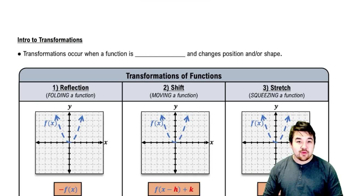
Graph transformations involve altering the position or shape of a function's graph through operations such as translations, reflections, and stretches. For instance, the function f(x) = ∛(-x-2) represents a horizontal shift and a reflection across the y-axis of the original cube root function. Mastery of these transformations allows for the accurate graphing of modified functions.
Recommended video:
5:25
Intro to Transformations

Horizontal and Vertical Shifts

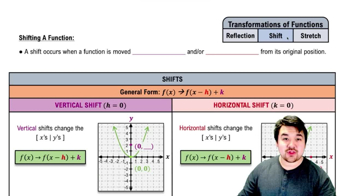
Horizontal and vertical shifts are specific types of transformations that move the graph of a function along the x-axis and y-axis, respectively. A horizontal shift occurs when a constant is added or subtracted from the input variable, while a vertical shift involves adding or subtracting a constant from the function's output. In the case of ∛(-x-2), the graph shifts left by 2 units and reflects across the y-axis.
Recommended video:
5:34
Shifts of Functions