Identify the expression to evaluate: \((-3)^3 \times (-2)^2\).
Evaluate each exponential term separately. For \((-3)^3\), raise -3 to the power of 3, which means multiplying -3 by itself three times: \((-3) \times (-3) \times (-3)\).
For \((-2)^2\), raise -2 to the power of 2, which means multiplying -2 by itself two times: \((-2) \times (-2)\).
Calculate the results of each exponential expression individually, keeping track of the signs carefully.
Multiply the two results obtained from the previous step to get the final value of the expression.
Verified video answer for a similar problem:
This video solution was recommended by our tutors as helpful for the problem above
Video duration:
1m
Play a video:
0 Comments
Key Concepts
Here are the essential concepts you must grasp in order to answer the question correctly.
Exponents and Powers
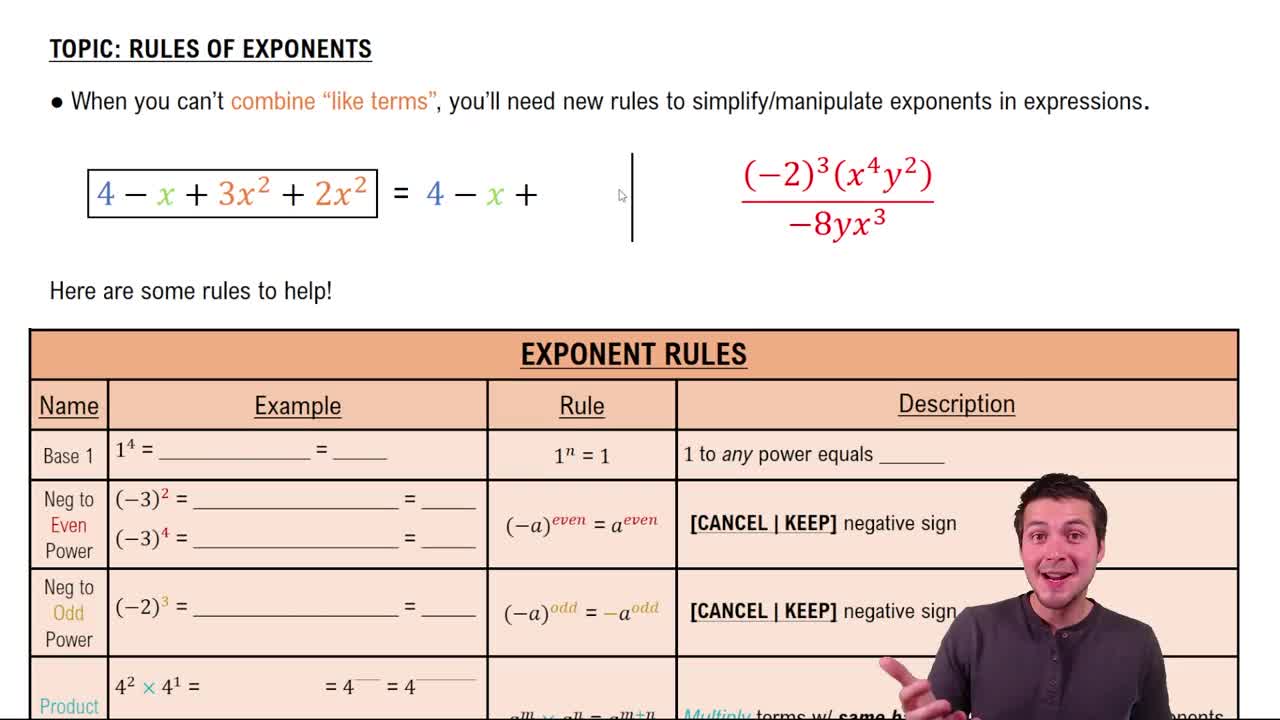
An exponent indicates how many times a base number is multiplied by itself. For example, a^n means multiplying 'a' by itself 'n' times. Understanding this helps in evaluating expressions like (-3)^3, which means (-3) × (-3) × (-3).
When a negative number is raised to a power, the sign of the result depends on whether the exponent is even or odd. An odd exponent results in a negative product, while an even exponent results in a positive product. For instance, (-3)^3 is negative, but (-2)^2 is positive.
When multiplying exponential expressions with different bases, calculate each power separately first, then multiply the results. For example, evaluate (-3)^3 and (-2)^2 individually, then multiply the two values to get the final answer.

 1:44 minutes
 Verified step by step guidance
 04:10
04:10