Write each equation in its equivalent logarithmic form. 132 = x
Ch. 4 - Exponential and Logarithmic Functions

Chapter 5, Problem 15
Write each equation in its equivalent exponential form. log3 81 = y
Verified step by step guidance1
Recall the definition of logarithm: \( \log_b a = c \) means \( b^c = a \).
Identify the base \( b \), the result \( a \), and the logarithm value \( c \) from the equation \( \log_3 81 = y \). Here, \( b = 3 \), \( a = 81 \), and \( c = y \).
Rewrite the logarithmic equation \( \log_3 81 = y \) in its equivalent exponential form using the definition: \( 3^y = 81 \).
This expresses the original logarithmic equation as an exponential equation, which is the required equivalent form.
You can verify this by recognizing that \( 81 \) is a power of \( 3 \), but the problem only asks for the equivalent exponential form, so no further calculation is needed.

Verified video answer for a similar problem:
This video solution was recommended by our tutors as helpful for the problem above.
Video duration:
1mWas this helpful?
Key Concepts
Here are the essential concepts you must grasp in order to answer the question correctly.
Definition of Logarithms
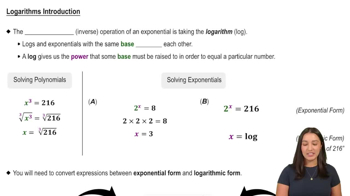
A logarithm answers the question: to what exponent must the base be raised to produce a given number? For example, log3 81 = y means 3 raised to the power y equals 81. Understanding this definition is essential to convert between logarithmic and exponential forms.
Recommended video:
Logarithms Introduction
Exponential Form of a Logarithmic Equation
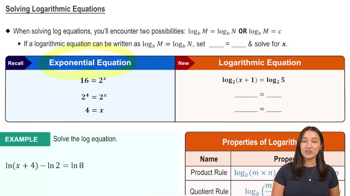
The exponential form of a logarithmic equation log_b a = c is b^c = a. This conversion is fundamental because it allows solving logarithmic equations by rewriting them as exponential equations, making it easier to find unknown exponents or values.
Recommended video:
Solving Logarithmic Equations
Properties of Exponents and Powers
Recognizing powers of numbers helps simplify and solve equations. For instance, knowing that 81 = 3^4 allows you to rewrite log3 81 = y as 3^y = 3^4, leading to y = 4. Familiarity with exponent rules aids in identifying equivalent expressions.
Recommended video:
Powers of i
Related Practice
Textbook Question
983
views
Textbook Question
Use properties of logarithms to expand each logarithmic expression as much as possible. Where possible, evaluate logarithmic expressions without using a calculator. ln(e2/5)
1188
views
Textbook Question
Graph each function by making a table of coordinates. If applicable, use a graphing utility to confirm your hand-drawn graph. g(x) = (3/2)x
965
views
Textbook Question
Graph each function by making a table of coordinates. If applicable, use a graphing utility to confirm your hand-drawn graph. h(x) = (1/2)x
909
views
Textbook Question
Solve each exponential equation in Exercises 1–22 by expressing each side as a power of the same base and then equating exponents. 31-x=1/27
986
views
Textbook Question
Solve each exponential equation in Exercises 1–22 by expressing each side as a power of the same base and then equating exponents. 6(x−3)/4=√6
622
views