Ch. 6 - Matrices and Determinants
Blitzer - College Algebra 8th Edition
Blitzer8th EditionCollege AlgebraISBN: 9780136970514Not the one you use?Change textbook
Chapter 7, Problem 33

Solve each system of equations using matrices. Use Gaussian elimination with back-substitution or Gauss-Jordan elimination.
{2x+2y+7z=12x+y+2z=24x+6y+z=15\(\begin{cases}\)2x + 2y + 7z = -1 \\2x + y + 2z = 2 \\4x + 6y + z = 15\(\end{cases}\)

Verified step by step guidance
1
Write the system of equations as an augmented matrix. For the system: \[\begin{cases} 2x + 2y + 7z = -1 \\ 2x + y + 2z = 2 \\ 4x + 6y + z = 15 \end{cases}\] The augmented matrix is: \[\left[ \begin{array}{ccc|c} 2 & 2 & 7 & -1 \\ 2 & 1 & 2 & 2 \\ 4 & 6 & 1 & 15 \end{array} \right]\]
Use Gaussian elimination to transform the matrix into an upper triangular form. Start by using the first row to eliminate the \(x\)-terms in the second and third rows. For example, subtract the first row from the second row, and subtract twice the first row from the third row.
Continue the elimination process to get zeros below the pivot in the second column. Use the second row to eliminate the \(y\)-term in the third row by appropriate row operations.
Once the matrix is in upper triangular form, write the corresponding system of equations from the matrix. This system will have the form: \[\begin{cases} a_{11}x + a_{12}y + a_{13}z = b_1 \\ 0 + a_{22}y + a_{23}z = b_2 \\ 0 + 0 + a_{33}z = b_3 \end{cases}\]
Use back-substitution to solve for \(z\) from the third equation, then substitute \(z\) into the second equation to solve for \(y\), and finally substitute \(y\) and \(z\) into the first equation to solve for \(x\).

Verified video answer for a similar problem:

This video solution was recommended by our tutors as helpful for the problem above.
Video duration:
7m
Was this helpful?

Key Concepts

Here are the essential concepts you must grasp in order to answer the question correctly.

Systems of Linear Equations

A system of linear equations consists of multiple linear equations involving the same set of variables. The goal is to find values for the variables that satisfy all equations simultaneously. Understanding how to represent and interpret these systems is fundamental before applying matrix methods.
Recommended video:
Guided course
4:27
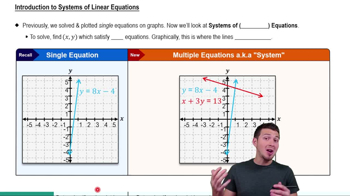
Introduction to Systems of Linear Equations

Matrix Representation of Systems

Systems of linear equations can be expressed in matrix form as AX = B, where A is the coefficient matrix, X is the column matrix of variables, and B is the constants matrix. This representation simplifies the use of matrix operations to solve the system efficiently.
Recommended video:
Guided course
6:19
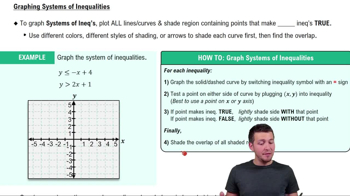
Systems of Inequalities

Gaussian Elimination and Gauss-Jordan Elimination

Gaussian elimination transforms the augmented matrix into an upper triangular form to solve via back-substitution, while Gauss-Jordan elimination reduces it further to reduced row-echelon form for direct solution. Both methods use row operations to systematically solve linear systems.
Recommended video:
Guided course
6:48
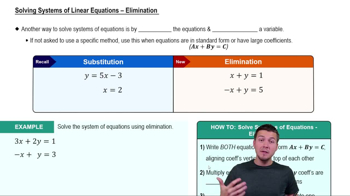
Solving Systems of Equations - Elimination
Related Practice
Textbook Question

In Exercises 31–36, use the alternative method for evaluating third-order determinants on here to evaluate each determinant. 1561451910\(\begin{vmatrix}\)1 & 5 & 6 \\1 & 4 & 5 \\1 & 9 & 10\(\end{vmatrix}\)

775
views
Textbook Question

Write each matrix equation as a system of linear equations without matrices.

[201030110][xyz]=[695]\(\begin{bmatrix}\)2 & 0 & -1 \\0 & 3 & 0 \\1 & 1 & 0\(\end{bmatrix}\[\begin{bmatrix}\)x \(\y\) \(\z\]\end{bmatrix}\)=\(\begin{bmatrix}\)6 \\9 \\5\(\end{bmatrix}\)

586
views
Textbook Question

Solve each system of equations using matrices. Use Gaussian elimination with back-substitution or Gauss-Jordan elimination.

{w+x+y+z=42w+x2yz=0w2xy2z=23w+2x+y+3z=4\(\begin{cases}\)w + x + y + z = 4 \\2w + x - 2y - z = 0 \(\w\) - 2x - y - 2z = -2 \\3w + 2x + y + 3z = 4\(\end{cases}\)

926
views
Textbook Question

In Exercises 27 - 36, find (if possible) the following matrices: a. AB b. BA 1 - 1 4 1 1 0 A = 4 - 1 3 B = 1 2 4 2 0 - 2 1 - 1 3

142
views
Textbook Question

In Exercises 27 - 36, find (if possible) the following matrices: a. AB b. BA 4 2 2 3 4 A = 6 1 B = 3 5 - 1 - 2 0

920
views
Textbook Question

Write each matrix equation as a system of linear equations without matrices.

[4723][xy]=[31]\(\begin{bmatrix}\)4 & -7 \\2 & -3\(\end{bmatrix}\[\begin{bmatrix}\)x \(\y\]\end{bmatrix}\)=\(\begin{bmatrix}\)-3 \\1\(\end{bmatrix}\)

624
views