Determine whether each equation is true or false. Where possible, show work to support your conclusion. If the statement is false, make the necessary change(s) to produce a true statement.
Ch. 4 - Exponential and Logarithmic Functions

Chapter 5, Problem 100
Evaluate or simplify each expression without using a calculator. 10log ∛x
Verified step by step guidance1
Recognize that the expression is \(10^{(\log \sqrt[3]{x})}\), where \(\log\) denotes the logarithm base 10.
Recall the property of logarithms and exponents: \(a^{\log_a b} = b\). Here, the base of the exponent and the base of the logarithm are both 10, so this property applies.
Rewrite the expression inside the logarithm: \(\sqrt[3]{x} = x^{\frac{1}{3}}\).
Apply the logarithm power rule: \(\log(x^{\frac{1}{3}}) = \frac{1}{3} \log x\).
Use the exponent and logarithm property to simplify: \(10^{\log \sqrt[3]{x}} = 10^{\frac{1}{3} \log x} = (10^{\log x})^{\frac{1}{3}} = x^{\frac{1}{3}}\).

Verified video answer for a similar problem:
This video solution was recommended by our tutors as helpful for the problem above.
Video duration:
1mWas this helpful?
Key Concepts
Here are the essential concepts you must grasp in order to answer the question correctly.
Properties of Logarithms
Logarithms have specific properties that simplify expressions, such as the power rule: log(a^b) = b·log(a). Understanding these properties allows you to rewrite and simplify complex logarithmic expressions effectively.
Recommended video:
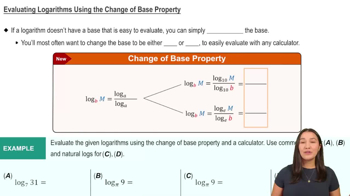
Change of Base Property
Relationship Between Exponents and Logarithms
Exponents and logarithms are inverse operations. For example, 10^(log x) = x when the log base is 10. This inverse relationship helps simplify expressions where an exponent is a logarithm.
Recommended video:
Guided course
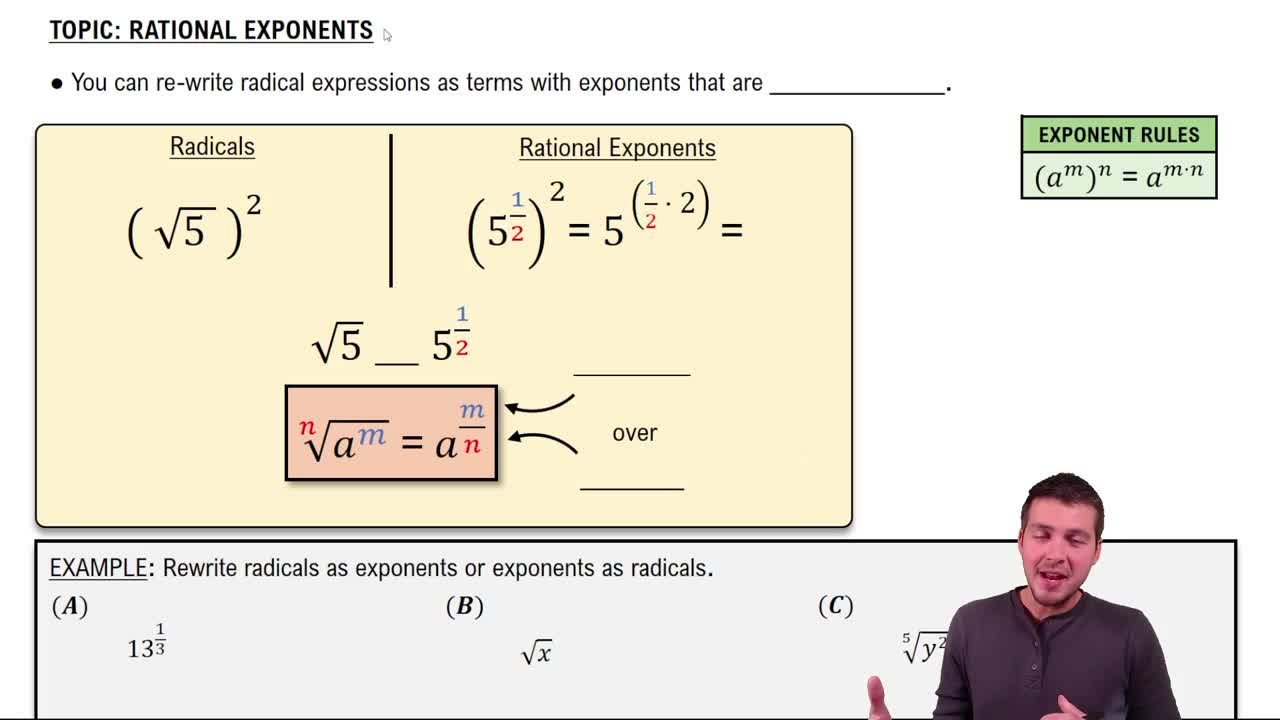
Rational Exponents
Simplifying Radicals and Fractional Exponents
Radicals like ∛x can be expressed as fractional exponents (x^(1/3)). Converting radicals to fractional exponents makes it easier to apply logarithmic and exponential rules during simplification.
Recommended video:
Guided course
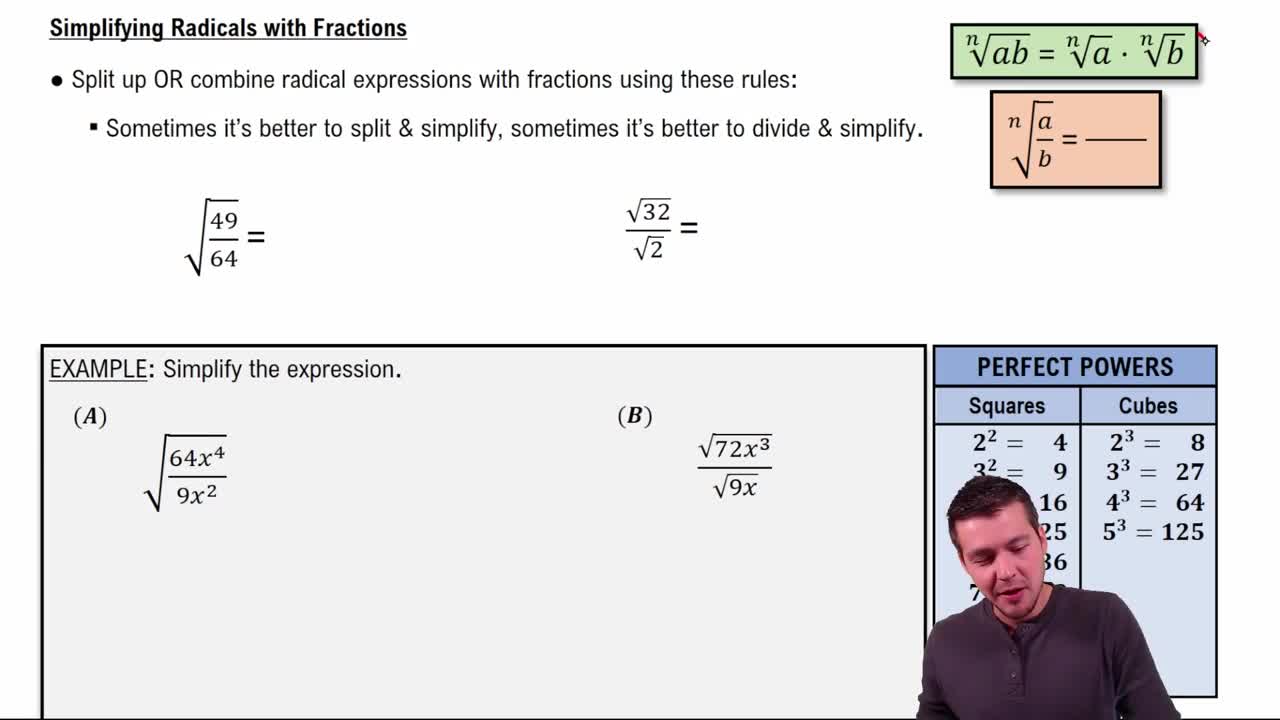
Radical Expressions with Fractions
Related Practice
Textbook Question
907
views
Textbook Question
Solve each equation. ln 3−ln(x+5)−ln x=0
733
views
Textbook Question
Determine whether each equation is true or false. Where possible, show work to support your conclusion. If the statement is false, make the necessary change(s) to produce a true statement. log3 (7) = 1/[log7 (3)]
744
views
Textbook Question
Solve each equation.
697
views
Textbook Question
Determine whether each equation is true or false. Where possible, show work to support your conclusion. If the statement is false, make the necessary change(s) to produce a true statement. log6 [4(x + 1)] = log6 (4) + log6 (x + 1)
768
views
Textbook Question
Write each equation in its equivalent exponential form. Then solve for x. log3 (x-1) = 2
994
views