Exercises 27–40 contain linear equations with constants in denominators. Solve each equation. 3x/5 - (x - 3)/2 = (x + 2)/3
Ch. 1 - Equations and Inequalities

Chapter 2, Problem 41
Exercises 41–60 contain rational equations with variables in denominators. For each equation, a. write the value or values of the variable that make a denominator zero. These are the restrictions on the variable. b. Keeping the restrictions in mind, solve the equation. 4/x = 5/2x + 3
Verified step by step guidance1
Identify the denominators in the equation \(\frac{4}{x} = \frac{5}{2x + 3}\). The denominators are \(x\) and \$2x + 3$.
Find the values of \(x\) that make the denominators zero to determine the restrictions. Solve \(x = 0\) and \$2x + 3 = 0$ separately.
From \$2x + 3 = 0\(, solve for \)x\( by isolating \)x\(: \)2x = -3\(, so \(x = -\frac{3}{2}\). These values (\)x = 0$ and \(x = -\frac{3}{2}\)) are restrictions and cannot be solutions.
Multiply both sides of the original equation by the least common denominator (LCD), which is \(x(2x + 3)\), to eliminate the denominators. This gives: \$4(2x + 3) = 5x$.
Expand and simplify the resulting equation, then solve for \(x\). After finding the solutions, check each against the restrictions to ensure they are valid.

Verified video answer for a similar problem:
This video solution was recommended by our tutors as helpful for the problem above.
Video duration:
3mWas this helpful?
Key Concepts
Here are the essential concepts you must grasp in order to answer the question correctly.
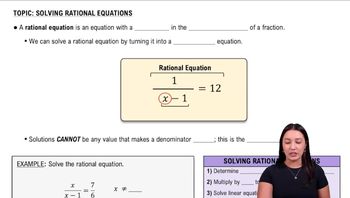
Rational Equations
Rational equations are equations that involve fractions with polynomials in the numerator and denominator. Solving them often requires finding a common denominator or multiplying both sides by the least common denominator to eliminate fractions and simplify the equation.
Recommended video:
Introduction to Rational Equations
Restrictions on the Variable
Restrictions are values of the variable that make any denominator zero, which are undefined in mathematics. Identifying these values is crucial before solving the equation to avoid invalid solutions and ensure the solution set is correct.
Recommended video:
Guided course
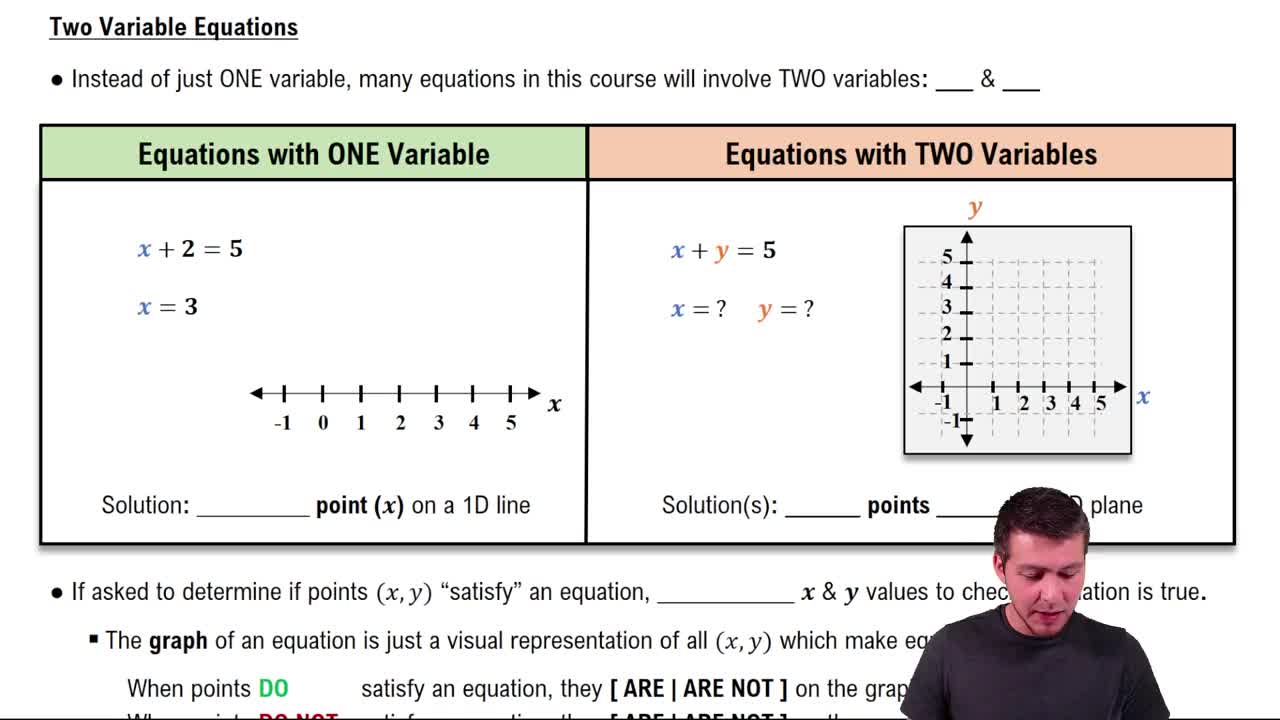
Equations with Two Variables
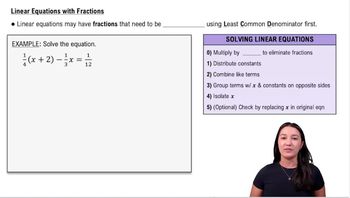
Solving Linear Equations After Clearing Denominators
Once denominators are cleared by multiplying both sides by the least common denominator, the equation becomes a linear equation. Solving this involves isolating the variable using inverse operations like addition, subtraction, multiplication, or division.
Recommended video:
Solving Linear Equations with Fractions
Related Practice
Textbook Question
778
views
Textbook Question
In Exercises 35–46, determine the constant that should be added to the binomial so that it becomes a perfect square trinomial. Then write and factor the trinomial.
977
views
Textbook Question
In Exercises 35–46, determine the constant that should be added to the binomial so that it becomes a perfect square trinomial. Then write and factor the trinomial. x2 + 3x
1236
views
Textbook Question
In Exercises 37–52, perform the indicated operations and write the result in standard form. (- 2 + √-4)2
837
views
Textbook Question
In Exercises 35–54, solve each formula for the specified variable. Do you recognize the formula? If so, what does it describe? E = mc2 for m
688
views
Textbook Question
Solve each equation with rational exponents in Exercises 31–40. Check all proposed solutions.
860
views