In Exercises 59–70, evaluate each exponential expression. (-1)^4
Verified step by step guidance
1
Identify the base and the exponent in the expression \((-1)^4\). Here, the base is \(-1\) and the exponent is \(4\).
Understand that the exponent \(4\) indicates how many times the base \(-1\) is multiplied by itself.
Calculate \((-1) \times (-1)\) to get \(1\), since multiplying two negative numbers results in a positive number.
Multiply the result \(1\) by \((-1)\) again to get \(-1\).
Finally, multiply \(-1\) by \((-1)\) to get \(1\), completing the evaluation of \((-1)^4\).
Verified video answer for a similar problem:
This video solution was recommended by our tutors as helpful for the problem above
Video duration:
1m
Play a video:
0 Comments
Key Concepts
Here are the essential concepts you must grasp in order to answer the question correctly.
Exponential Expressions
Exponential expressions involve a base raised to a power, where the base is multiplied by itself as many times as indicated by the exponent. For example, in the expression a^n, 'a' is the base and 'n' is the exponent. Understanding how to evaluate these expressions is crucial, especially when dealing with positive and negative bases.
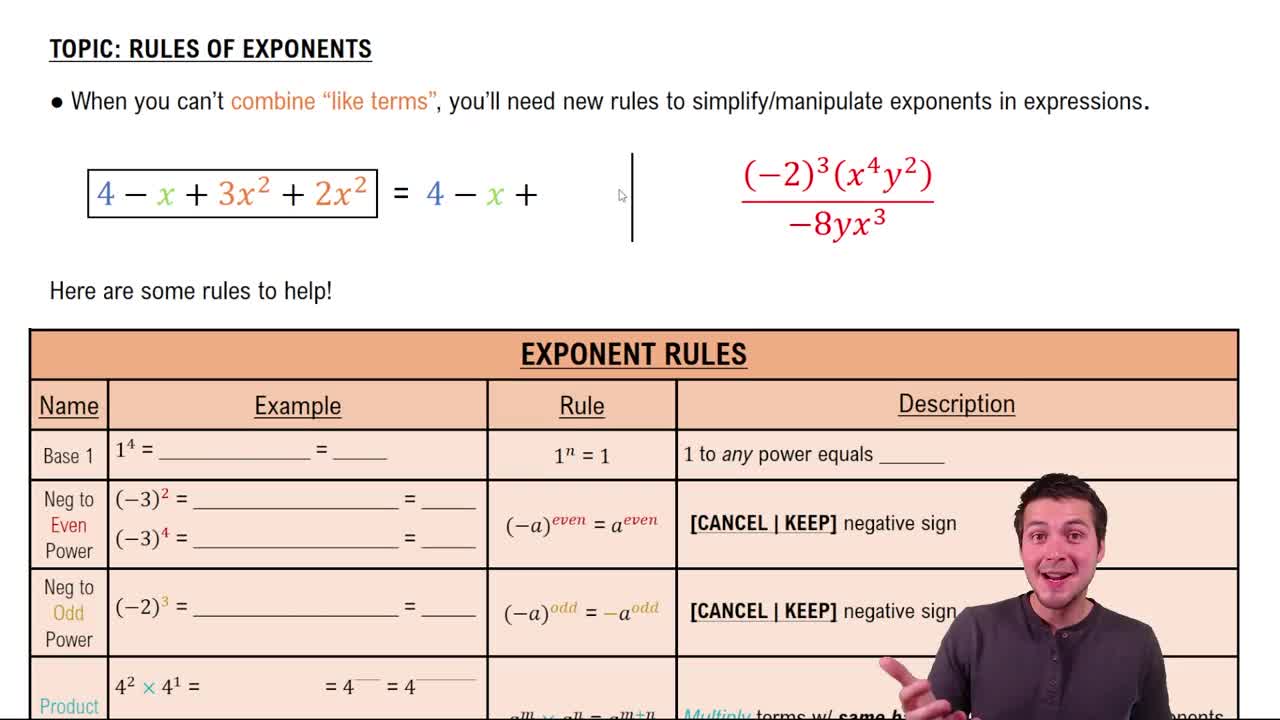
The properties of exponents are rules that simplify the process of working with exponential expressions. Key properties include the product of powers, power of a power, and the power of a product. For instance, any non-zero number raised to an even exponent results in a positive value, which is essential for evaluating expressions like (-1)^4.
The distinction between even and odd exponents is important in evaluating expressions. An even exponent means the base is multiplied by itself an even number of times, resulting in a positive outcome, while an odd exponent results in the base's sign being preserved. This concept is particularly relevant when evaluating negative bases, such as (-1) raised to any power.

 1:26 minutes
 Verified step by step guidance
 6:39
6:39