Find all zeros of the polynomial function or solve the given polynomial equation. Use the Rational Zero Theorem, Descartes's Rule of Signs, and possibly the graph of the polynomial function shown by a graphing utility as an aid in obtaining the first zero or the first root. f(x)=3x4−11x3−x2+19x+6

Solve each rational inequality in Exercises 43–60 and graph the solution set on a real number line. Express each solution set in interval notation. (−x+2)/(x−4)≥0
Verified step by step guidance
Verified video answer for a similar problem:
Key Concepts
Rational Inequalities
Critical Points and Sign Analysis
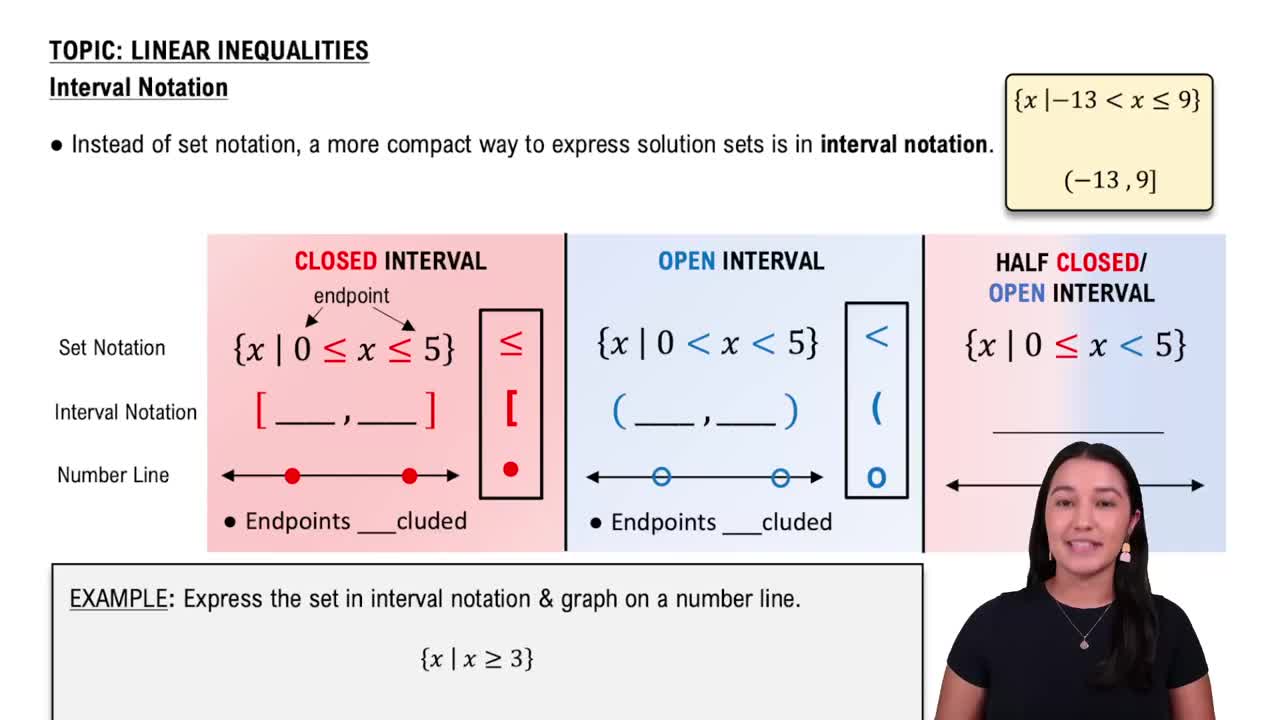
Interval Notation and Graphing Solutions
Give the domain and the range of each quadratic function whose graph is described. The vertex is and the parabola opens up.
In Exercises 45–46, describe in words the variation shown by the given equation. z = kx^2 √y
In Exercises 39–52, find all zeros of the polynomial function or solve the given polynomial equation. Use the Rational Zero Theorem, Descartes's Rule of Signs, and possibly the graph of the polynomial function shown by a graphing utility as an aid in obtaining the first zero or the first root. x4−3x3−20x2−24x−8=0
Use transformations of f(x)=1/x or f(x)=1/x2 to graph each rational function. h(x)=(1/x) + 2
In Exercises 47–48, find an nth-degree polynomial function with real coefficients satisfying the given conditions. Verify the real zeros and the given function value. n = 3; 2 and 2 - 3i are zeros; f(1) = -10
