In Exercises 35–46, determine the constant that should be added to the binomial so that it becomes a perfect square trinomial. Then write and factor the trinomial.
Ch. 1 - Equations and Inequalities

Chapter 2, Problem 43
In Exercises 36–43, use the five-step strategy for solving word problems. The length of a rectangular field is 6 yards less than triple the width. If the perimeter of the field is 340 yards, what are its dimensions?
Verified step by step guidance1
Define the variables: Let the width of the rectangular field be denoted as \( w \) (in yards). Since the length is described as 6 yards less than triple the width, the length can be expressed as \( 3w - 6 \).
Recall the formula for the perimeter of a rectangle: \( P = 2 \times \text{length} + 2 \times \text{width} \). Substitute the given perimeter (340 yards) and the expressions for length and width into the formula: \( 340 = 2(3w - 6) + 2w \).
Simplify the equation: Distribute and combine like terms. Start by expanding \( 2(3w - 6) \) to get \( 6w - 12 \). Then, the equation becomes \( 340 = 6w - 12 + 2w \). Combine \( 6w \) and \( 2w \) to get \( 8w \), resulting in \( 340 = 8w - 12 \).
Solve for \( w \): Add 12 to both sides to isolate the term with \( w \), giving \( 352 = 8w \). Then, divide both sides by 8 to find \( w \).
Find the dimensions: Once \( w \) (the width) is determined, substitute it back into the expression for the length, \( 3w - 6 \), to calculate the length. The dimensions of the field are the width and the length.

Verified video answer for a similar problem:
This video solution was recommended by our tutors as helpful for the problem above.
Video duration:
3mWas this helpful?
Key Concepts
Here are the essential concepts you must grasp in order to answer the question correctly.
Perimeter of a Rectangle
The perimeter of a rectangle is the total distance around the rectangle, calculated by the formula P = 2L + 2W, where L is the length and W is the width. Understanding this formula is essential for solving problems related to the dimensions of rectangular shapes, as it allows you to relate the length and width to the given perimeter.
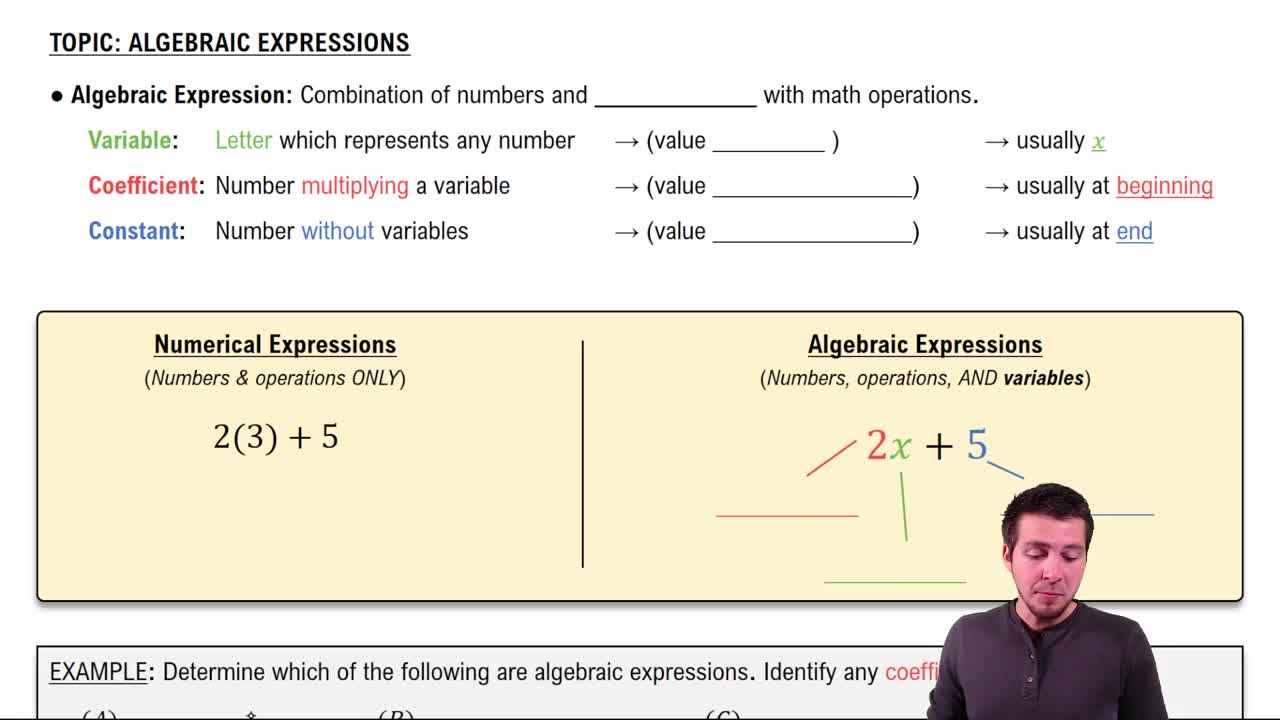
Algebraic Expressions
Algebraic expressions are mathematical phrases that can include numbers, variables, and operations. In this problem, the relationship between the length and width is expressed as L = 3W - 6. Recognizing how to form and manipulate these expressions is crucial for setting up equations that represent the problem's conditions.
Recommended video:
Guided course
Introduction to Algebraic Expressions
Solving Linear Equations
Solving linear equations involves finding the value of variables that satisfy the equation. In this context, once the perimeter equation is set up using the expressions for length and width, you will need to solve for W and then use that value to find L. Mastery of this concept is vital for determining the dimensions of the field.
Recommended video:
Solving Linear Equations with Fractions
Related Practice
Textbook Question
956
views
Textbook Question
Use the graph to a. determine the x-intercepts, if any; b. determine the y-intercepts, if any. For each graph, tick marks along the axes represent one unit each.
1371
views
Textbook Question
Solve and check: 24 + 3 (x + 2) = 5(x − 12).
873
views
Textbook Question
In Exercises 37–52, perform the indicated operations and write the result in standard form. (- 3 - √-7)2
830
views
Textbook Question
Exercises 41–60 contain rational equations with variables in denominators. For each equation, a. write the value or values of the variable that make a denominator zero. These are the restrictions on the variable. b. Keeping the restrictions in mind, solve the equation. 7/2x - 5/3x = 22/3
844
views
Textbook Question
Solve each equation in Exercises 41–60 by making an appropriate substitution.
720
views