In Exercises 19–24, (a) Use the Leading Coefficient Test to determine the graph's end behavior. (b) Determine whether the graph has y-axis symmetry, origin symmetry, or neither. (c) Graph the function.
Ch. 3 - Polynomial and Rational Functions

Chapter 4, Problem 19
Write an equation that expresses each relationship. Then solve the equation for y. x varies directly as z and inversely as the difference between y and w.
Verified step by step guidance1
Identify the type of variation described: "x varies directly as z" means \(x\) is proportional to \(z\), so we can write \(x = k \cdot z\) for some constant \(k\).
The phrase "inversely as the difference between y and w" means \(x\) is inversely proportional to \((y - w)\), so we include this as a denominator: \(x = \frac{k \cdot z}{y - w}\).
Write the combined variation equation: \(x = \frac{k \cdot z}{y - w}\), where \(k\) is the constant of proportionality.
To solve for \(y\), start by multiplying both sides of the equation by \((y - w)\) to eliminate the denominator: \(x(y - w) = k \cdot z\).
Next, divide both sides by \(x\) to isolate \((y - w)\): \(y - w = \frac{k \cdot z}{x}\). Finally, add \(w\) to both sides to solve for \(y\): \(y = w + \frac{k \cdot z}{x}\).

Verified video answer for a similar problem:
This video solution was recommended by our tutors as helpful for the problem above.
Video duration:
3mWas this helpful?
Key Concepts
Here are the essential concepts you must grasp in order to answer the question correctly.
Direct Variation
Direct variation describes a relationship where one variable increases or decreases proportionally with another. If x varies directly as z, it means x = k * z for some constant k. This concept helps set up equations involving proportional relationships.
Recommended video:
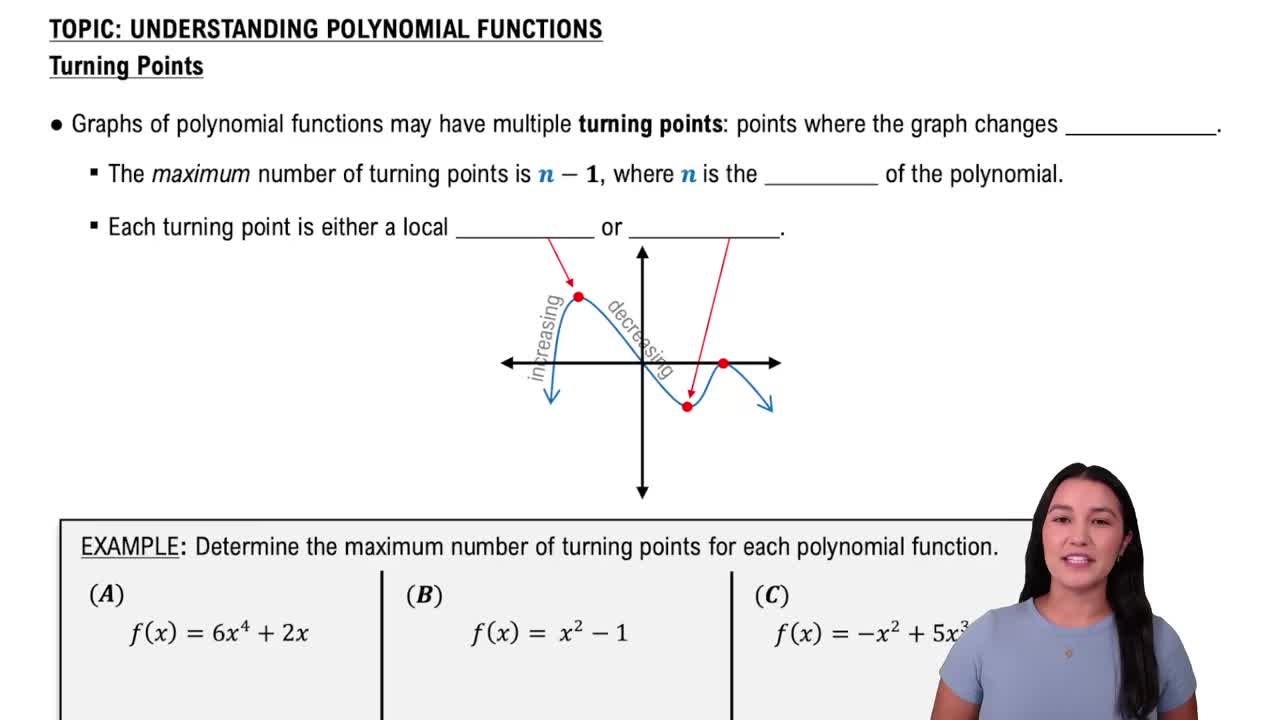
Maximum Turning Points of a Polynomial Function
Inverse Variation
Inverse variation occurs when one variable increases as another decreases, such that their product is constant. If x varies inversely as (y - w), then x = k / (y - w) for some constant k. This helps model relationships where variables are inversely related.
Recommended video:
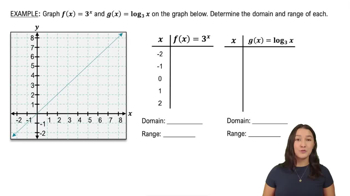
Graphing Logarithmic Functions
Solving for a Variable in an Equation
Solving for y means isolating y on one side of the equation. This involves algebraic manipulation such as multiplying both sides, adding or subtracting terms, and simplifying expressions. Mastery of these steps is essential to express y explicitly.
Recommended video:
Guided course
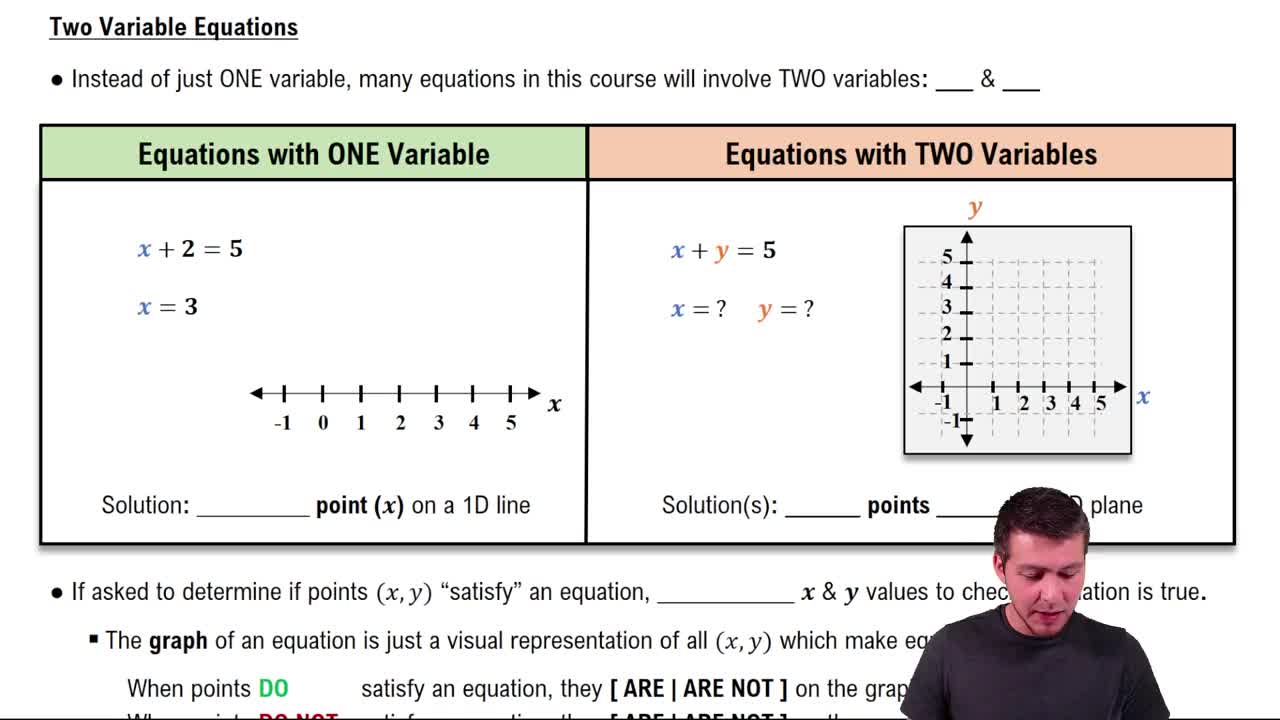
Equations with Two Variables
Related Practice
Textbook Question
969
views
Textbook Question
Divide using synthetic division. (3x2+7x−20)÷(x+5)
563
views
Textbook Question
Write an equation that expresses each relationship. Then solve the equation for y. x varies jointly as z and the difference between y and w.
561
views
Textbook Question
In Exercises 17–24, a) List all possible rational roots. b) List all possible rational roots. c) Use the quotient from part (b) to find the remaining roots and solve the equation. x3−10x−12=0
863
views
Textbook Question
Use the vertex and intercepts to sketch the graph of each quadratic function. Give the equation of the parabola's axis of symmetry. Use the graph to determine the function's domain and range. f(x)=(x−1)2+2
838
views
Textbook Question
Solve each polynomial inequality in Exercises 1–42 and graph the solution set on a real number line. Express each solution set in interval notation.
507
views