In Exercises 1–16, divide using long division. State the quotient, and the remainder, r(x). (6x3+13x2−11x−15)/(3x2−x−3)
Ch. 3 - Polynomial and Rational Functions

Chapter 4, Problem 13
Write an equation that expresses each relationship. Then solve the equation for y. x varies directly as the cube of z and inversely as y.
Verified step by step guidance1
Identify the given variation relationship: "x varies directly as the cube of z and inversely as y." This means x is proportional to \( z^3 \) and inversely proportional to \( y \).
Write the variation equation using a constant of proportionality \( k \):
\[ x = \frac{k \cdot z^3}{y} \]
To solve for \( y \), multiply both sides of the equation by \( y \) to get rid of the denominator:
\[ x \cdot y = k \cdot z^3 \]
Next, isolate \( y \) by dividing both sides by \( x \):
\[ y = \frac{k \cdot z^3}{x} \]
The equation is now solved for \( y \) in terms of \( x \), \( z \), and the constant \( k \).

Verified video answer for a similar problem:
This video solution was recommended by our tutors as helpful for the problem above.
Video duration:
1mWas this helpful?
Key Concepts
Here are the essential concepts you must grasp in order to answer the question correctly.
Direct Variation
Direct variation describes a relationship where one variable is proportional to another. If x varies directly as the cube of z, it means x = k * z³ for some constant k, indicating that as z increases, x changes proportionally to z cubed.
Recommended video:
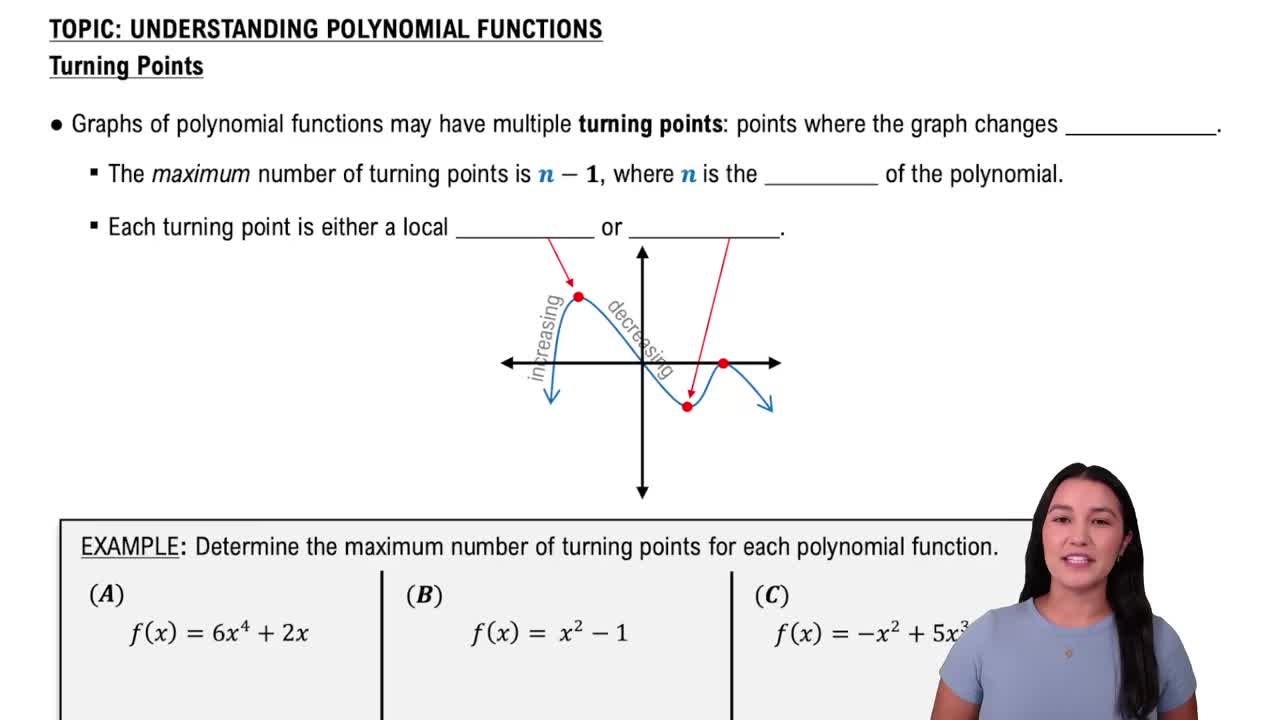
Maximum Turning Points of a Polynomial Function
Inverse Variation
Inverse variation means one variable changes in the opposite way to another. Here, x varies inversely as y, so x = k / y, implying that as y increases, x decreases proportionally, and vice versa.
Recommended video:
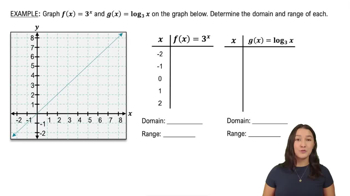
Graphing Logarithmic Functions
Solving for a Variable in an Equation
Solving for y involves manipulating the equation algebraically to isolate y on one side. This requires understanding how to rearrange terms, use inverse operations, and simplify expressions to express y explicitly in terms of x and z.
Recommended video:
Guided course
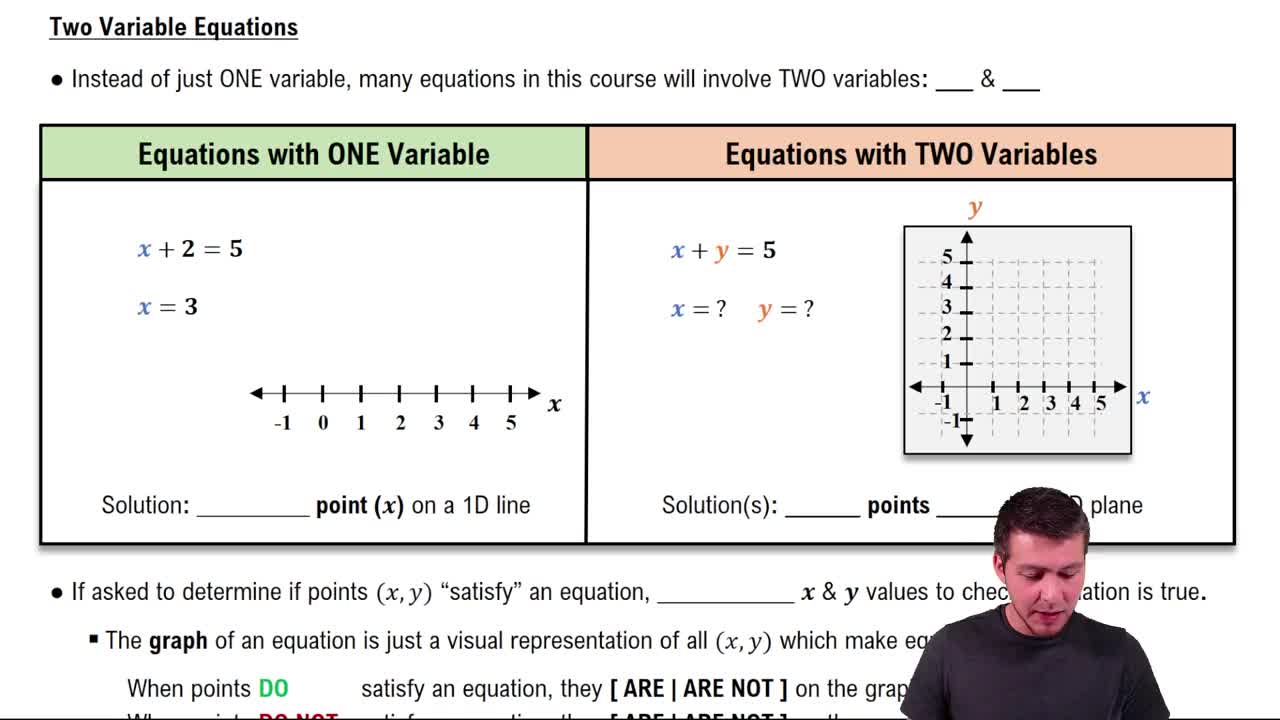
Equations with Two Variables
Related Practice
Textbook Question
449
views
Textbook Question
Find the coordinates of the vertex for the parabola defined by the given quadratic function. f(x)=2x2−8x+3
1194
views
Textbook Question
Use the graph of the rational function in the figure shown to complete each statement in Exercises 9–14.
As _____
1390
views
1
rank
Textbook Question
Divide using long division. State the quotient, and the remainder, r(x). (x4−81)/(x−3)
549
views
Textbook Question
In Exercises 9–16, a) List all possible rational zeros. b) Use synthetic division to test the possible rational zeros and find an actual zero. c) Use the quotient from part (b) to find the remaining zeros of the polynomial function.
442
views
Textbook Question
Solve each polynomial inequality in Exercises 1–42 and graph the solution set on a real number line. Express each solution set in interval notation. 2x2+x<15
505
views