Recall the property of exponents that states when dividing powers with the same base, you subtract the exponents: \(\frac{a^m}{a^n} = a^{m-n}\).
Identify the base and the exponents in the expression \(\frac{3^3}{3^6}\). Here, the base is 3, the numerator exponent is 3, and the denominator exponent is 6.
Apply the exponent subtraction rule: \(\frac{3^3}{3^6} = 3^{3-6}\).
Simplify the exponent by performing the subtraction: \$3^{3-6} = 3^{-3}$.
Recognize that a negative exponent means the reciprocal: \$3^{-3} = \frac{1}{3^3}$. This is the simplified form of the expression.
Verified video answer for a similar problem:
This video solution was recommended by our tutors as helpful for the problem above
Video duration:
1m
Play a video:
0 Comments
Key Concepts
Here are the essential concepts you must grasp in order to answer the question correctly.
Properties of Exponents
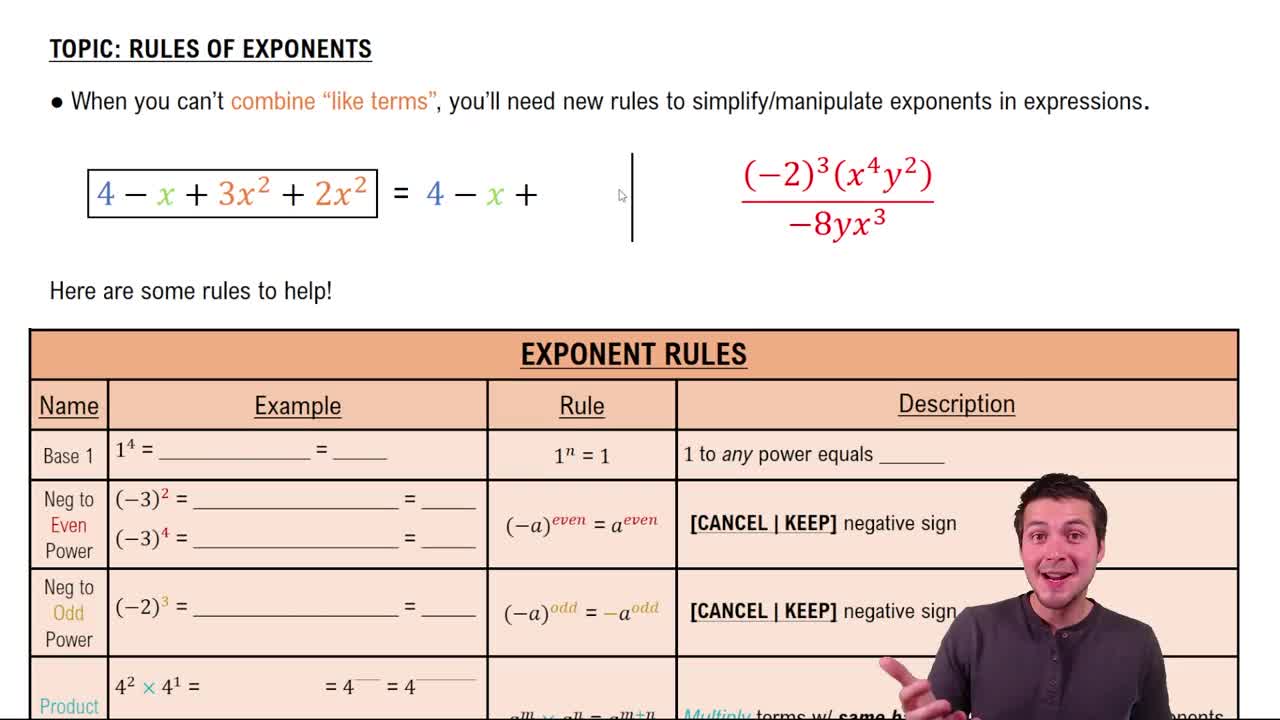
Exponents follow specific rules that simplify expressions, such as when dividing powers with the same base, you subtract the exponents. For example, (a^m)/(a^n) = a^(m-n). This property helps in reducing complex exponential expressions efficiently.
When working with exponential expressions, the base must be the same to apply exponent rules like multiplication or division. In the given problem, both numerator and denominator have base 3, allowing the use of exponent subtraction.
After simplifying the exponent expression, you may need to calculate the numerical value by raising the base to the resulting exponent. For example, 3^(3-6) = 3^(-3), which equals 1/(3^3) = 1/27.