Ch. P - Fundamental Concepts of Algebra
Blitzer - College Algebra 8th Edition
Blitzer8th EditionCollege AlgebraISBN: 9780136970514Not the one you use?Change textbook
Chapter 1, Problem 68

Evaluate each expression 27^(-4/3)

Verified step by step guidance
1
Rewrite the expression using the property of exponents for negative powers: a^(-n) = 1/(a^n). This gives 27^(-4/3) = 1/(27^(4/3)).
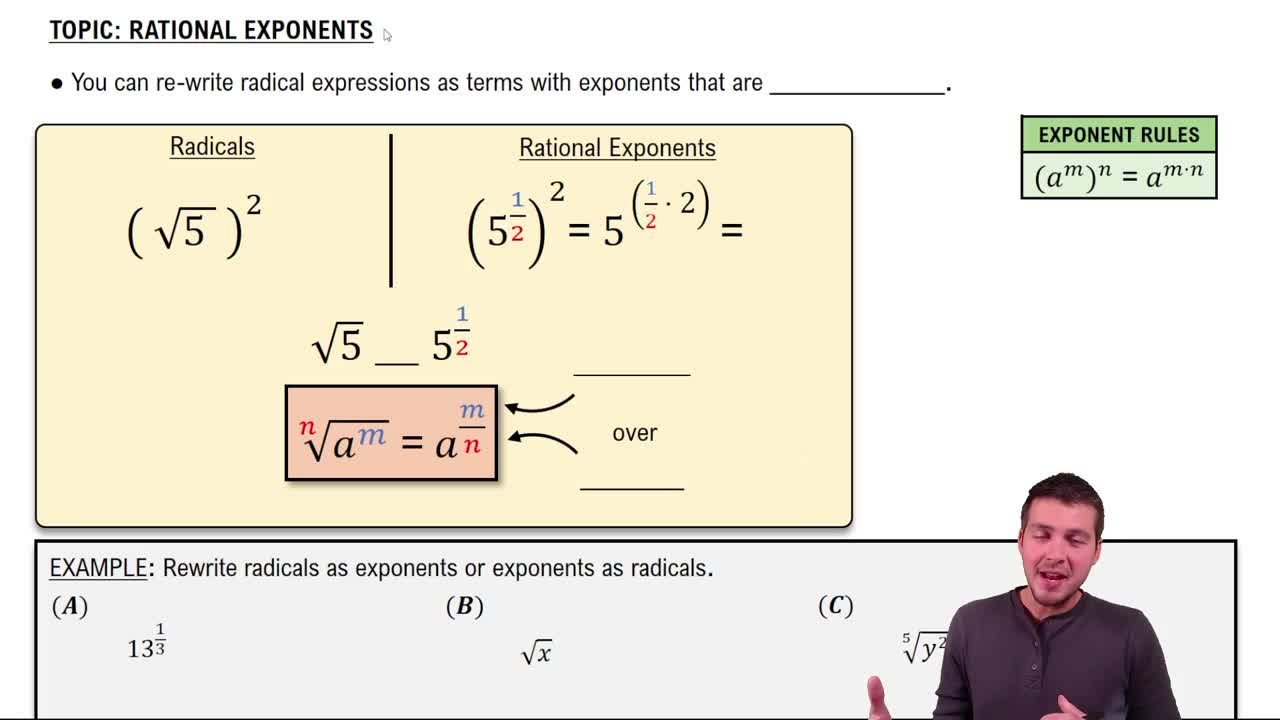
Recognize that the fractional exponent 4/3 can be broken into two parts: the denominator (3) represents a cube root, and the numerator (4) represents raising to the fourth power. So, 27^(4/3) = (27^(1/3))^4.
Find the cube root of 27. Since 27 = 3^3, the cube root of 27 is 3. Therefore, 27^(1/3) = 3.
Raise the result from the previous step to the fourth power. This means (27^(1/3))^4 = 3^4.
Substitute the result back into the original expression: 1/(27^(4/3)) = 1/(3^4). Simplify further if needed.

Verified video answer for a similar problem:

This video solution was recommended by our tutors as helpful for the problem above.
Video duration:
57s
Was this helpful?

Key Concepts

Here are the essential concepts you must grasp in order to answer the question correctly.

Exponents and Rational Exponents

Exponents represent repeated multiplication of a base number. Rational exponents, such as -4/3, indicate both a root and a power. The numerator indicates the power, while the denominator indicates the root. For example, 27^(-4/3) can be interpreted as 1/(27^(4/3)), which involves taking the cube root of 27 and then raising it to the fourth power.
Recommended video:
Guided course
04:06
Rational Exponents

Negative Exponents

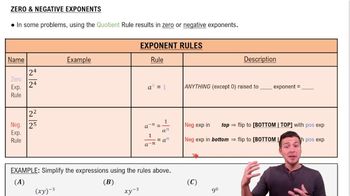
Negative exponents indicate the reciprocal of the base raised to the corresponding positive exponent. For instance, a^(-n) is equivalent to 1/(a^n). In the expression 27^(-4/3), the negative exponent means we will first evaluate 27^(4/3) and then take the reciprocal of that result, which is essential for simplifying the expression correctly.
Recommended video:
Guided course
6:37
Zero and Negative Rules

Evaluating Roots

Evaluating roots involves finding a number that, when raised to a specific power, yields the original number. In the case of 27^(1/3), we are looking for a number that, when cubed, equals 27. This number is 3, as 3^3 = 27. Understanding how to evaluate roots is crucial for simplifying expressions with rational exponents.
Recommended video:
02:20
Imaginary Roots with the Square Root Property