Determine whether each function graphed or defined is one-to-one. y = x+4 / x-3
Verified step by step guidance
1
Recall that a function is one-to-one if and only if each output corresponds to exactly one input. This means the function passes the Horizontal Line Test: no horizontal line intersects the graph more than once.
Given the function \(y = \frac{x+4}{x-3}\), identify its domain. Note that the denominator cannot be zero, so \(x \neq 3\).
To check if the function is one-to-one algebraically, assume \(y = \frac{x+4}{x-3}\) and solve for \(x\) in terms of \(y\). This involves cross-multiplying to get \(y(x-3) = x + 4\).
Rearrange the equation to isolate \(x\): \(yx - 3y = x + 4\) which can be rewritten as \(yx - x = 3y + 4\). Factor \(x\) out: \(x(y - 1) = 3y + 4\).
Solve for \(x\): \(x = \frac{3y + 4}{y - 1}\). Since for each \(y\) (except \(y=1\)) there is exactly one \(x\), the function is one-to-one on its domain excluding any values that cause division by zero in this inverse expression.
Verified video answer for a similar problem:
This video solution was recommended by our tutors as helpful for the problem above
Video duration:
3m
Play a video:
0 Comments
Key Concepts
Here are the essential concepts you must grasp in order to answer the question correctly.
One-to-One Function
A function is one-to-one if each output corresponds to exactly one input, meaning no two different inputs produce the same output. This property ensures the function has an inverse. To test this, you can use the Horizontal Line Test on the graph or algebraically check if f(a) = f(b) implies a = b.
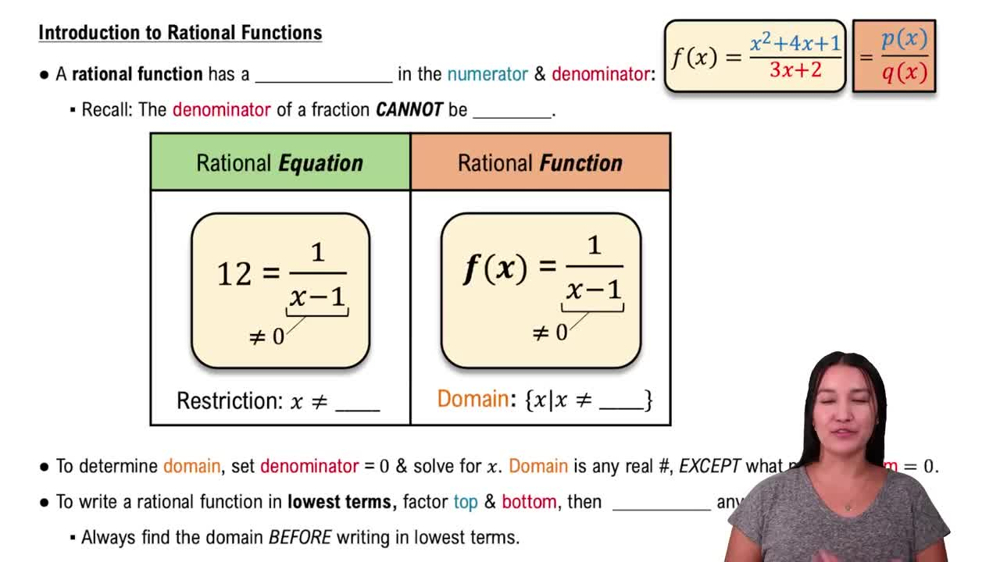
A rational function is a ratio of two polynomials, such as y = (x + 4) / (x - 3). These functions can have vertical asymptotes where the denominator is zero and may have restrictions on the domain. Understanding their behavior helps in analyzing their graphs and determining properties like one-to-one.
The Horizontal Line Test is a graphical method to determine if a function is one-to-one. If any horizontal line intersects the graph more than once, the function is not one-to-one. This test helps visually confirm whether the function passes the one-to-one criterion.

 3:54 minutes
 Verified step by step guidance
 4:07
4:07