Start by distributing the factor \(-\frac{1}{4}\) to each term inside the parentheses: \(-\frac{1}{4} \times 20m\), \(-\frac{1}{4} \times 8y\), and \(-\frac{1}{4} \times (-32z)\).
Multiply each term separately: For \(-\frac{1}{4} \times 20m\), multiply the coefficients \(-\frac{1}{4}\) and \$20\( and keep the variable \)m$; do the same for the other terms.
Remember that multiplying two negative numbers results in a positive number, so pay attention to the sign when multiplying \(-\frac{1}{4}\) and \(-32z\).
After multiplying, write down the simplified terms: the product of \(-\frac{1}{4}\) and \$20m\(, the product of \(-\frac{1}{4}\) and \)8y\(, and the product of \(-\frac{1}{4}\) and \)-32z$.
Combine all the simplified terms to write the final simplified expression.
Verified video answer for a similar problem:
This video solution was recommended by our tutors as helpful for the problem above
Video duration:
1m
Play a video:
0 Comments
Key Concepts
Here are the essential concepts you must grasp in order to answer the question correctly.
Distributive Property
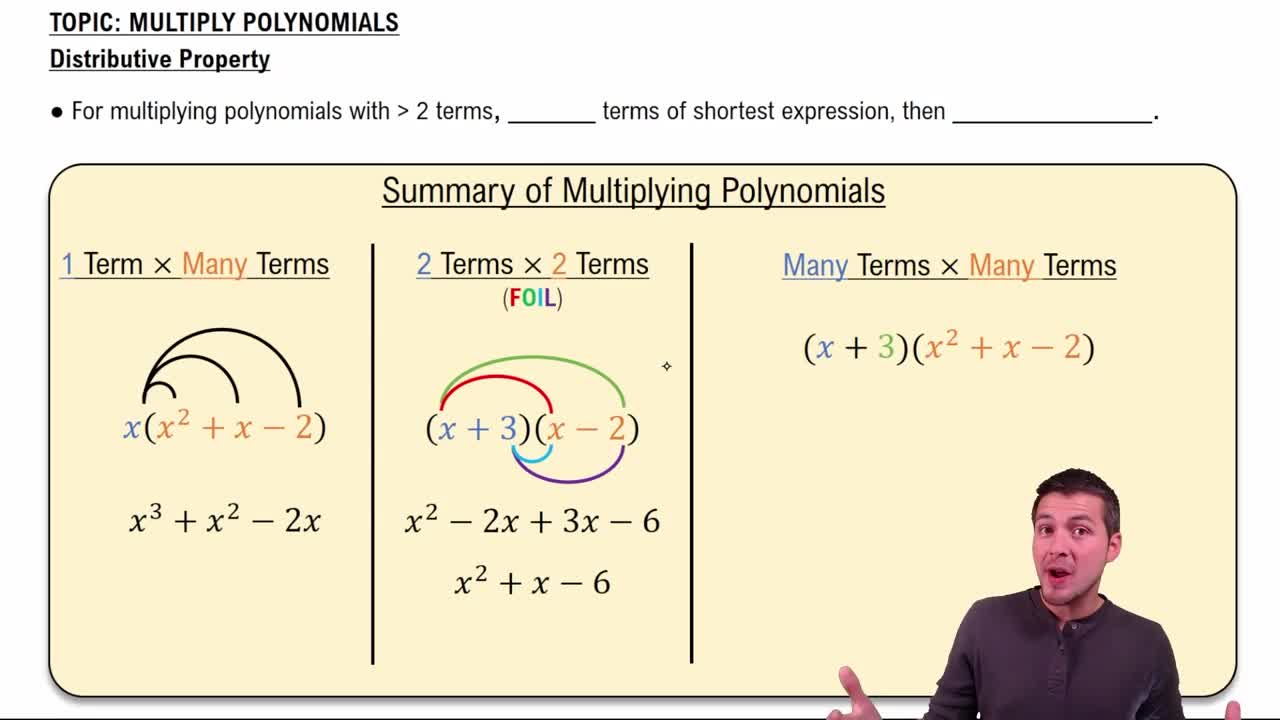
The distributive property allows you to multiply a single term outside the parentheses by each term inside the parentheses. For example, a(b + c) = ab + ac. This property is essential for simplifying expressions like -1/4(20m + 8y - 32z) by distributing -1/4 to each term.
Multiply Polynomials Using the Distributive Property
Multiplying Fractions and Variables
When multiplying a fraction by a term with variables, multiply the numerator by the term and keep the denominator. Variables remain attached to their coefficients during multiplication. For instance, (-1/4) × 20m equals (-1 × 20m)/4 = -5m.
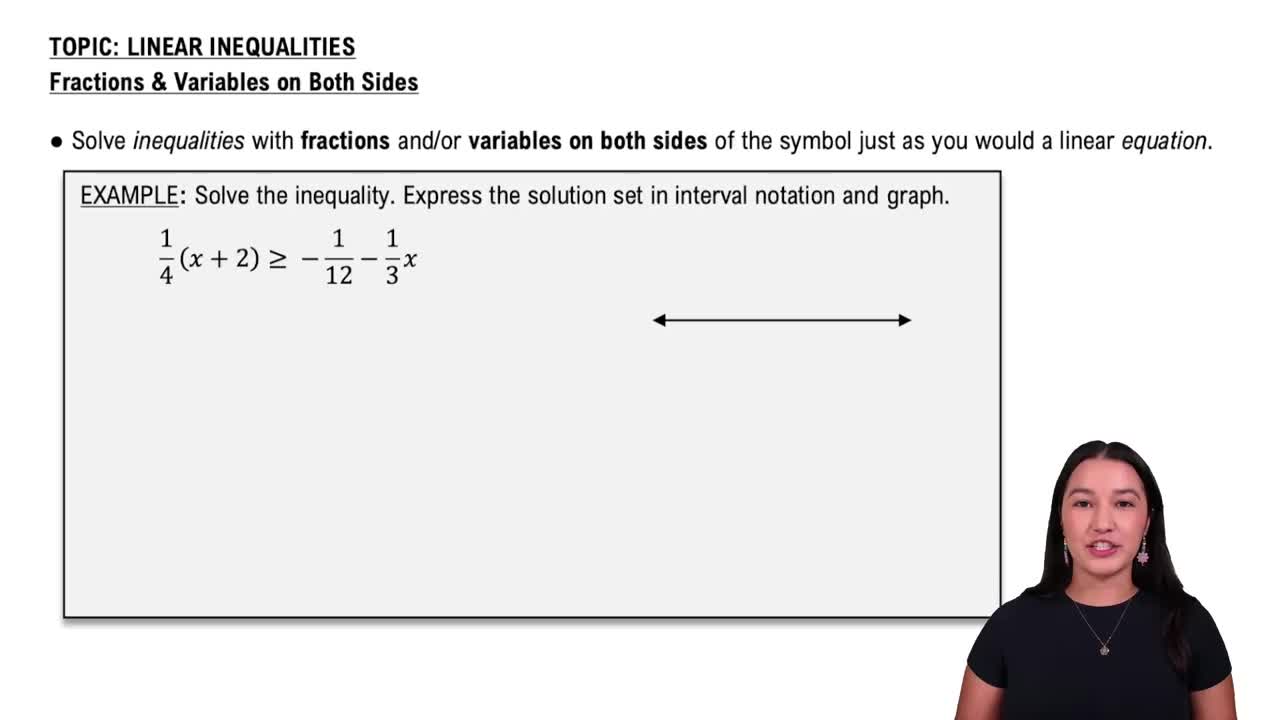
Linear Inequalities with Fractions & Variables on Both Sides
Combining Like Terms
After distributing, expressions may have terms that can be combined if they have the same variable and exponent. Combining like terms simplifies the expression further. In this problem, each term is distinct, so combining like terms may not apply, but understanding this concept is important for simplification.

 1:44 minutes
 Verified step by step guidance
 04:15
04:15