Identify the polynomial to factor: \(m^4 - 3m^2 - 10\).
Recognize that this is a quadratic form in terms of \(m^2\). Let \(x = m^2\), so the expression becomes \(x^2 - 3x - 10\).
Factor the quadratic \(x^2 - 3x - 10\) by finding two numbers that multiply to \(-10\) and add to \(-3\). These numbers are \(-5\) and \$2$.
Rewrite the factored form as \((x - 5)(x + 2)\), and substitute back \(x = m^2\) to get \((m^2 - 5)(m^2 + 2)\).
Check if either factor can be factored further. Since \(m^2 - 5\) and \(m^2 + 2\) are not perfect squares or factorable over the real numbers, the factorization is complete.
Verified video answer for a similar problem:
This video solution was recommended by our tutors as helpful for the problem above
Video duration:
3m
Play a video:
0 Comments
Key Concepts
Here are the essential concepts you must grasp in order to answer the question correctly.
Polynomial Factoring
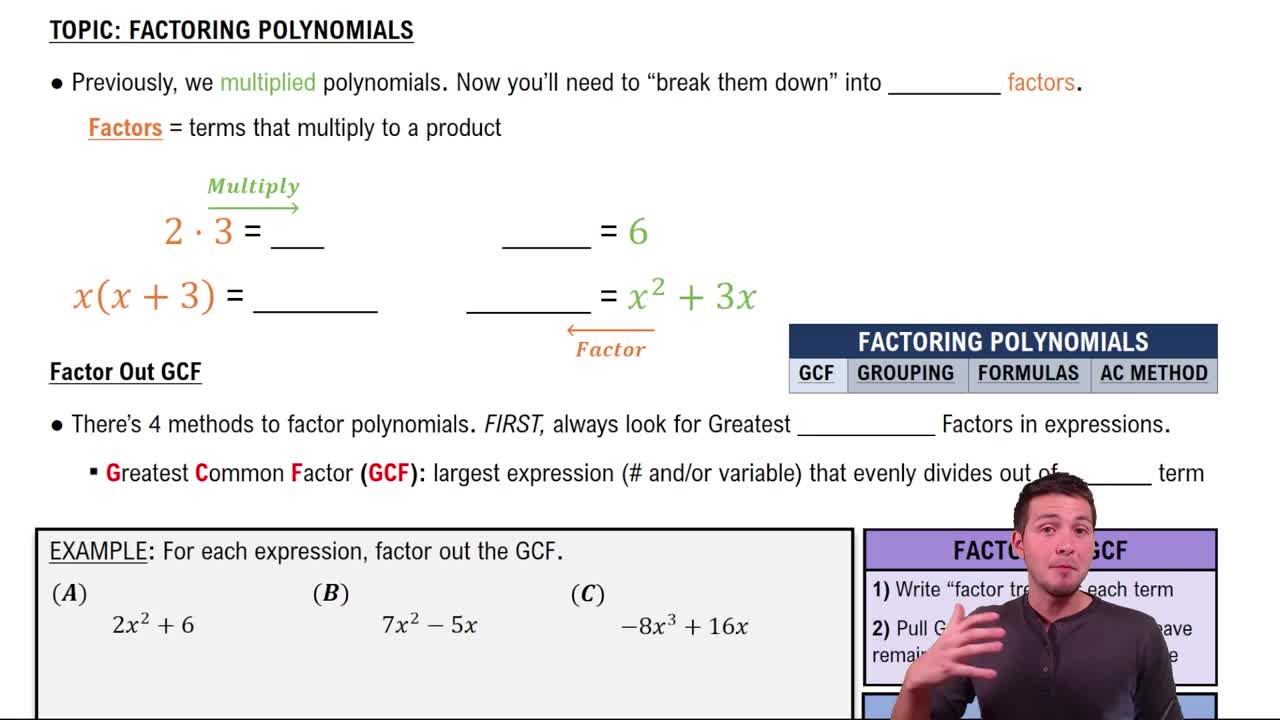
Factoring polynomials involves rewriting a polynomial as a product of simpler polynomials. This process helps simplify expressions and solve equations. Common methods include factoring out the greatest common factor, grouping, and recognizing special patterns like difference of squares or trinomials.
Some polynomials, like m^4 - 3m^2 - 10, can be treated as quadratic in form by substituting a variable (e.g., let x = m^2). This reduces the problem to factoring a quadratic expression, which can then be factored using methods like finding two numbers that multiply to the constant term and add to the middle coefficient.
The substitution method simplifies complex polynomials by temporarily replacing a variable expression with a single variable. For example, setting x = m^2 transforms a quartic polynomial into a quadratic one, making it easier to factor. After factoring, substitute back to express the factors in terms of the original variable.