Solve each logarithmic equation in Exercises 49–92. Be sure to reject any value of x that is not in the domain of the original logarithmic expressions. Give the exact answer. Then, where necessary, use a calculator to obtain a decimal approximation, correct to two decimal places, for the solution. 2 log x=log 25
Ch. 4 - Exponential and Logarithmic Functions

Chapter 5, Problem 81
Evaluate or simplify each expression without using a calculator. log 100
Verified step by step guidance1
Recall the definition of the logarithm: \(\log_b a = c\) means that \(b^c = a\). Here, the base is 10 since it is a common logarithm (log without a base is base 10).
Rewrite the expression \(\log 100\) as \(\log_{10} 100\) to emphasize the base 10.
Express 100 as a power of 10: \$100 = 10^2$.
Use the logarithm power rule: \(\log_b (a^c) = c \log_b a\). Applying this, \(\log_{10} (10^2) = 2 \log_{10} 10\).
Since \(\log_{10} 10 = 1\), simplify the expression to \(2 \times 1 = 2\).

Verified video answer for a similar problem:
This video solution was recommended by our tutors as helpful for the problem above.
Video duration:
49sWas this helpful?
Key Concepts
Here are the essential concepts you must grasp in order to answer the question correctly.
Definition of Logarithms
A logarithm answers the question: to what exponent must the base be raised to produce a given number? For example, log base 10 of 100 asks, '10 raised to what power equals 100?' Understanding this definition is fundamental to evaluating logarithmic expressions.
Recommended video:
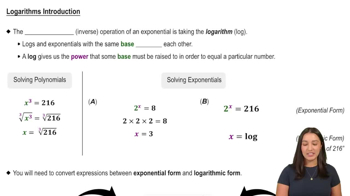
Logarithms Introduction
Common Logarithms (Base 10)
Common logarithms use base 10 and are often written simply as log without a base. Since 100 = 10^2, log 100 means log base 10 of 100, which equals 2. Recognizing powers of 10 helps simplify these expressions quickly.
Recommended video:
Graphs of Common Functions
Properties of Logarithms
Logarithms have properties like log(a^b) = b * log(a), which allow simplification of expressions. Applying these properties helps evaluate or simplify logarithmic expressions without a calculator by rewriting numbers as powers of the base.
Recommended video:
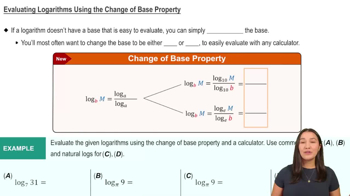
Change of Base Property
Related Practice
Textbook Question
1005
views
Textbook Question
In Exercises 83–88, let logb 2 = A and logb 3 = C and Write each expression in terms of A and C.
logb (3/2)
819
views
Textbook Question
Use a graphing utility and the change-of-base property to graph each function. y = log2 (x + 2)
680
views
Textbook Question
In Exercises 74–79, solve each logarithmic equation. log4 (2x+1) = log4 (x-3) + log4 (x+5)
959
views
Textbook Question
Expand:
797
views
Textbook Question
Solve each logarithmic equation in Exercises 49–92. Be sure to reject any value of x that is not in the domain of the original logarithmic expressions. Give the exact answer. Then, where necessary, use a calculator to obtain a decimal approximation, correct to two decimal places, for the solution. log(3x−3)=log(x+1)+log 4
719
views
