In Exercises 35–46, determine the constant that should be added to the binomial so that it becomes a perfect square trinomial. Then write and factor the trinomial.
Ch. 1 - Equations and Inequalities

Chapter 2, Problem 44
Exercises 41–60 contain rational equations with variables in denominators. For each equation, a. write the value or values of the variable that make a denominator zero. These are the restrictions on the variable. b. Keeping the restrictions in mind, solve the equation. 7/2x - 5/3x = 22/3
Verified step by step guidance1
Identify the denominators in the equation \(\frac{7}{2x} - \frac{5}{3x} = \frac{22}{3}\). The denominators are \$2x\( and \)3x$.
Find the values of \(x\) that make any denominator zero. Set each denominator equal to zero: \$2x = 0\( and \)3x = 0\(. Solve these to find the restrictions on \)x$.
Rewrite the equation to have a common denominator on the left side. The common denominator for \$2x\( and \)3x\( is \)6x\(. Express each fraction with denominator \)6x$:
\(\frac{7}{2x} = \frac{7 \times 3}{6x} = \frac{21}{6x}\) and \(\frac{5}{3x} = \frac{5 \times 2}{6x} = \frac{10}{6x}\).
Combine the fractions on the left side: \(\frac{21}{6x} - \frac{10}{6x} = \frac{21 - 10}{6x} = \frac{11}{6x}\). So the equation becomes \(\frac{11}{6x} = \frac{22}{3}\).
Solve for \(x\) by cross-multiplying: \(11 \times 3 = 22 \times 6x\). Simplify and solve the resulting equation for \(x\), keeping in mind the restrictions found earlier.

Verified video answer for a similar problem:
This video solution was recommended by our tutors as helpful for the problem above.
Video duration:
3mWas this helpful?
Key Concepts
Here are the essential concepts you must grasp in order to answer the question correctly.
Rational Expressions and Denominators
Rational expressions are fractions that contain variables in the denominator. Understanding how to identify values that make denominators zero is crucial because these values are undefined and must be excluded from the solution set to avoid division by zero.
Recommended video:
Guided course
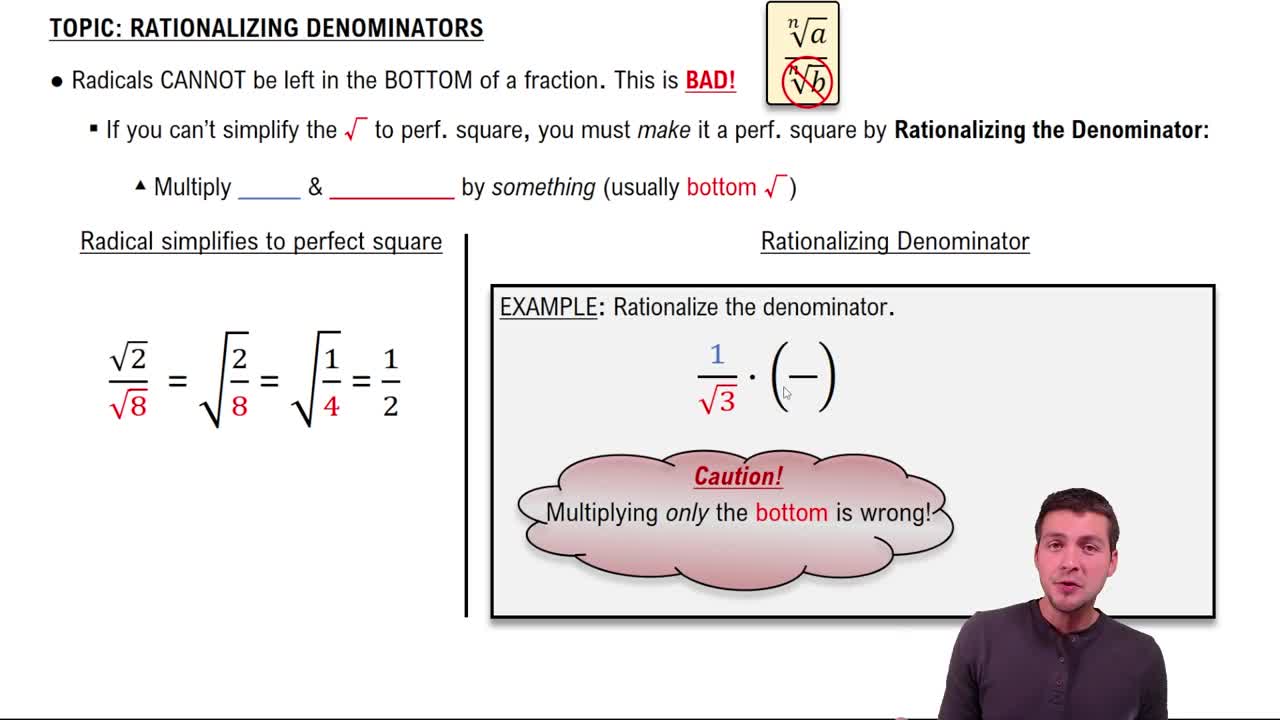
Rationalizing Denominators
Finding Restrictions on the Variable
Restrictions are values of the variable that cause any denominator in the equation to be zero. Before solving, determine these values to ensure they are not included in the final solution, maintaining the equation's validity.
Recommended video:
Guided course
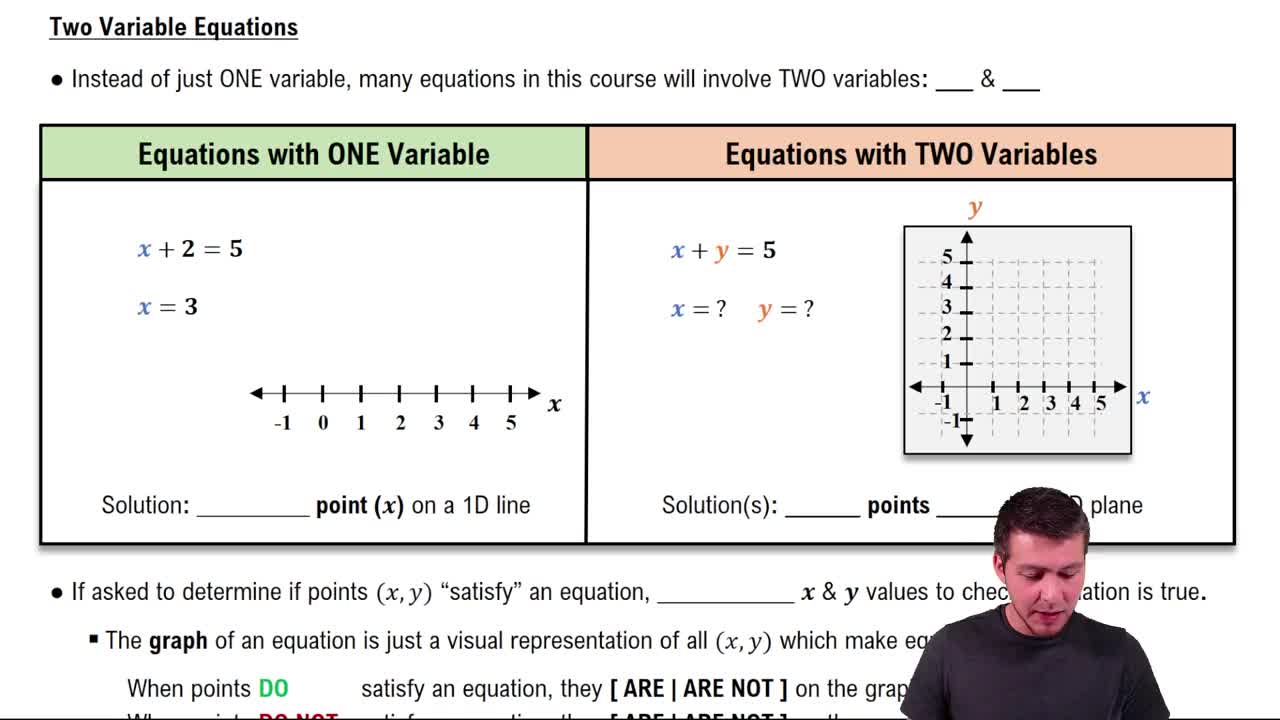
Equations with Two Variables
Solving Rational Equations
To solve rational equations, first clear denominators by multiplying both sides by the least common denominator (LCD). Then solve the resulting equation, and finally check solutions against restrictions to exclude any invalid answers.
Recommended video:
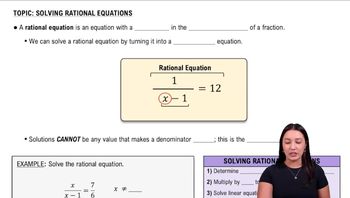
Introduction to Rational Equations
Related Practice
Textbook Question
956
views
Textbook Question
Use the graph to a. determine the x-intercepts, if any; b. determine the y-intercepts, if any. For each graph, tick marks along the axes represent one unit each.
1371
views
Textbook Question
Solve and check: 24 + 3 (x + 2) = 5(x − 12).
873
views
Textbook Question
Use the graph to a. determine the x-intercepts, if any; b. determine the y-intercepts, if any. For each graph, tick marks along the axes represent one unit each.
112
views
Textbook Question
In Exercises 36–43, use the five-step strategy for solving word problems. The length of a rectangular field is 6 yards less than triple the width. If the perimeter of the field is 340 yards, what are its dimensions?
744
views
Textbook Question
In Exercises 35–46, determine the constant that should be added to the binomial so that it becomes a perfect square trinomial. Then write and factor the trinomial.
840
views