Solve each logarithmic equation in Exercises 49–92. Be sure to reject any value of x that is not in the domain of the original logarithmic expressions. Give the exact answer. Then, where necessary, use a calculator to obtain a decimal approximation, correct to two decimal places, for the solution. log(x+4)−log 2=log(5x+1)
Ch. 4 - Exponential and Logarithmic Functions

Chapter 5, Problem 84
Use the formula for continuous compounding to solve Exercises 84–85. How long, to the nearest tenth of a year, will it take \$50,000 to triple in value at an annual rate of 7.5% compounded continuously?
Verified step by step guidance1
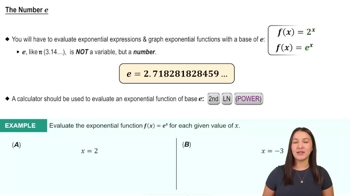
Identify the formula for continuous compounding: \( A = P e^{rt} \), where \( A \) is the future value, \( P \) is the principal, \( r \) is the annual interest rate (in decimal form), \( t \) is the time in years, and \( e \) is the base of the natural logarithm.
Substitute the known values into the formula: \( A = 3P \) (since the value triples), \( P = 50000 \), and \( r = 0.075 \). The equation becomes \( 3(50000) = 50000 e^{0.075t} \).
Simplify the equation by dividing both sides by \( 50000 \): \( 3 = e^{0.075t} \).
Take the natural logarithm (\( \ln \)) of both sides to isolate \( t \): \( \ln(3) = 0.075t \).
Solve for \( t \) by dividing both sides by \( 0.075 \): \( t = \frac{\ln(3)}{0.075} \). This will give the time in years to the nearest tenth.

Verified video answer for a similar problem:
This video solution was recommended by our tutors as helpful for the problem above.
Video duration:
4mWas this helpful?
Key Concepts
Here are the essential concepts you must grasp in order to answer the question correctly.
Continuous Compounding
Continuous compounding refers to the process of earning interest on an investment at every possible moment, rather than at discrete intervals. The formula used for continuous compounding is A = Pe^(rt), where A is the amount of money accumulated after time t, P is the principal amount, r is the annual interest rate, and e is the base of the natural logarithm. This method allows for the maximum growth of an investment over time.
Recommended video:
The Number e
Exponential Growth
Exponential growth occurs when the growth rate of a value is proportional to its current value, leading to rapid increases over time. In the context of finance, this is often modeled using the exponential function, which reflects how investments grow when interest is compounded continuously. Understanding this concept is crucial for predicting how long it will take for an investment to reach a certain value.
Recommended video:
Exponential Functions
Natural Logarithm
The natural logarithm, denoted as ln, is the logarithm to the base e (approximately 2.71828). It is particularly useful in solving equations involving exponential growth, such as those found in continuous compounding. When determining the time required for an investment to grow to a specific amount, the natural logarithm helps isolate the variable t in the continuous compounding formula.
Recommended video:
The Natural Log
Related Practice
Textbook Question
1283
views
Textbook Question
In Exercises 83–88, let logb 2 = A and logb 3 = C and Write each expression in terms of A and C.
logb (3/2)
819
views
Textbook Question
In Exercises 83–88, let logb 2 = A and logb 3 = C and Write each expression in terms of A and C.
logb 8
894
views
Textbook Question
Evaluate or simplify each expression without using a calculator. 10log 33
894
views
Textbook Question
Evaluate or simplify each expression without using a calculator. log 107
885
views
Textbook Question
Solve each logarithmic equation in Exercises 49–92. Be sure to reject any value of x that is not in the domain of the original logarithmic expressions. Give the exact answer. Then, where necessary, use a calculator to obtain a decimal approximation, correct to two decimal places, for the solution. 2 log x−log 7=log 112
814
views
