Start by identifying the rational function given: \(f(x) = \frac{3x}{x^2 - x - 2}\).
Factor the denominator to find its zeros and potential vertical asymptotes. Factor \(x^2 - x - 2\) as \( (x - 2)(x + 1)\).
Determine the vertical asymptotes by setting the denominator equal to zero: solve \(x - 2 = 0\) and \(x + 1 = 0\), which gives \(x = 2\) and \(x = -1\).
Find the horizontal asymptote by comparing the degrees of the numerator and denominator. Since the degree of the denominator (2) is greater than the numerator (1), the horizontal asymptote is \(y = 0\).
Find the x-intercepts by setting the numerator equal to zero: solve \$3x = 0\(, which gives \)x = 0\(. Also, find the y-intercept by evaluating \)f(0)$ if defined.
Verified video answer for a similar problem:
This video solution was recommended by our tutors as helpful for the problem above
Video duration:
13m
Play a video:
0 Comments
Key Concepts
Here are the essential concepts you must grasp in order to answer the question correctly.
Rational Functions
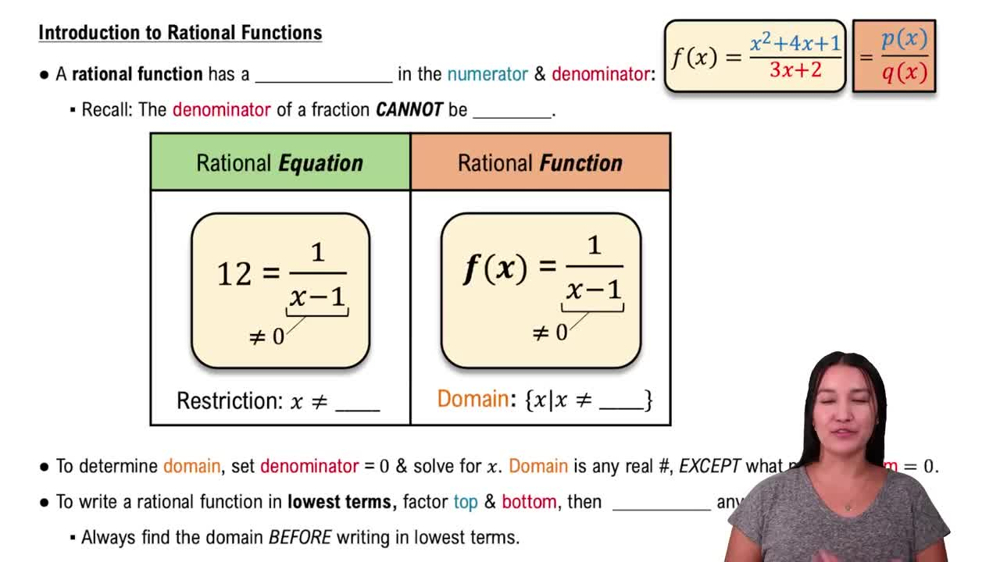
A rational function is a ratio of two polynomials, expressed as f(x) = P(x)/Q(x). Understanding its domain, where the denominator Q(x) ≠ 0, is essential to avoid undefined points. Graphing involves analyzing behavior such as intercepts, asymptotes, and discontinuities.
Factoring the denominator helps identify values that make the function undefined, which are excluded from the domain. For example, factoring x² - x - 2 into (x - 2)(x + 1) shows vertical asymptotes at x = 2 and x = -1, critical for graphing and understanding function behavior.
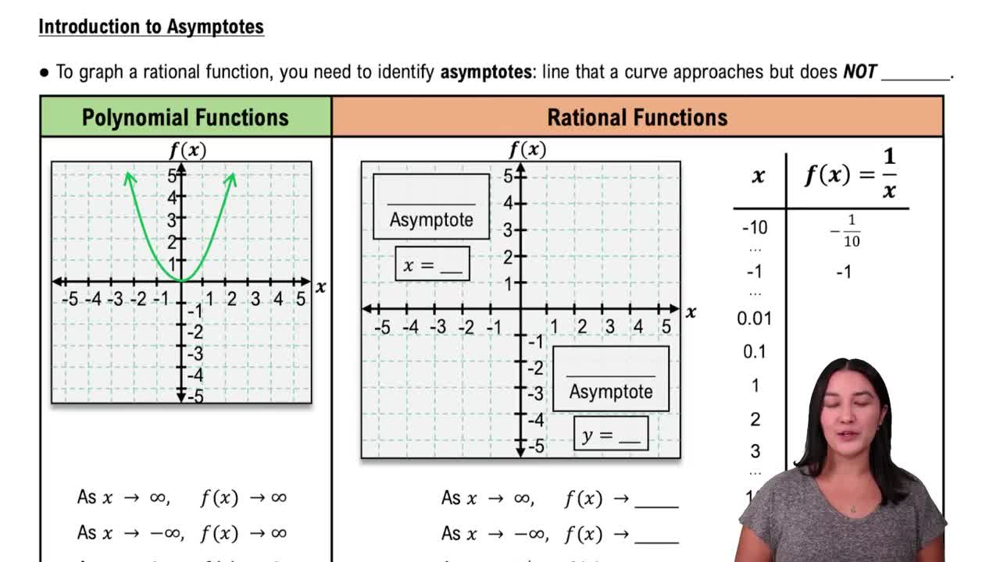
Vertical asymptotes occur where the denominator is zero, indicating values the function approaches but never reaches. Horizontal or oblique asymptotes describe end behavior as x approaches infinity or negative infinity. These asymptotes guide the shape and limits of the graph.