Ch. P - Fundamental Concepts of Algebra
Blitzer - College Algebra 8th Edition
Blitzer8th EditionCollege AlgebraISBN: 9780136970514Not the one you use?Change textbook
Chapter 1, Problem 60

Simplify each exponential expression in Exercises 23–64. (3x4y)3\(\left\)(\(\frac{3x^4}{y}\]\right\))^{-3}

Verified step by step guidance
1
Identify the given expression: \(\left(\frac{3x^{4}}{y}\right)^{-3}\).
Recall the rule for negative exponents: \(a^{-n} = \frac{1}{a^{n}}\). Apply this to rewrite the expression as \(\frac{1}{\left(\frac{3x^{4}}{y}\right)^{3}}\).
Apply the power of a quotient rule: \(\left(\frac{a}{b}\right)^{n} = \frac{a^{n}}{b^{n}}\). Rewrite the denominator as \(\frac{(3x^{4})^{3}}{y^{3}}\).
Rewrite the entire expression as \(\frac{1}{\frac{(3x^{4})^{3}}{y^{3}}}\), which is equivalent to multiplying by the reciprocal: \(\frac{y^{3}}{(3x^{4})^{3}}\).
Apply the power of a product rule: \((ab)^{n} = a^{n}b^{n}\). Expand the denominator to \(3^{3} \cdot (x^{4})^{3}\), and then use the power of a power rule: \((x^{m})^{n} = x^{mn}\) to simplify \(x^{4 \cdot 3}\).

Verified video answer for a similar problem:

This video solution was recommended by our tutors as helpful for the problem above.
Video duration:
3m
Was this helpful?

Key Concepts

Here are the essential concepts you must grasp in order to answer the question correctly.

Negative Exponents

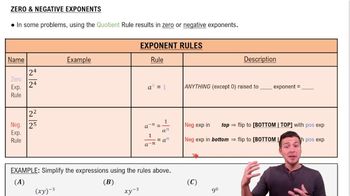
A negative exponent indicates the reciprocal of the base raised to the corresponding positive exponent. For example, x^(-n) equals 1 divided by x^n. This rule helps simplify expressions by rewriting negative powers as fractions.
Recommended video:
Guided course
6:37
Zero and Negative Rules

Power of a Quotient Rule

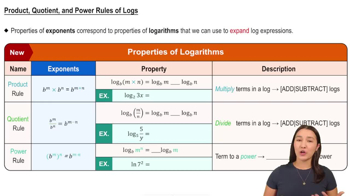
When an entire fraction is raised to an exponent, both the numerator and denominator are raised to that power separately. For instance, (a/b)^n equals a^n divided by b^n. This rule is essential for simplifying expressions like (3x^4/y)^-3.
Recommended video:
3:49
Product, Quotient, and Power Rules of Logs

Power of a Product Rule

When a product inside parentheses is raised to an exponent, each factor is raised to that exponent individually. For example, (ab)^n equals a^n times b^n. This helps in breaking down expressions like (3x^4)^-3 for simplification.
Recommended video:
3:49
Product, Quotient, and Power Rules of Logs