Ch. 4 - Exponential and Logarithmic Functions
Blitzer - College Algebra 8th Edition
Blitzer8th EditionCollege AlgebraISBN: 9780136970514Not the one you use?Change textbook
Chapter 5, Problem 63

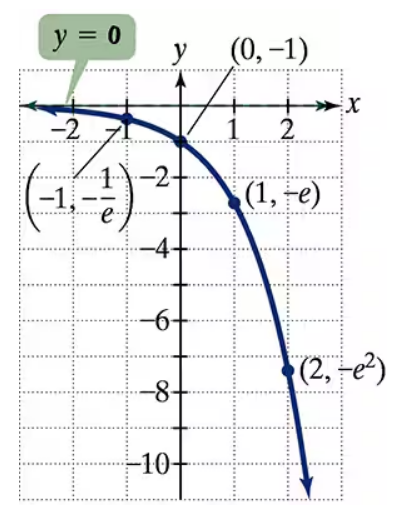
Give the equation of each exponential function whose graph is shown.
Graph of a decreasing exponential function passing through points (0, -1), (1, -e), and (2, -e squared).

Verified step by step guidance
1
Step 1: Identify the general form of the exponential function. Since the graph shows an exponential function with negative values, it likely has the form \(y = -a e^{bx}\), where \(a > 0\) and \(b\) is a constant to be determined.
Step 2: Use the point where the graph crosses the y-axis, which is \((0, -4)\). Substitute \(x=0\) and \(y=-4\) into the equation \(y = -a e^{bx}\) to find \(a\). Since \(e^{0} = 1\), this gives \(-4 = -a \cdot 1\), so \(a = 4\).
Step 3: Now the equation is \(y = -4 e^{bx}\). Use another point from the graph, for example \((-4, -\frac{4}{e})\), and substitute \(x = -4\) and \(y = -\frac{4}{e}\) into the equation to solve for \(b\).
Step 4: Substitute the values into the equation: \(-\frac{4}{e} = -4 e^{b(-4)}\). Simplify this to \(\frac{4}{e} = 4 e^{-4b}\), then divide both sides by 4 to get \(\frac{1}{e} = e^{-4b}\).
Step 5: Recognize that \(\frac{1}{e} = e^{-1}\), so set \(e^{-1} = e^{-4b}\). Since the bases are the same, equate the exponents: \(-1 = -4b\), and solve for \(b\).

Verified video answer for a similar problem:

This video solution was recommended by our tutors as helpful for the problem above.
Video duration:
4m
Was this helpful?

Key Concepts

Here are the essential concepts you must grasp in order to answer the question correctly.

Exponential Function Form

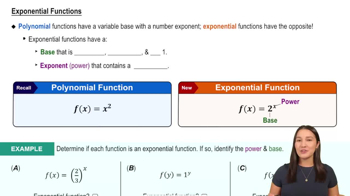
An exponential function is generally written as y = ab^x, where a is the initial value (y-intercept) and b is the base that determines the growth or decay rate. Understanding this form helps in identifying the function from given points on its graph.
Recommended video:
6:13
Exponential Functions

Using Points to Find Parameters

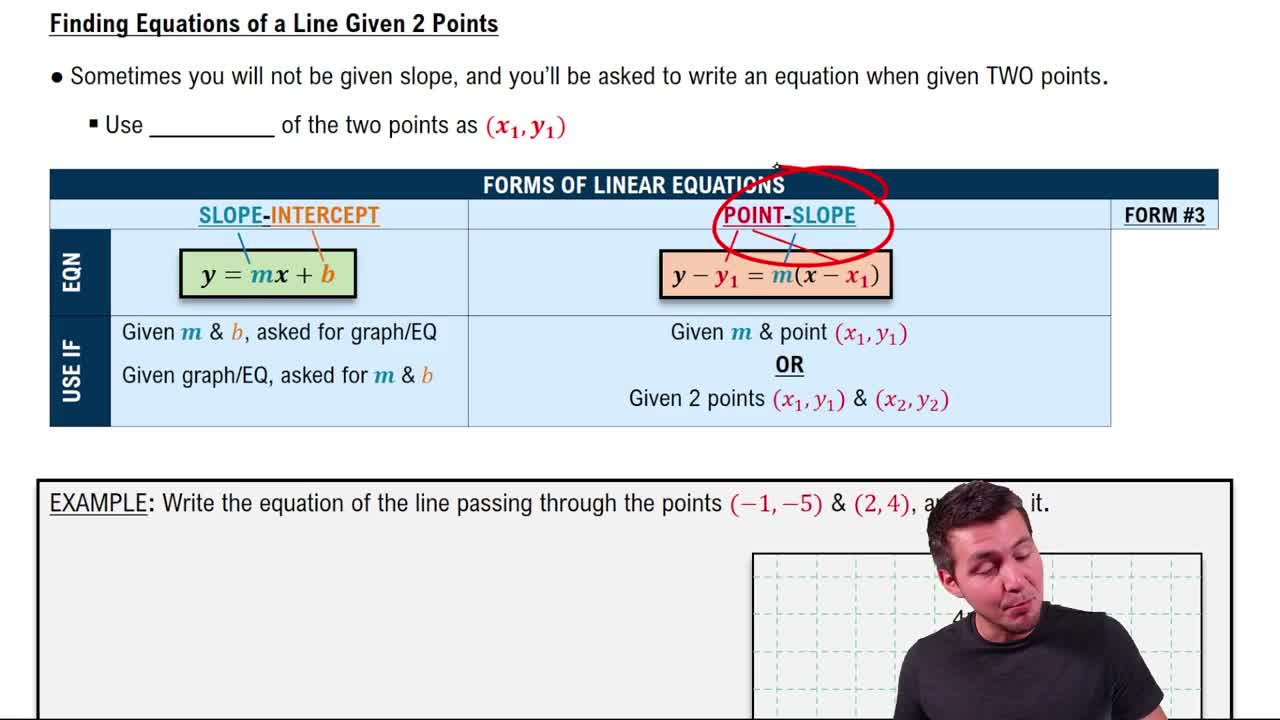
Given points on the graph, you can substitute their coordinates into the exponential function to create equations. Solving these equations allows you to find the values of a and b, which define the specific exponential function.
Recommended video:
Guided course
04:27
Finding Equations of Lines Given Two Points

Properties of the Number e

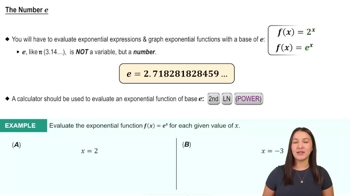
The number e (~2.718) is a special base for exponential functions, often used in continuous growth or decay models. Recognizing e in the points (like -4/e or -4e) helps in simplifying and understanding the function's behavior.
Recommended video:
4:47
The Number e
Related Practice
Textbook Question

In Exercises 60–63, determine whether each equation is true or false. Where possible, show work to support your conclusion. If the statement is false, make the necessary change(s) to produce a true statement. (log2 x)^4 = 4 log2 x

725
views
Textbook Question

In Exercises 64–73, solve each exponential equation. Where necessary, express the solution set in terms of natural or common logarithms and use a calculator to obtain a decimal approximation, correct to two decimal places, for the solution. 2^(4x-2) = 64

970
views
Textbook Question

Use properties of logarithms to condense each logarithmic expression. Write the expression as a single logarithm whose coefficient is 1. Where possible, evaluate logarithmic expressions without using a calculator. 12(log5x+log5y)2log5(x+1)\(\frac{1}{2}\) \(\left\)( \(\log\)_5 x + \(\log\)_5 y \(\right\)) - 2 \(\log\)_5 (x + 1)

970
views
Textbook Question

The figure shows the graph of f(x) = log x. In Exercises 59–64, use transformations of this graph to graph each function. Graph and give equations of the asymptotes. Use the graphs to determine each function's domain and range.

g(x) = 1-log x

1364
views
Textbook Question

Solve each logarithmic equation in Exercises 49–92. Be sure to reject any value of x that is not in the domain of the original logarithmic expressions. Give the exact answer. Then, where necessary, use a calculator to obtain a decimal approximation, correct to two decimal places, for the solution. 6+2 ln x=5

923
views
Textbook Question

Use properties of logarithms to condense each logarithmic expression. Write the expression as a single logarithm whose coefficient is 1. Where possible, evaluate logarithmic expressions without using a calculator. (1/2)(log x + log y)

794
views