Ch. 4 - Exponential and Logarithmic Functions
Blitzer - College Algebra 8th Edition
Blitzer8th EditionCollege AlgebraISBN: 9780136970514Not the one you use?Change textbook
Chapter 5, Problem 49

Graph functions f and g in the same rectangular coordinate system. Graph and give equations of all asymptotes. If applicable, use a graphing utility to confirm your hand-drawn graphs. f(x) = 3x and g(x) = (1/3). 3x

Verified step by step guidance
1
Identify the given functions: \(f(x) = 3^x\) and \(g(x) = \left(\frac{1}{3}\right) \cdot 3^x\).
Rewrite \(g(x)\) to understand its form better: since \(g(x) = \frac{1}{3} \times 3^x\), it can be expressed as \(g(x) = 3^{x-1}\) by using the property \(a^m \times a^n = a^{m+n}\).
Determine the domain and range of both functions: both \(f(x)\) and \(g(x)\) are exponential functions with base 3, so their domain is all real numbers \((-\infty, \infty)\) and their range is \((0, \infty)\).
Find the asymptotes: for both functions, the horizontal asymptote is the line \(y = 0\) because as \(x \to -\infty\), \(3^x \to 0\) and similarly for \(g(x)\).
Sketch the graphs on the same coordinate system: plot key points such as \(x=0\) where \(f(0) = 1\) and \(g(0) = \frac{1}{3}\), and note that \(g(x)\) is a shifted version of \(f(x)\), shifted one unit to the right. Confirm the shape and asymptotes using a graphing utility if available.

Verified video answer for a similar problem:

This video solution was recommended by our tutors as helpful for the problem above.
Video duration:
8m
Was this helpful?

Key Concepts

Here are the essential concepts you must grasp in order to answer the question correctly.

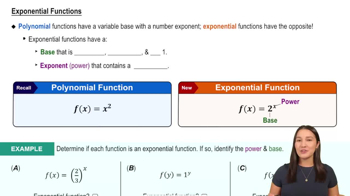
Exponential Functions

Exponential functions have the form f(x) = a^x, where the base a is a positive constant. They exhibit rapid growth or decay depending on whether a is greater than or less than 1. Understanding their shape and behavior is essential for graphing and comparing functions like f(x) = 3^x and g(x) = (1/3) * 3^x.
Recommended video:
6:13
Exponential Functions

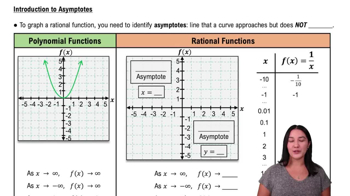
Asymptotes of Exponential Functions

An asymptote is a line that a graph approaches but never touches. For exponential functions like f(x) = 3^x, the horizontal asymptote is typically y = 0, since the function approaches zero as x approaches negative infinity. Identifying asymptotes helps in accurately sketching the graph.
Recommended video:
6:24
Introduction to Asymptotes

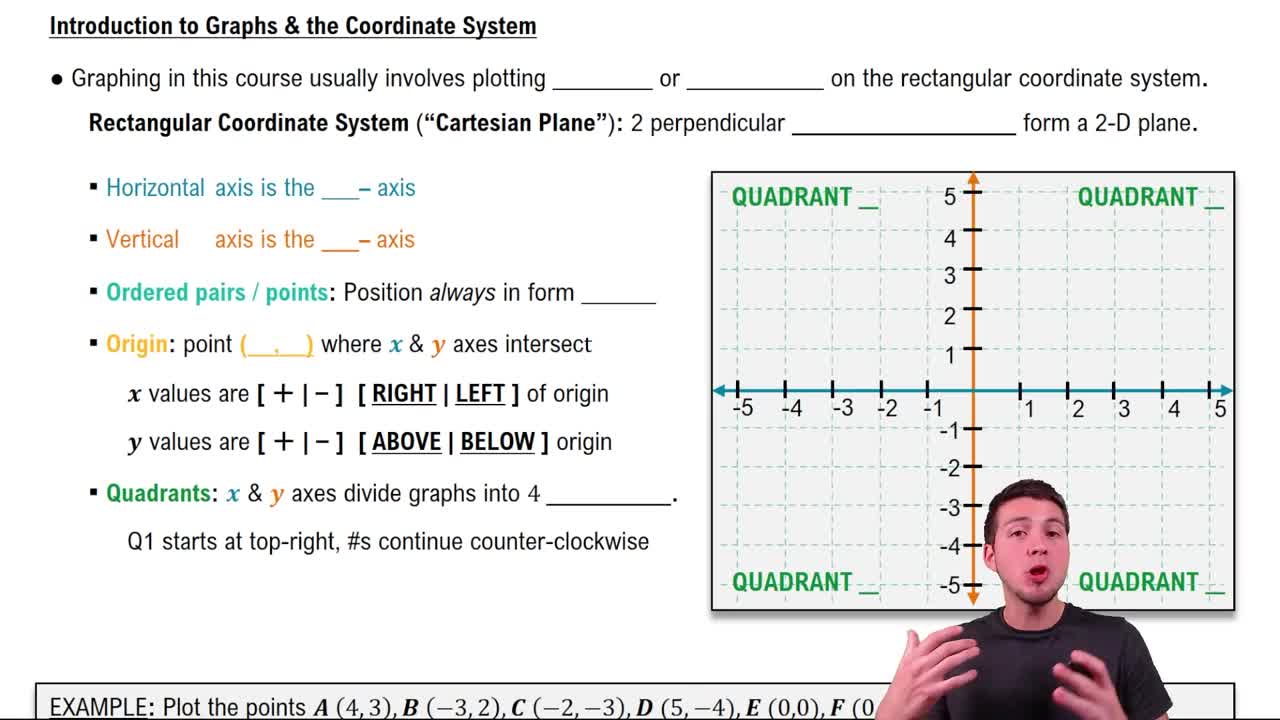
Graphing Multiple Functions on the Same Coordinate System

Plotting multiple functions together requires understanding their relative positions and transformations. For example, g(x) = (1/3) * 3^x is a vertical scaling of f(x) = 3^x by a factor of 1/3. Comparing their graphs helps visualize differences in growth rates and intercepts.
Recommended video:
Guided course
05:10
Graphs & the Rectangular Coordinate System
Related Practice
Textbook Question

Graph functions f and g in the same rectangular coordinate system. Graph and give equations of all asymptotes. If applicable, use a graphing utility to confirm your hand-drawn graphs. f(x) = 3x and g(x) = 3-x

882
views
Textbook Question

Solve each exponential equation in Exercises 23–48. Express the solution set in terms of natural logarithms or common logarithms. Then use a calculator to obtain a decimal approximation, correct to two decimal places, for the solution. 32x+3x−2=0

803
views
Textbook Question

Use properties of logarithms to condense each logarithmic expression. Write the expression as a single logarithm whose coefficient is 1. Where possible, evaluate logarithmic expressions without using a calculator. log x + 3 log y

998
views
Textbook Question

In Exercises 50–53, use properties of logarithms to expand each logarithmic expression as much as possible. Where possible, evaluate logarithmic expressions without using a calculator. log4(x64)\(\log\)_4\(\left\)(\(\frac{\sqrt{x}\)}{64}\(\right\))

1099
views
Textbook Question

Solve each logarithmic equation in Exercises 49–92. Be sure to reject any value of x that is not in the domain of the original logarithmic expressions. Give the exact answer. Then, where necessary, use a calculator to obtain a decimal approximation, correct to two decimal places, for the solution. log3x=4

771
views
Textbook Question

Use properties of logarithms to condense each logarithmic expression. Write the expression as a single logarithm whose coefficient is 1. Where possible, evaluate logarithmic expressions without using a calculator. (1/2)ln x + ln y

765
views