Use the formula for the sum of the first n terms of a geometric sequence to solve Exercises 25–30. Find the sum of the first 14 terms of the geometric sequence: - 3/2, 3, - 6, 12, ...
Ch. 8 - Sequences, Induction, and Probability

Chapter 9, Problem 28
In Exercises 23–28, evaluate each factorial expression. (2n+1)!/(2n)!
Verified step by step guidance1
Identify the factorial expressions in the problem: \((2n+1)!\) and \((2n)!\).
Recall the definition of a factorial: \(n! = n \times (n-1) \times (n-2) \times \ldots \times 1\).
Express \((2n+1)!\) in terms of \((2n)!\): \((2n+1)! = (2n+1) \times (2n)!\).
Substitute the expression for \((2n+1)!\) into the original problem: \(\frac{(2n+1) \times (2n)!}{(2n)!}\).
Simplify the expression by canceling out \((2n)!\) from the numerator and the denominator, leaving \(2n+1\).

Verified video answer for a similar problem:
This video solution was recommended by our tutors as helpful for the problem above.
Video duration:
3mWas this helpful?
Key Concepts
Here are the essential concepts you must grasp in order to answer the question correctly.
Factorial Definition
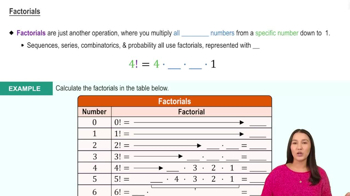
A factorial, denoted as n!, is the product of all positive integers from 1 to n. For example, 5! = 5 × 4 × 3 × 2 × 1 = 120. Factorials are used in permutations, combinations, and various mathematical calculations, making them fundamental in algebra and combinatorics.
Recommended video:
Factorials
Properties of Factorials
Factorials have specific properties that simplify calculations, such as n! = n × (n-1)! and 0! = 1. These properties allow for the reduction of factorial expressions, which is essential when evaluating complex factorial ratios like (2n+1)!/(2n)!. Understanding these properties helps in manipulating and simplifying expressions effectively.
Recommended video:
Factorials
Ratio of Factorials
The ratio of two factorials, such as (2n+1)!/(2n)!, can be simplified by canceling common terms. This involves recognizing that (2n+1)! = (2n+1) × (2n)!, allowing for the expression to reduce to (2n+1). This concept is crucial for evaluating factorial expressions efficiently and accurately.
Recommended video:
Factorials
Related Practice
Textbook Question
909
views
Textbook Question
Use mathematical induction to prove that each statement is true for every positive integer n. 6 is a factor of n(n + 1)(n + 2).
691
views
Textbook Question
Use mathematical induction to prove that each statement is true for every positive integer n.
736
views
Textbook Question
Use the Fundamental Counting Principle to solve Exercises 29–40. The model of the car you are thinking of buying is available in nine different colors and three different styles (hatchback, sedan, or sport). In how many ways can you order the car?
720
views
Textbook Question
Use the formula for the sum of the first n terms of a geometric sequence to solve Exercises 25–30. Find the sum of the first 11 terms of the geometric sequence: 3, - 6, 12, - 24, ...
945
views
Textbook Question
Evaluate each expression.
564
views