Ch. P - Fundamental Concepts of Algebra
Blitzer - College Algebra 8th Edition
Blitzer8th EditionCollege AlgebraISBN: 9780136970514Not the one you use?Change textbook
Chapter 1, Problem 123

In Exercises 121–128, write each English phrase as an algebraic expression. Then simplify the expression. Let x represent the number. Six times the product of negative five and a number

Verified step by step guidance
1
Step 1: Start by identifying the key components of the English phrase. The phrase mentions 'six times' and 'the product of negative five and a number'. Let the variable x represent the unknown number.
Step 2: Translate 'the product of negative five and a number' into an algebraic expression. The product of -5 and x is written as -5x.
Step 3: Now, incorporate the 'six times' part. To represent six times the product, multiply -5x by 6. This gives the expression 6(-5x).
Step 4: Simplify the expression by performing the multiplication. Multiply 6 by -5 to get -30, so the expression becomes -30x.
Step 5: The simplified algebraic expression for the given phrase is -30x.

Verified video answer for a similar problem:

This video solution was recommended by our tutors as helpful for the problem above.
Video duration:
1m
Was this helpful?

Key Concepts

Here are the essential concepts you must grasp in order to answer the question correctly.

Algebraic Expressions

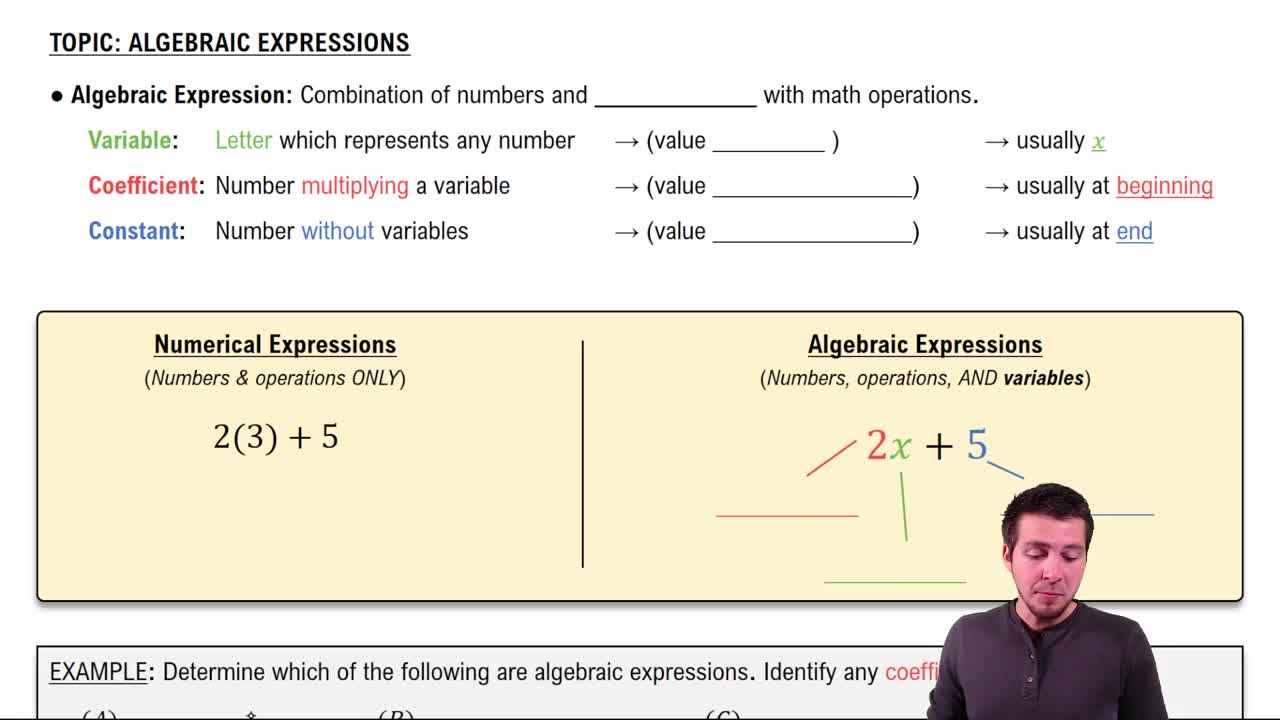
An algebraic expression is a mathematical phrase that can include numbers, variables, and operation symbols. It represents a value and can be simplified or manipulated according to algebraic rules. Understanding how to translate verbal phrases into algebraic expressions is crucial for solving problems in algebra.
Recommended video:
Guided course
05:09
Introduction to Algebraic Expressions

Variables and Constants

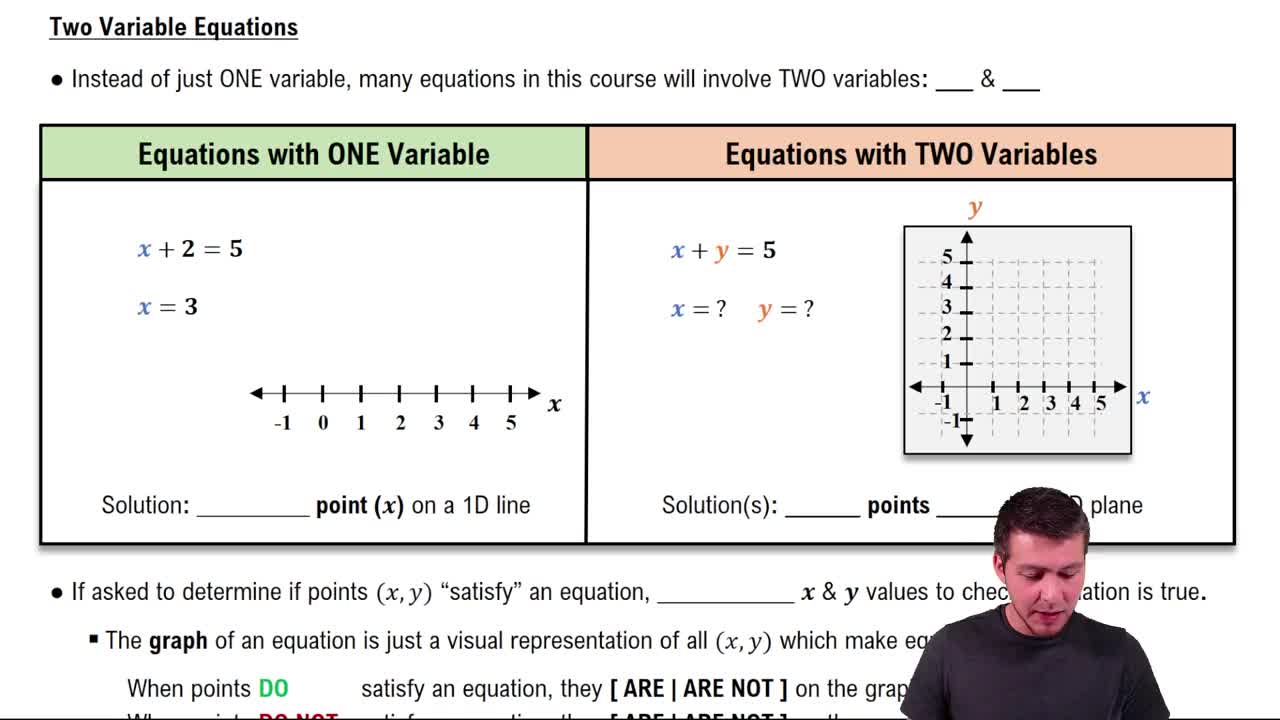
In algebra, a variable is a symbol, often represented by letters like x, that stands for an unknown value. Constants are fixed values that do not change. In the given question, 'x' represents the number, while '-5' is a constant. Recognizing the role of variables and constants is essential for forming and simplifying expressions.
Recommended video:
Guided course
05:28
Equations with Two Variables

Order of Operations

The order of operations is a set of rules that dictates the sequence in which mathematical operations should be performed to ensure consistent results. The common acronym PEMDAS (Parentheses, Exponents, Multiplication and Division, Addition and Subtraction) helps remember this order. Applying these rules correctly is vital when simplifying algebraic expressions.
Recommended video:
Guided course
8:38
Performing Row Operations on Matrices