Join thousands of students who trust us to help them ace their exams!
Multiple Choice
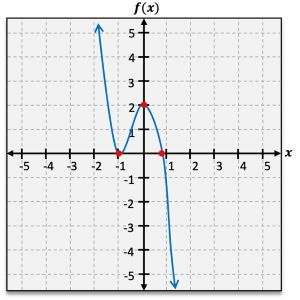
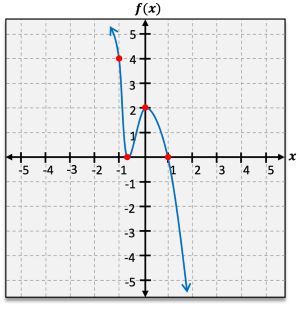
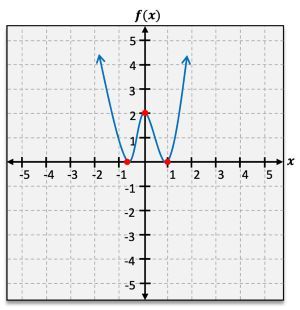
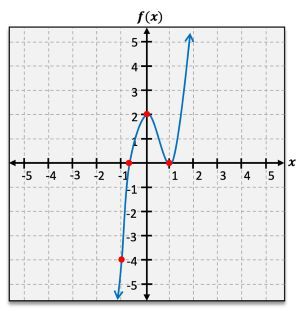
Graph the polynomial function. Determine the domain and range. f(x)=(3x+2)(x−1)2
A
B
C
D
2 Comments
Verified step by step guidance
1
Identify the polynomial function given: \( f(x) = (3x + 2)(x - 1)^2 \). This is a product of a linear term and a squared term.
Determine the x-intercepts by setting \( f(x) = 0 \). Solve \( (3x + 2) = 0 \) to find one intercept, and \( (x - 1)^2 = 0 \) to find the other intercept.
Analyze the behavior at each x-intercept. The intercept at \( x = -\frac{2}{3} \) is a simple root, so the graph will cross the x-axis. The intercept at \( x = 1 \) is a double root, so the graph will touch the x-axis and turn around.
Determine the end behavior of the polynomial. Since the leading term when expanded is \( 3x^3 \), as \( x \to \infty \), \( f(x) \to \infty \) and as \( x \to -\infty \), \( f(x) \to -\infty \).
Identify the domain and range. The domain of a polynomial is all real numbers, \( (-\infty, \infty) \). The range is also all real numbers, \( (-\infty, \infty) \), because the cubic polynomial can take any real value.




 Verified step by step guidance

