Ch. R - Review of Basic Concepts
Lial - College Algebra 13th Edition
Lial13th EditionCollege AlgebraISBN: 9780136881063Not the one you use?Change textbook
Chapter 1, Problem 43

Determine whether each statement is true or false. 9 ∉ {8, 5, 2, 1}

Verified step by step guidance
1
Understand the notation: The symbol \( \in \) means "is an element of," and \( \notin \) means "is not an element of."
Identify the set given: \( \{8, 5, 2, 1\} \) is a set containing the elements 8, 5, 2, and 1.
Check if the number 9 is in the set: Look through the elements of the set to see if 9 appears.
Since 9 does not appear in the set \( \{8, 5, 2, 1\} \), the statement \( 9 \notin \{8, 5, 2, 1\} \) is true.
Therefore, the statement correctly expresses that 9 is not an element of the set.

Verified video answer for a similar problem:

This video solution was recommended by our tutors as helpful for the problem above.
Video duration:
47s
Was this helpful?

Key Concepts

Here are the essential concepts you must grasp in order to answer the question correctly.

Set Membership

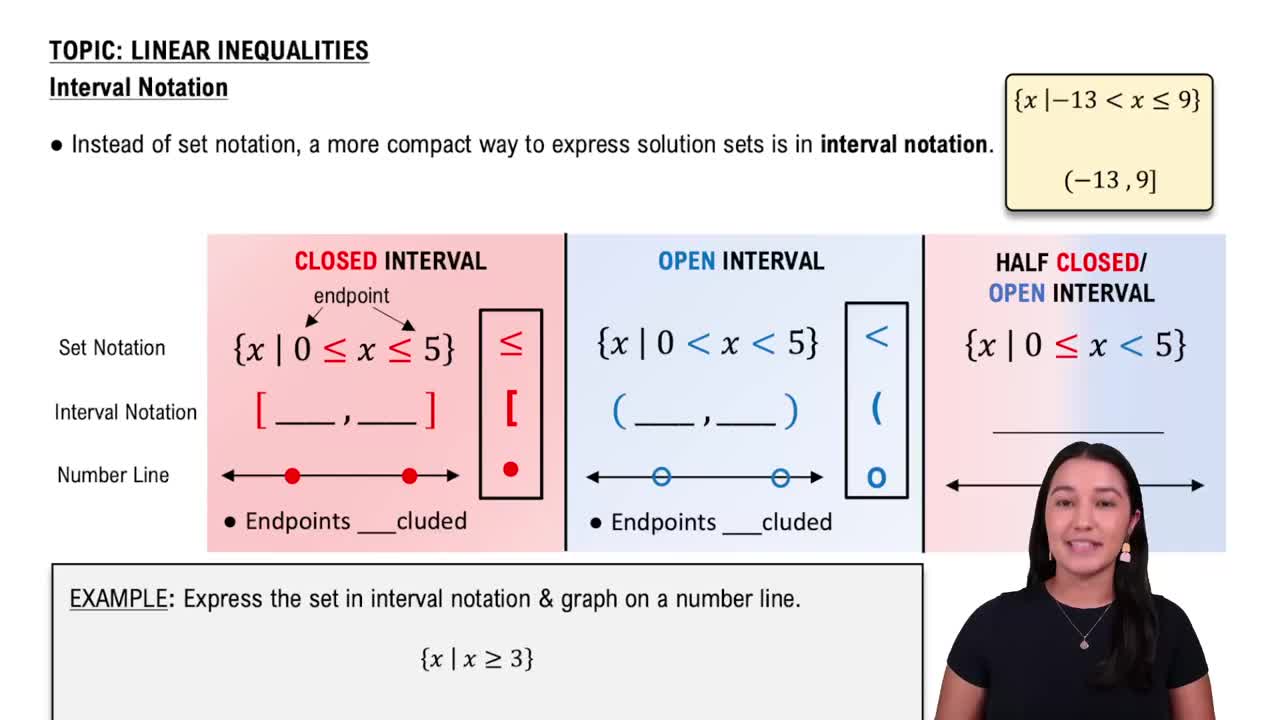
Set membership refers to whether an element belongs to a given set. The symbol ∈ denotes 'is an element of,' while ∉ means 'is not an element of.' Understanding this helps determine if a specific number is included in the set.
Recommended video:
05:18
Interval Notation

Set Notation

Set notation uses curly braces {} to list elements of a set. Each element inside the braces is a member of the set. Recognizing this notation is essential to identify which numbers are included in the set.
Recommended video:
05:18
Interval Notation

True or False Statements

Evaluating true or false statements involves verifying the accuracy of a claim based on given information. In this context, it means checking if the element 9 is or is not in the set {8, 5, 2, 1} to determine the statement's truth value.
Recommended video:
Guided course
6:57
Classifying Systems of Linear Equations