Ch. 4 - Exponential and Logarithmic Functions
Blitzer - College Algebra 8th Edition
Blitzer8th EditionCollege AlgebraISBN: 9780136970514Not the one you use?Change textbook
Chapter 5, Problem 39

In Exercises 39–40, graph f and g in the same rectangular coordinate system. Use transformations of the graph of f to obtain the graph of g. Graph and give equations of all asymptotes. Use the graphs to determine each function's domain and range. f(x) = log x and g(x) = - log (x+3)

Verified step by step guidance
1
Identify the base function f(x) = \(\log\) x, which is the logarithmic function with vertical asymptote at x = 0 and domain (0, \(\infty\)). Its range is all real numbers (-\(\infty\), \(\infty\)).
Analyze the function g(x) = -\(\log\)(x+3). Notice that the argument of the logarithm is (x + 3), which means the graph of f(x) is shifted horizontally to the left by 3 units. This changes the vertical asymptote from x = 0 to x = -3.
The negative sign in front of the logarithm reflects the graph of f(x) across the x-axis. So, after shifting the graph of f(x) left by 3 units, reflect it over the x-axis to get g(x).
Write the equation of the vertical asymptote for g(x) as x = -3, since the logarithm is undefined when its argument is zero, i.e., x + 3 = 0.
Determine the domain and range of g(x): the domain is all x such that x + 3 > 0, or x > -3, and the range remains all real numbers (-\(\infty\), \(\infty\)) because reflection and horizontal shifts do not restrict the range of the logarithmic function.

Verified video answer for a similar problem:

This video solution was recommended by our tutors as helpful for the problem above.
Video duration:
13m
Was this helpful?

Key Concepts

Here are the essential concepts you must grasp in order to answer the question correctly.

Logarithmic Functions and Their Graphs

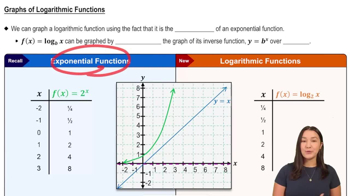
A logarithmic function, such as f(x) = log x, is the inverse of an exponential function. Its graph passes through (1,0) and has a vertical asymptote at x = 0. The function is defined only for positive x-values, and its range is all real numbers.
Recommended video:
5:26
Graphs of Logarithmic Functions

Transformations of Functions

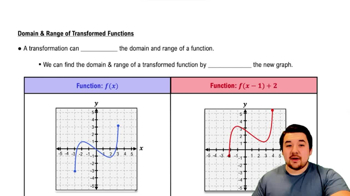
Transformations include shifts, reflections, and stretches/compressions of a graph. For g(x) = -log(x+3), the graph of f(x) = log x is shifted left by 3 units and reflected across the x-axis. Understanding these helps in sketching g(x) from f(x) and identifying changes in domain and range.
Recommended video:
4:22
Domain & Range of Transformed Functions

Asymptotes and Domain/Range of Logarithmic Functions

Logarithmic functions have vertical asymptotes where the argument equals zero. For f(x) = log x, the asymptote is x = 0; for g(x) = -log(x+3), it is x = -3. The domain excludes these values, while the range remains all real numbers. Recognizing asymptotes is key to understanding function behavior.
Recommended video:
5:26
Graphs of Logarithmic Functions