Ch. 1 - Equations and Inequalities
Blitzer - College Algebra 8th Edition
Blitzer8th EditionCollege AlgebraISBN: 9780136970514Not the one you use?Change textbook
Chapter 2, Problem 65

In Exercises 59–94, solve each absolute value inequality. |2(x - 1) + 4| ≤ 8

Verified step by step guidance
1
Start by rewriting the absolute value inequality \( |2(x - 1) + 4| \leq 8 \) as a compound inequality without the absolute value: \( -8 \leq 2(x - 1) + 4 \leq 8 \).
Next, simplify the expression inside the inequality by distributing and combining like terms: \( 2(x - 1) + 4 = 2x - 2 + 4 = 2x + 2 \). So the inequality becomes \( -8 \leq 2x + 2 \leq 8 \).
Now, isolate the term with \( x \) by subtracting 2 from all parts of the inequality: \( -8 - 2 \leq 2x + 2 - 2 \leq 8 - 2 \), which simplifies to \( -10 \leq 2x \leq 6 \).
Then, solve for \( x \) by dividing all parts of the inequality by 2 (remember to keep the inequality signs the same since 2 is positive): \( \frac{-10}{2} \leq \frac{2x}{2} \leq \frac{6}{2} \), resulting in \( -5 \leq x \leq 3 \).
Finally, write the solution set as all \( x \) values between \( -5 \) and \( 3 \), inclusive, which can be expressed in interval notation as \( [-5, 3] \).

Verified video answer for a similar problem:

This video solution was recommended by our tutors as helpful for the problem above.
Video duration:
6m
Was this helpful?

Key Concepts

Here are the essential concepts you must grasp in order to answer the question correctly.

Absolute Value Inequalities

An absolute value inequality involves expressions within absolute value bars and compares them to a number. To solve |A| ≤ B, where B ≥ 0, rewrite it as a compound inequality: -B ≤ A ≤ B. This approach helps find the range of values for the variable that satisfy the inequality.
Recommended video:
06:07
Linear Inequalities

Distributive Property

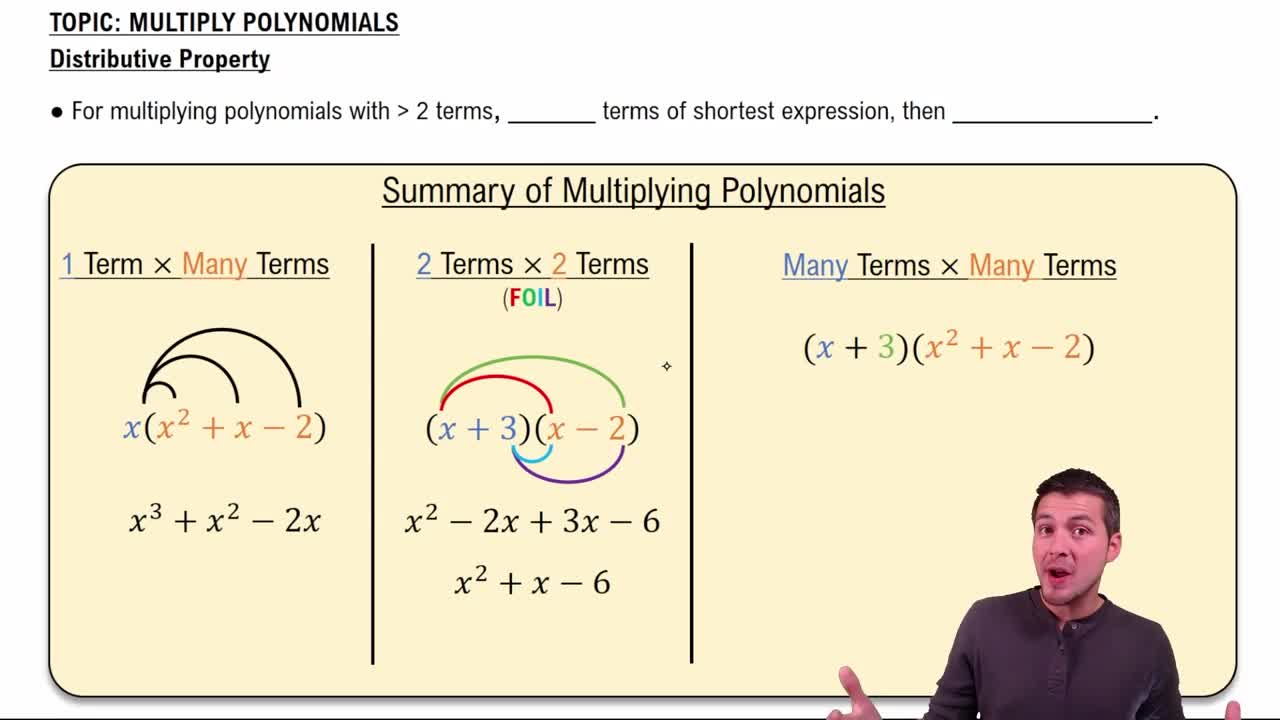
The distributive property allows you to multiply a single term across terms inside parentheses: a(b + c) = ab + ac. Applying this property simplifies expressions like 2(x - 1) into 2x - 2, making it easier to isolate variables and solve inequalities.
Recommended video:
Guided course
04:15
Multiply Polynomials Using the Distributive Property

Solving Linear Inequalities

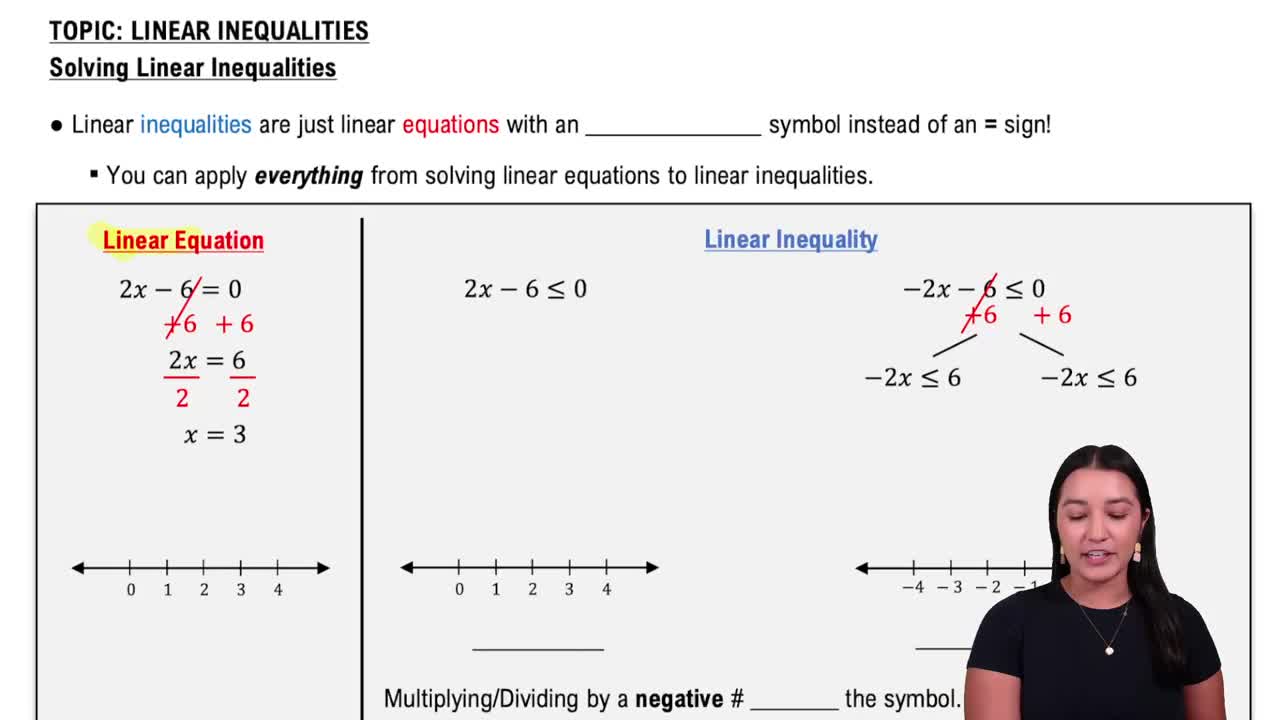
Solving linear inequalities involves isolating the variable on one side using inverse operations while maintaining inequality direction. When multiplying or dividing by a negative number, the inequality sign reverses. This process helps determine the solution set for the variable.
Recommended video:
06:07
Linear Inequalities