Solve each polynomial inequality in Exercises 1–42 and graph the solution set on a real number line. Express each solution set in interval notation. x2+5x+4>0
Ch. 3 - Polynomial and Rational Functions

Chapter 4, Problem 7
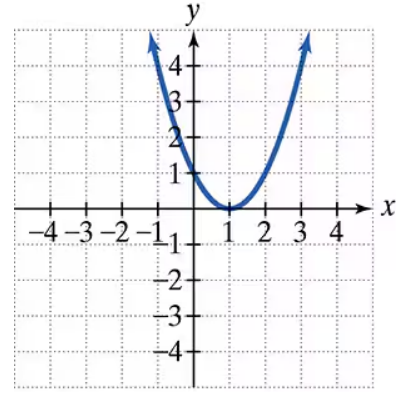
The graph of a quadratic function is given. Write the function's equation, selecting from the following options.

Verified step by step guidance1
Step 1: Identify the general form of the quadratic function, which is \(y = ax^2 + bx + c\).
Step 2: Use the point where the graph crosses the y-axis, which is the y-intercept. From the graph, this point is \((0, -20)\), so substitute \(x=0\) and \(y=-20\) into the equation to find \(c\). This gives \(-20 = a(0)^2 + b(0) + c\), so \(c = -20\).
Step 3: Use the other given point on the graph, \((3, -2)\), and substitute \(x=3\), \(y=-2\), and \(c=-20\) into the equation: \(-2 = a(3)^2 + b(3) - 20\).
Step 4: Simplify the equation from Step 3 to get \(-2 = 9a + 3b - 20\). Rearrange it to \$9a + 3b = 18$.
Step 5: To find \(a\) and \(b\), you need another equation. Use the vertex form or the fact that the vertex is at \(x=2\) (since the maximum point is between 2 and 3 on the graph). Use the vertex formula \(x = -\frac{b}{2a}\) to set up the second equation: \(2 = -\frac{b}{2a}\). Solve this system of two equations to find \(a\) and \(b\).

Verified video answer for a similar problem:
This video solution was recommended by our tutors as helpful for the problem above.
Video duration:
1mWas this helpful?
Key Concepts
Here are the essential concepts you must grasp in order to answer the question correctly.
Quadratic Function and Its Standard Form
A quadratic function is a polynomial of degree two, typically written as f(x) = ax^2 + bx + c. The graph of a quadratic function is a parabola that opens upward if a > 0 and downward if a < 0. Understanding the standard form helps in identifying the coefficients and how they affect the shape and position of the parabola.
Recommended video:
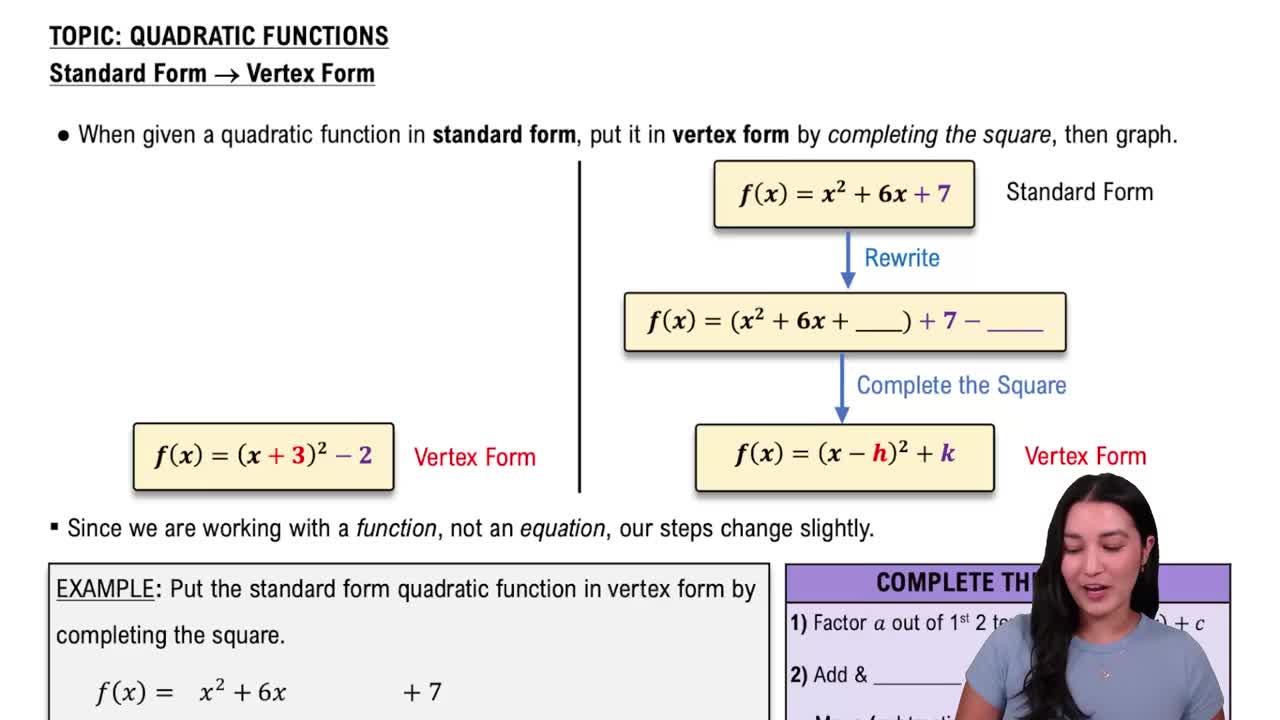
Converting Standard Form to Vertex Form
Using Points to Determine the Quadratic Equation
Given points on the graph, such as (0, -20) and (3, -2), you can substitute these coordinates into the quadratic equation to form a system of equations. This system can be solved to find the values of a, b, and c, which define the specific quadratic function that fits the graph.
Recommended video:
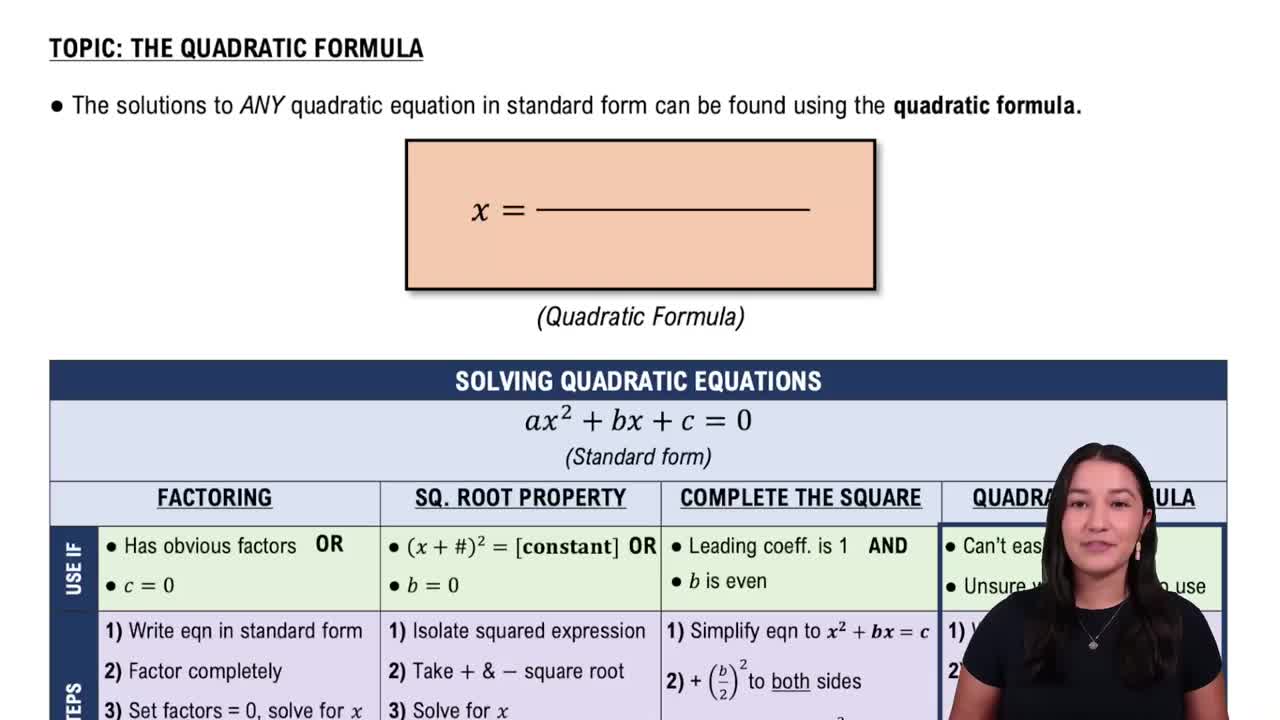
Solving Quadratic Equations Using The Quadratic Formula
Interpreting the Y-Intercept and Vertex
The y-intercept of a quadratic function is the point where the graph crosses the y-axis, given by (0, c). The vertex is the highest or lowest point on the parabola, indicating the maximum or minimum value of the function. Identifying these points from the graph helps in writing or verifying the quadratic equation.
Recommended video:
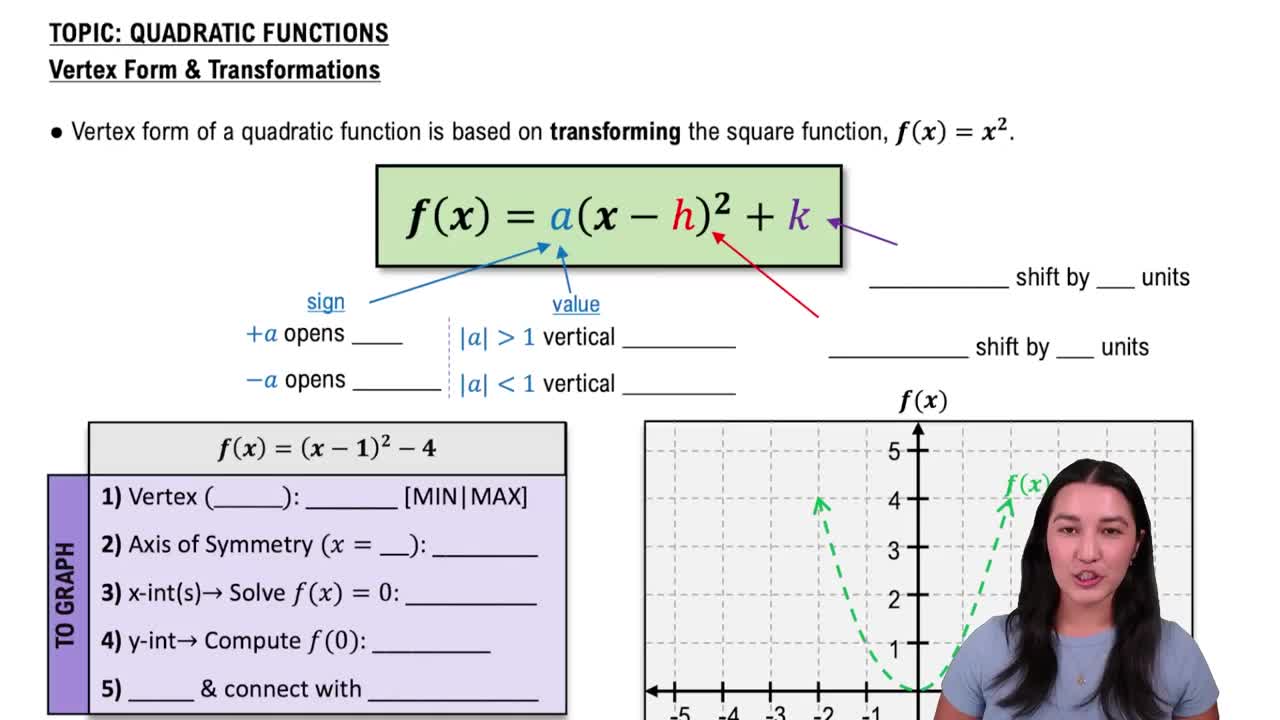
Vertex Form
Related Practice
Textbook Question
609
views
Textbook Question
Use the Rational Zero Theorem to list all possible rational zeros for each given function. f(x)=x5−x4−7x3+7x2−12x−12
701
views
Textbook Question
Divide using long division. State the quotient, and the remainder, .
934
views
Textbook Question
In Exercises 1–8, use the Rational Zero Theorem to list all possible rational zeros for each given function. f(x)=3x4−11x3−3x2−6x+8
482
views
Textbook Question
Use the four-step procedure for solving variation problems given on page 447 to solve Exercises 1–10. y varies jointly as x and z. y = 25 when x = 2 and z = 5. Find y when x = 8 and z = 12.
663
views
Textbook Question
Determine which functions are polynomial functions. For those that are, identify the degree.
1199
views