Isolate one of the square root expressions to one side of the equation. For example, subtract 2 from both sides to get: \(\sqrt{\!x+5} = \sqrt{\!x-1} - 2\).
Square both sides of the equation to eliminate the square root on the left. This means you will square \(\sqrt{\!x+5}\) and also square \(\sqrt{\!x-1} - 2\) on the right side.
After squaring, simplify both sides carefully. Remember that when you square a binomial like \((a - b)^2\), it expands to \(a^2 - 2ab + b^2\). Apply this to \(\left(\sqrt{\!x-1} - 2\right)^2\).
Once simplified, you will get an equation without square roots. If there is still a square root remaining, isolate it and square both sides again to fully eliminate radicals.
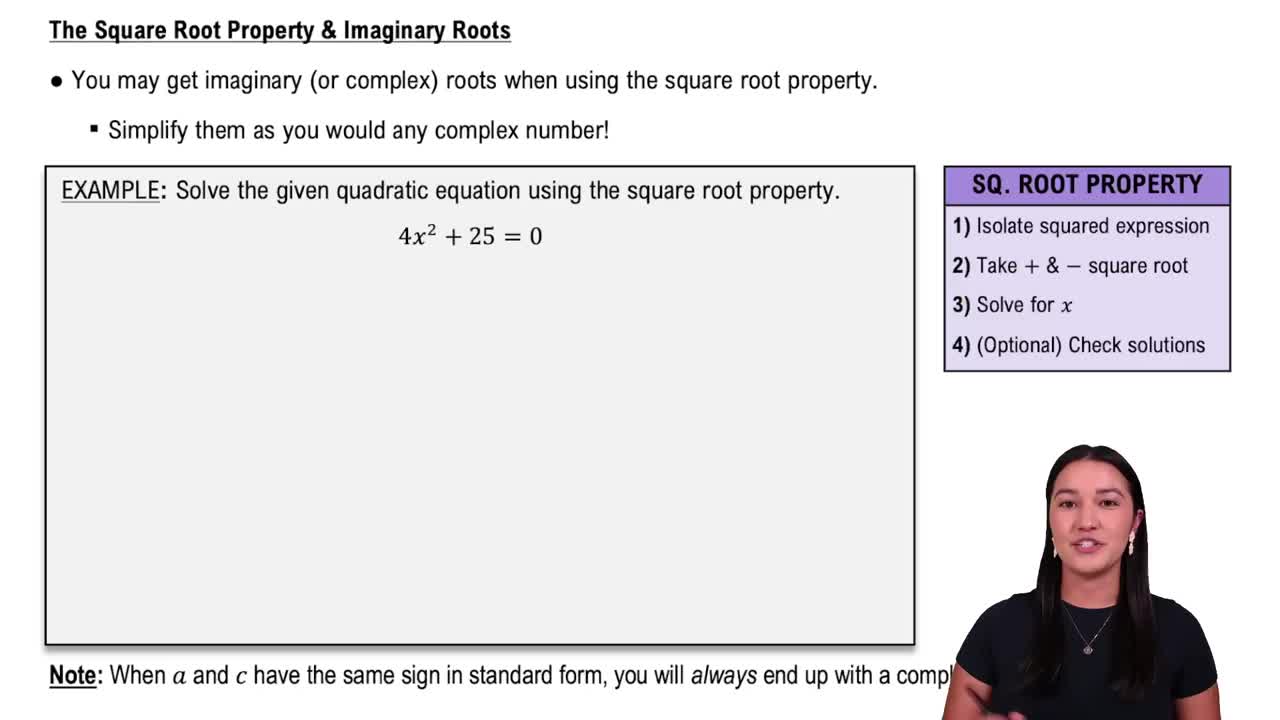
Solve the resulting polynomial equation for \(x\). After finding potential solutions, check each one by substituting back into the original equation to verify they do not produce extraneous solutions.
Verified video answer for a similar problem:
This video solution was recommended by our tutors as helpful for the problem above
Video duration:
9m
Play a video:
0 Comments
Key Concepts
Here are the essential concepts you must grasp in order to answer the question correctly.
Square Root Functions and Radicals
Square root functions involve expressions under a radical sign (√). Understanding how to manipulate and isolate these radicals is essential for solving equations that contain square roots, as it allows you to eliminate the radical by squaring both sides.
Before squaring both sides of an equation with radicals, it is important to isolate the radical on one side. This step helps prevent introducing extraneous solutions and simplifies the process of solving the equation.
Squaring both sides of an equation can introduce solutions that do not satisfy the original equation. After solving, substitute the solutions back into the original equation to verify which are valid and discard any extraneous ones.

 9:39 minutes
 Verified step by step guidance
 02:20
02:20